Voting Methods Finally Explained in Plain English
We keep arguing about opinions. The real problem is the counting system.


This Isn’t A Culture War. It’s A Cost of Living War.
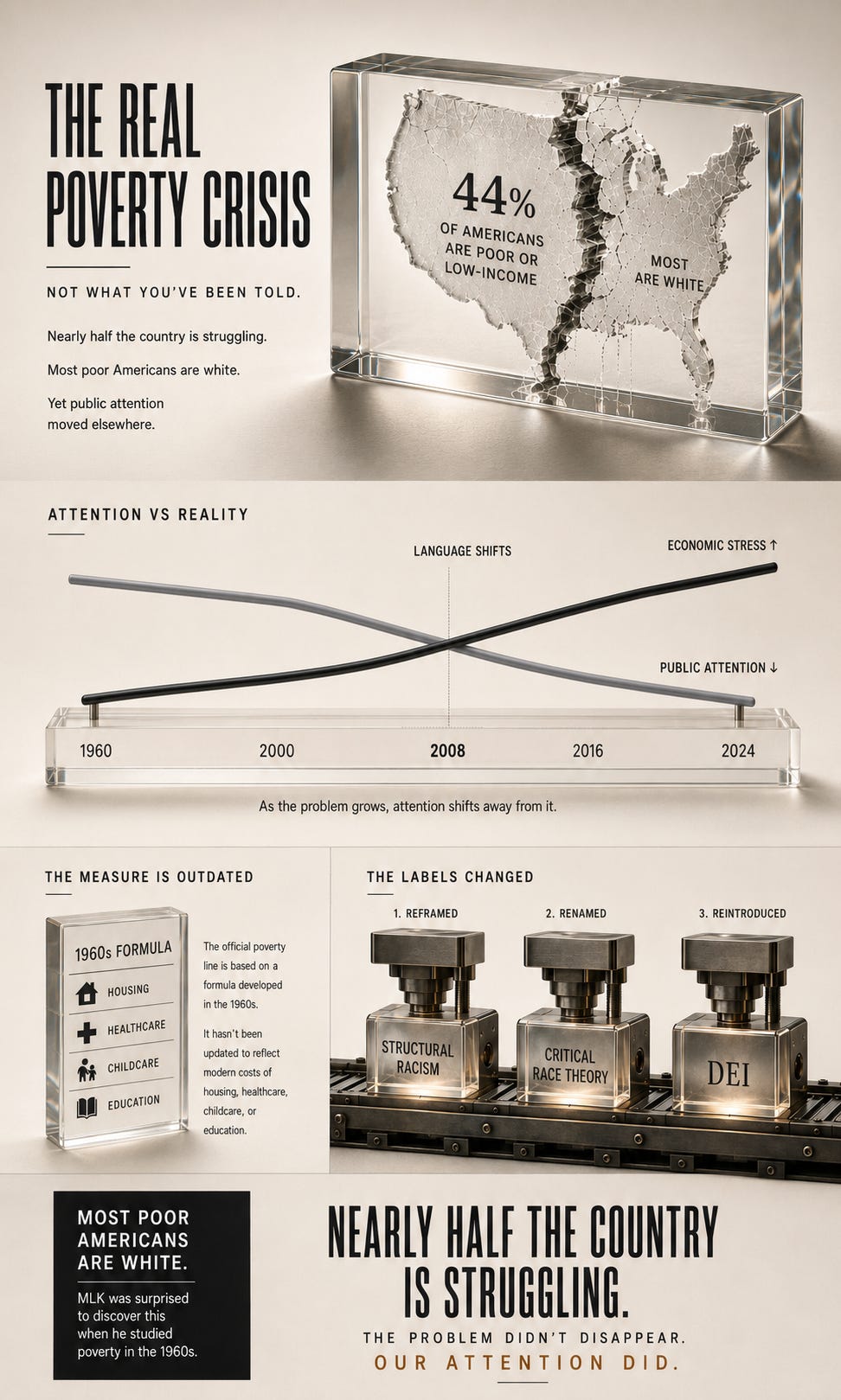
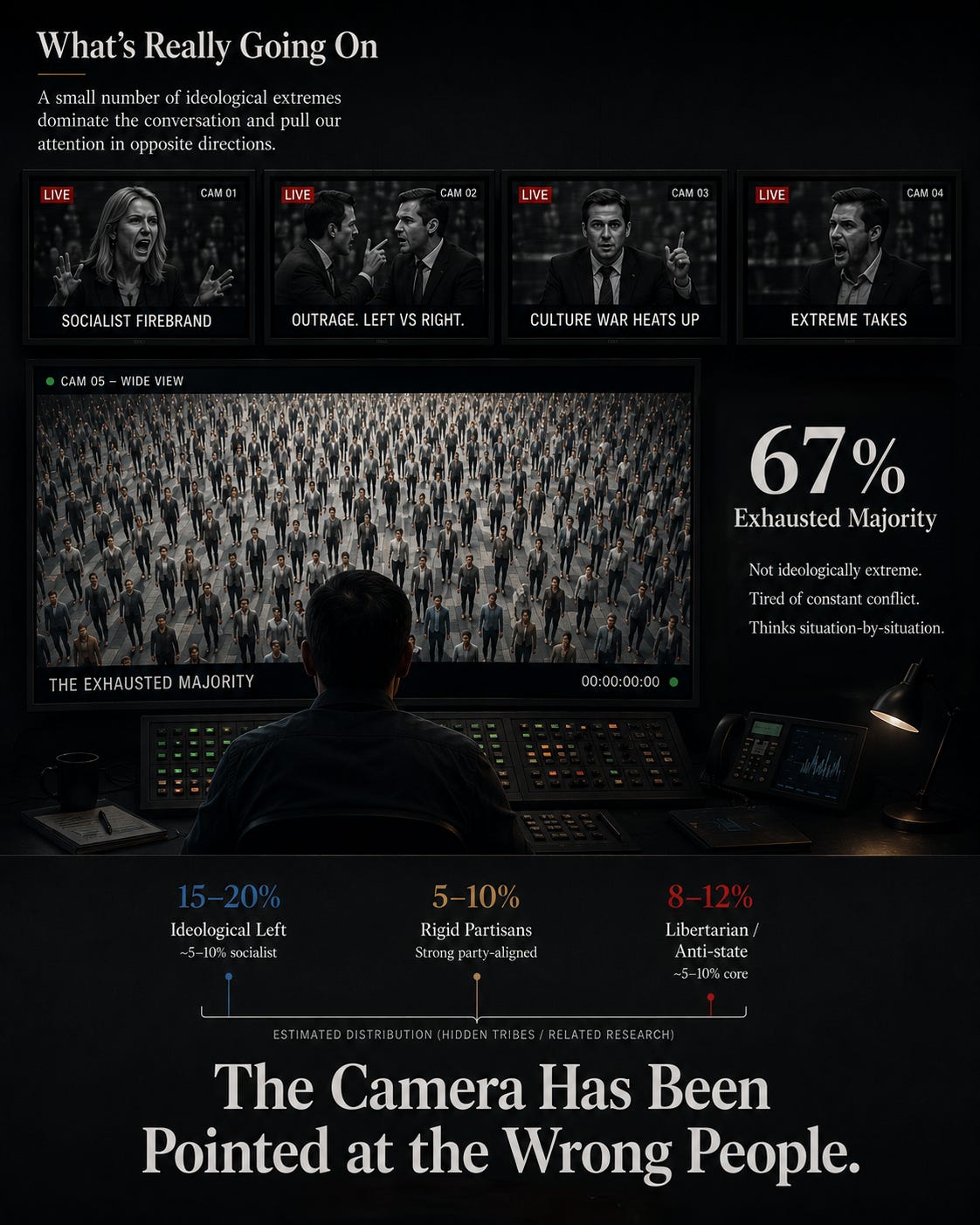
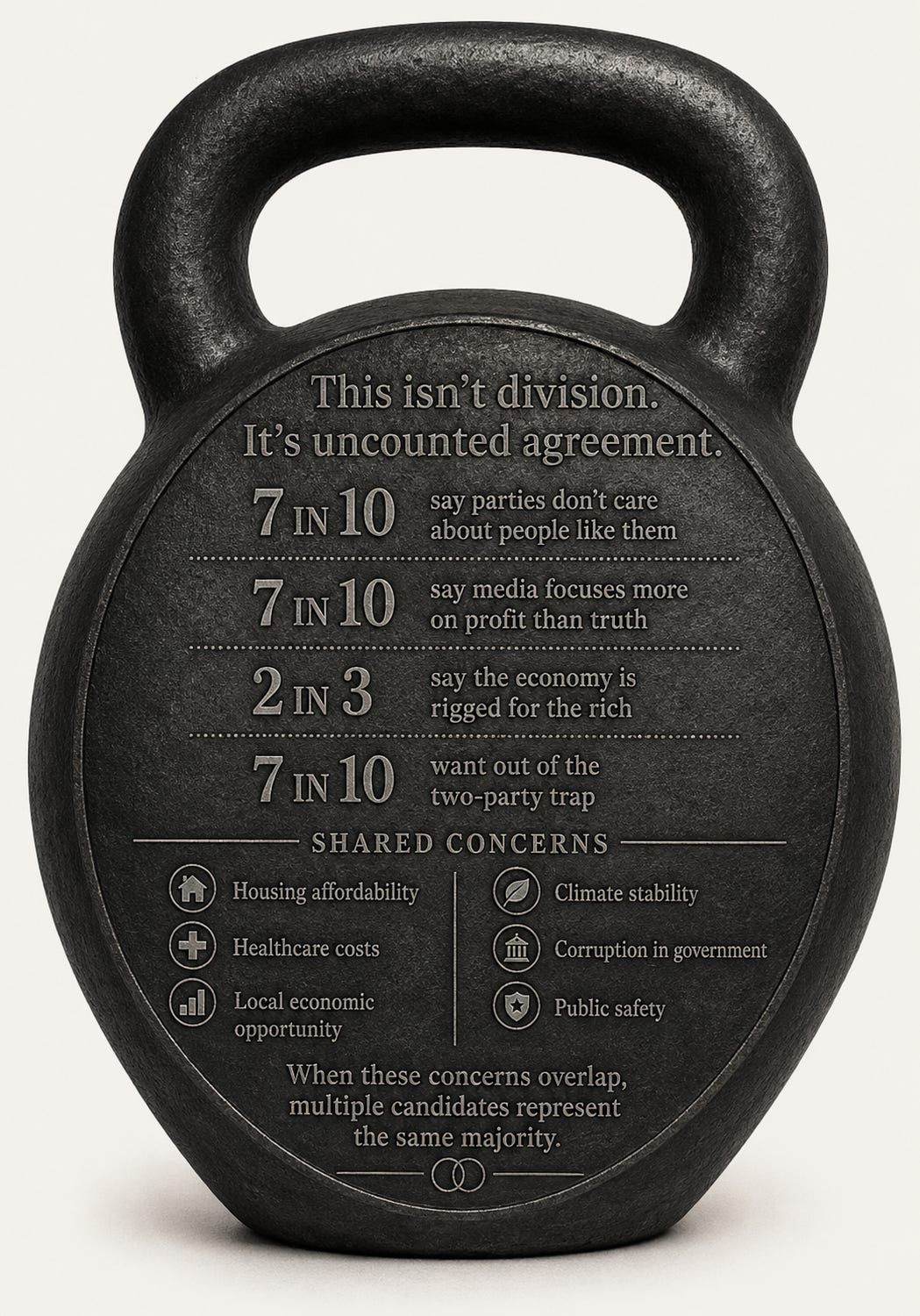
Two thirds of Americans say affordability is the biggest issue facing the country. Not a lane. Not a demographic. Not a partisan position. The dominant issue — strong across party lines, regions, and income levels, and even stronger among renters, young people, and anyone earning under $40,000 a year.
So why does everything still look so divided?
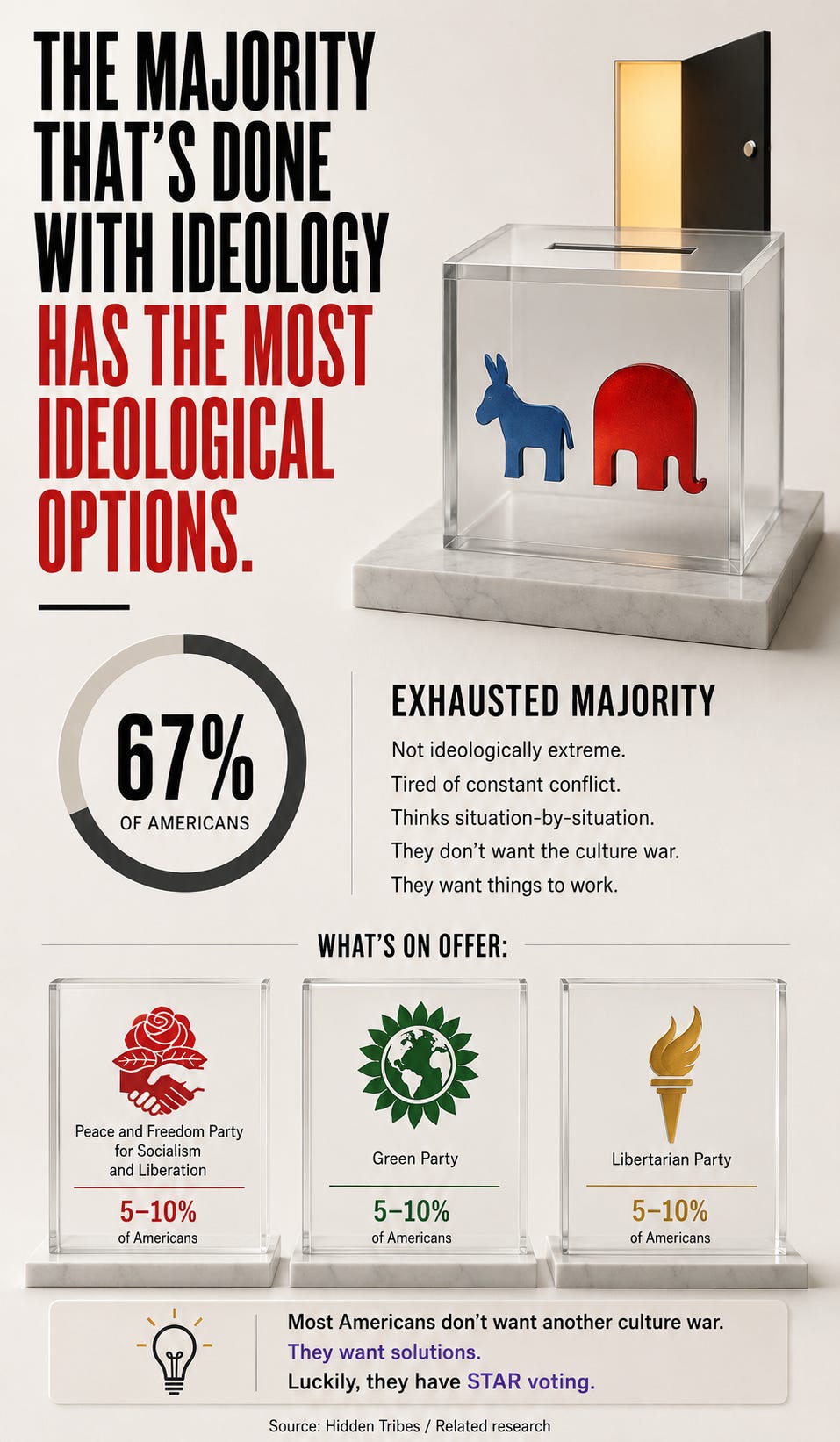
Nearly 70% of Americans want out of the two-party system. So why doesn’t anything change?
Because the count was never designed to find consensus. It was designed to manufacture a fight.



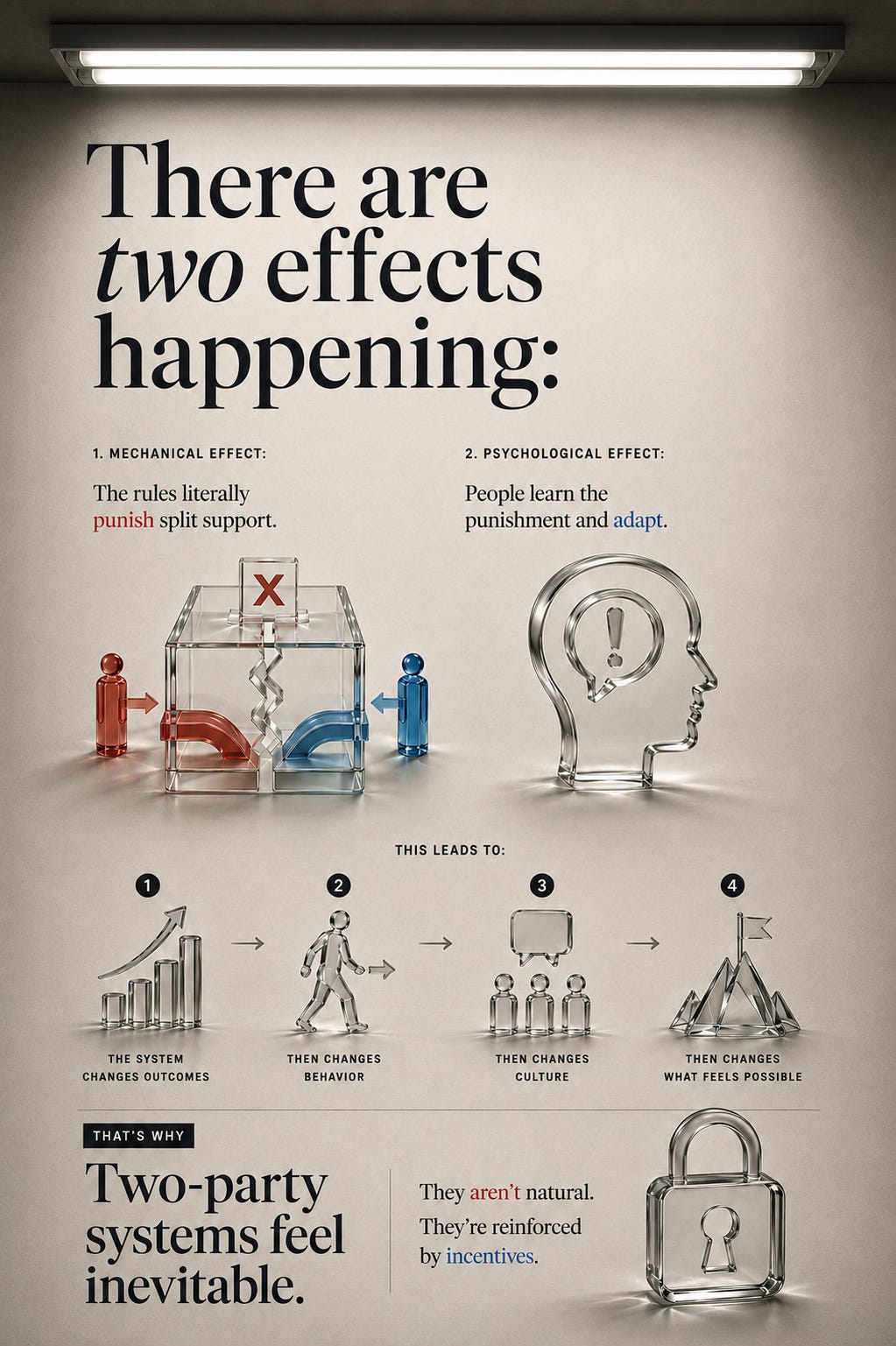
Chapter 1: When The Majority Disappears Into The Count
Here’s what actually happens in most elections.
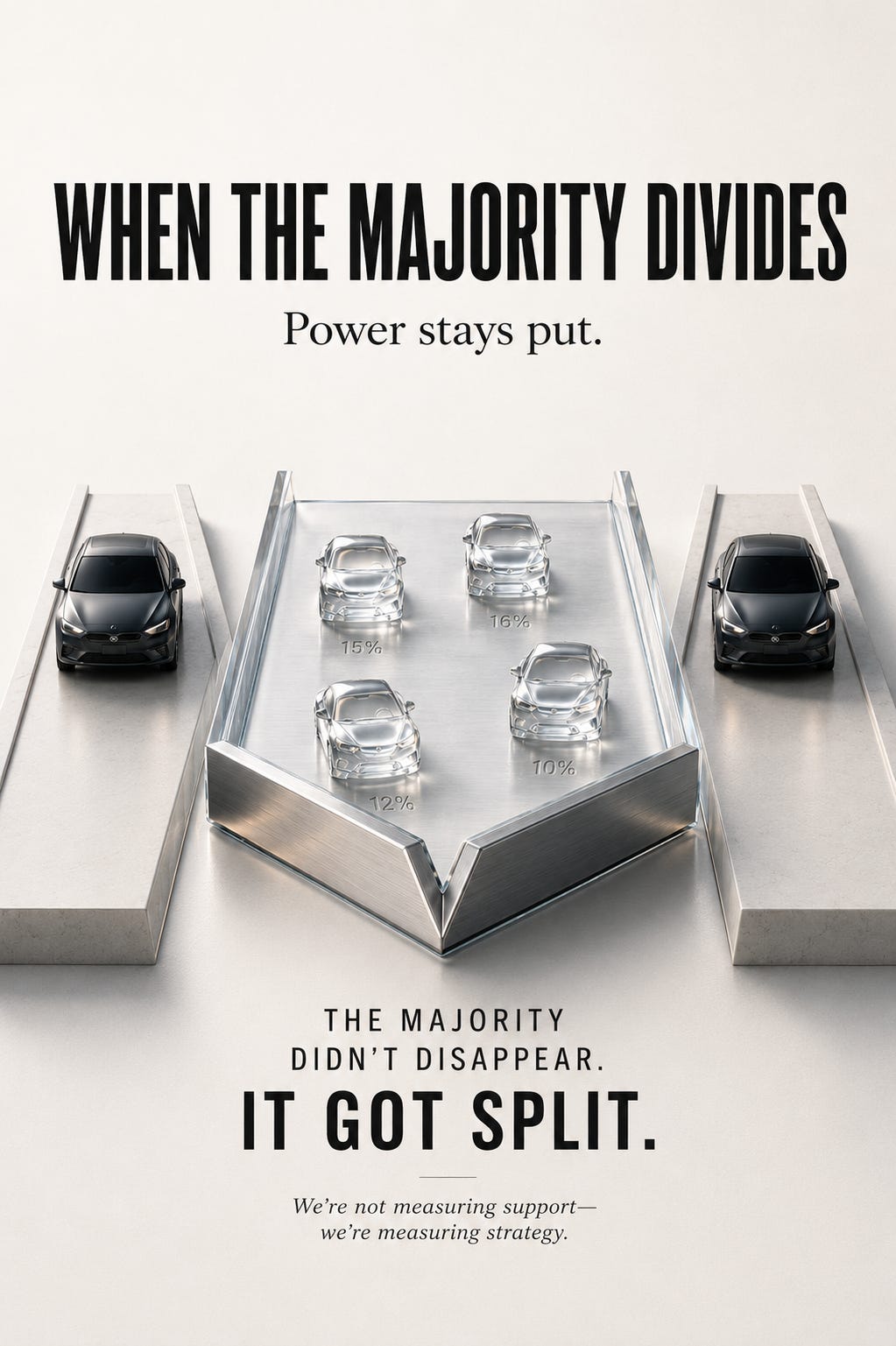
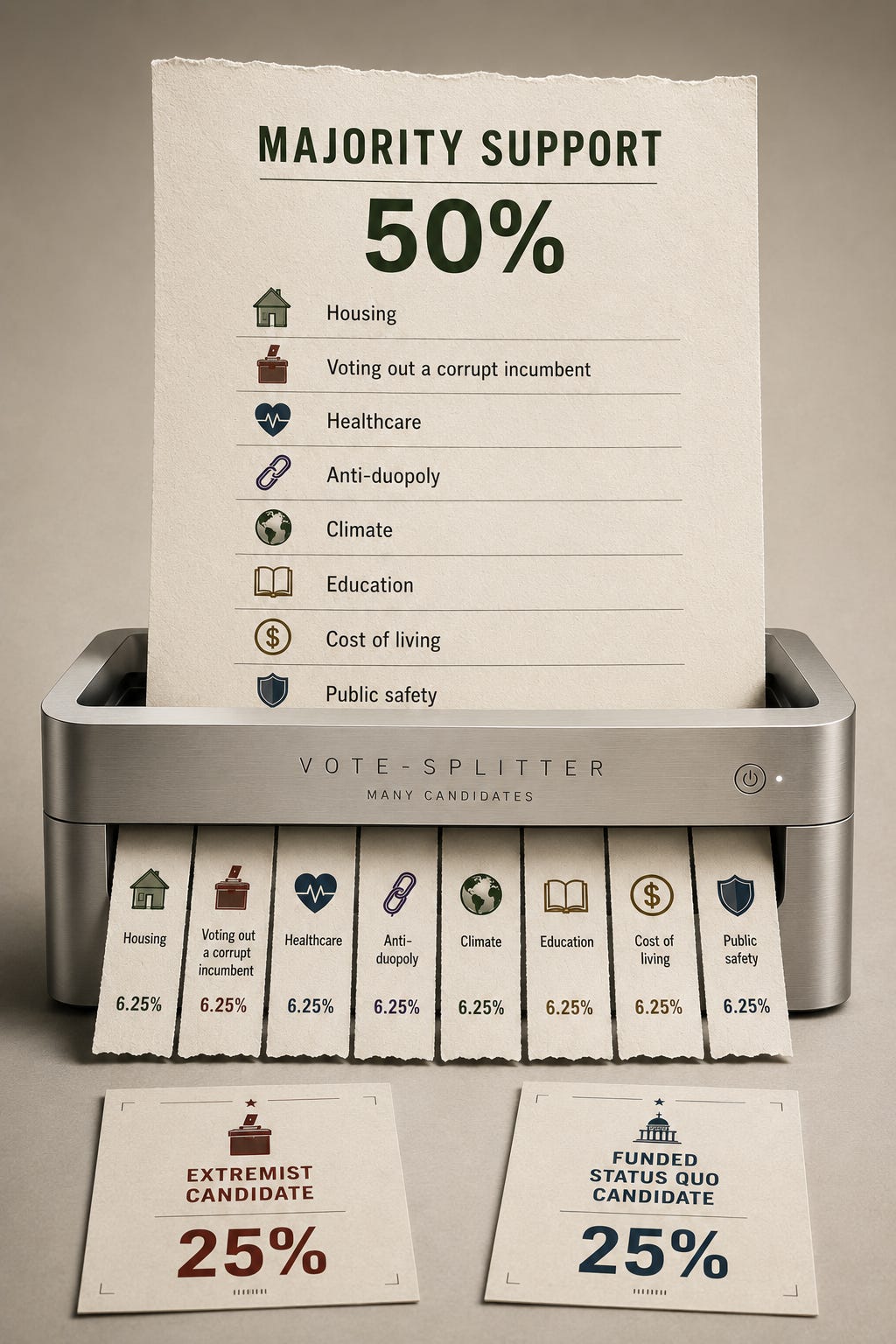
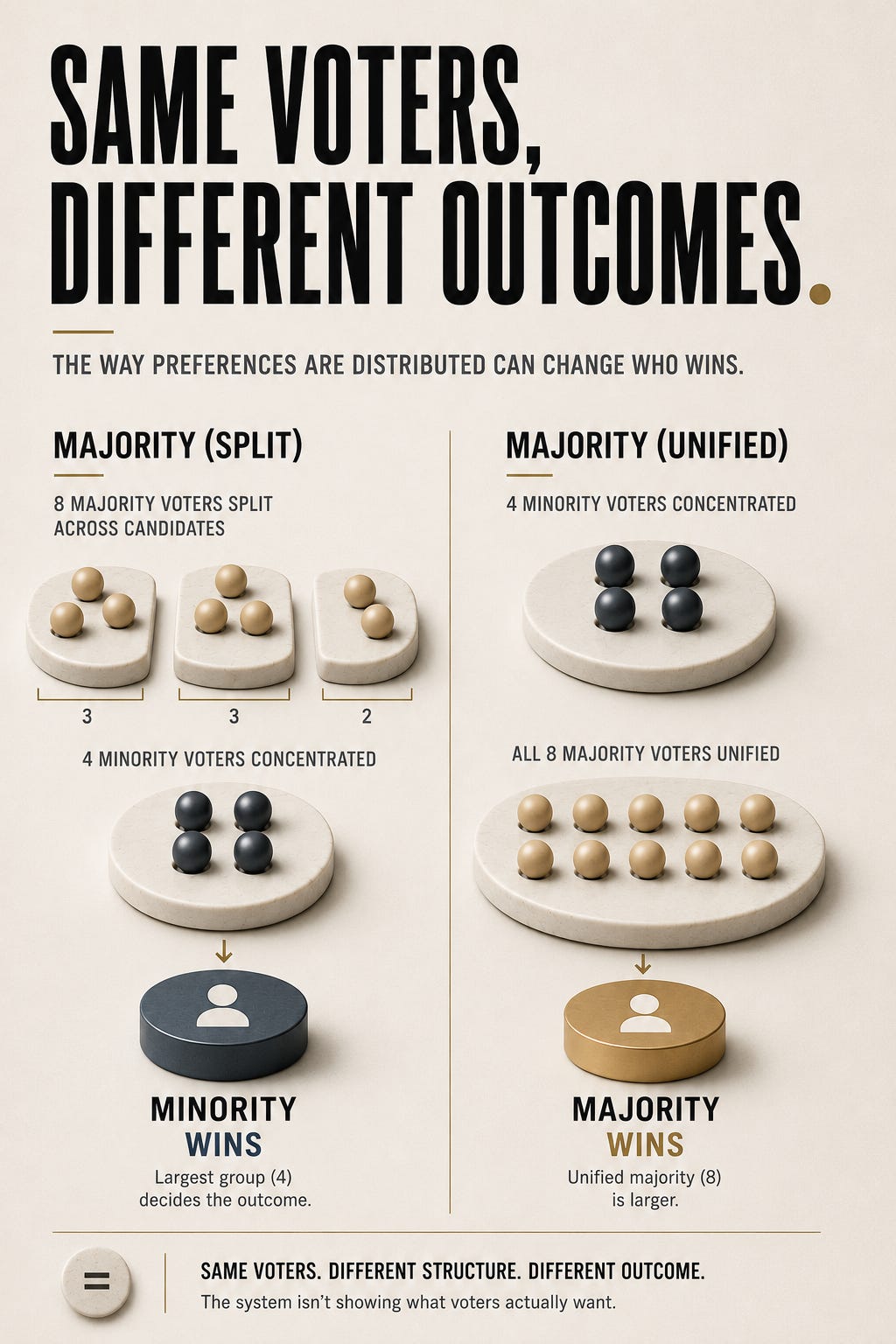
Imagine a majority of voters — say, 60% of the electorate — all care about the same things. Affordability. Stability. Something that actually works. Several candidates represent that direction, so voters spread across them naturally.
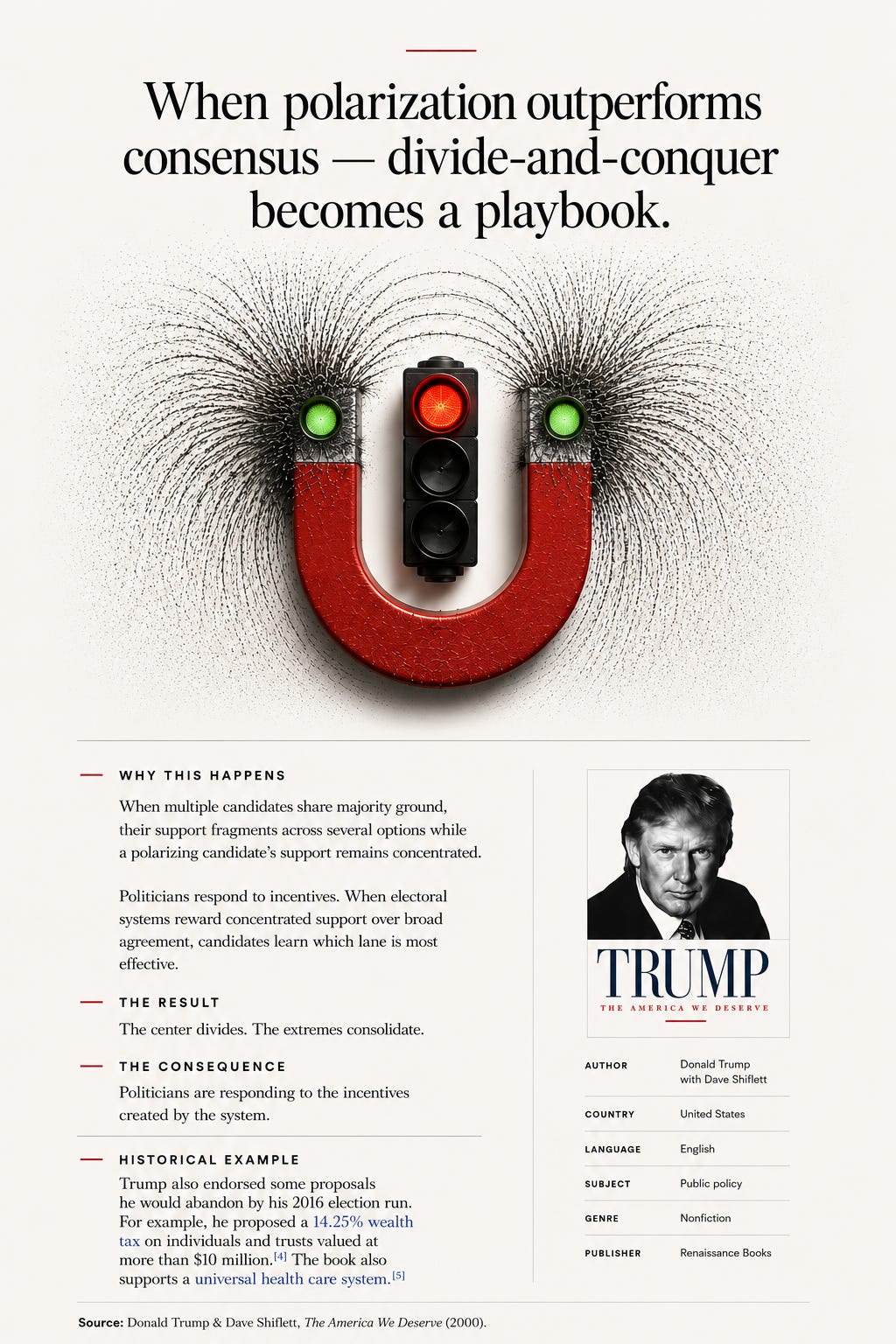
Meanwhile, a smaller, more unified group consolidates behind one candidate from the start.
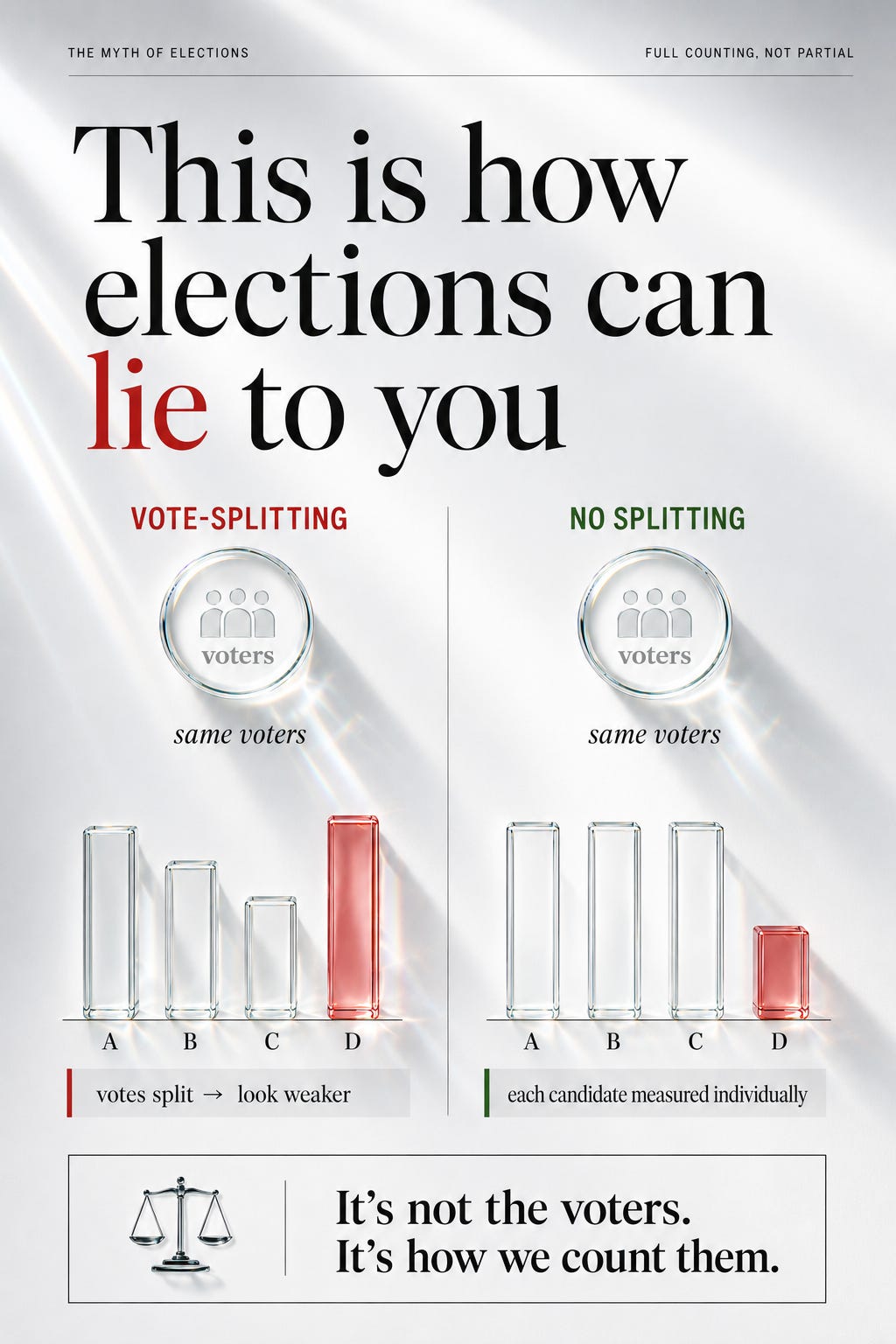
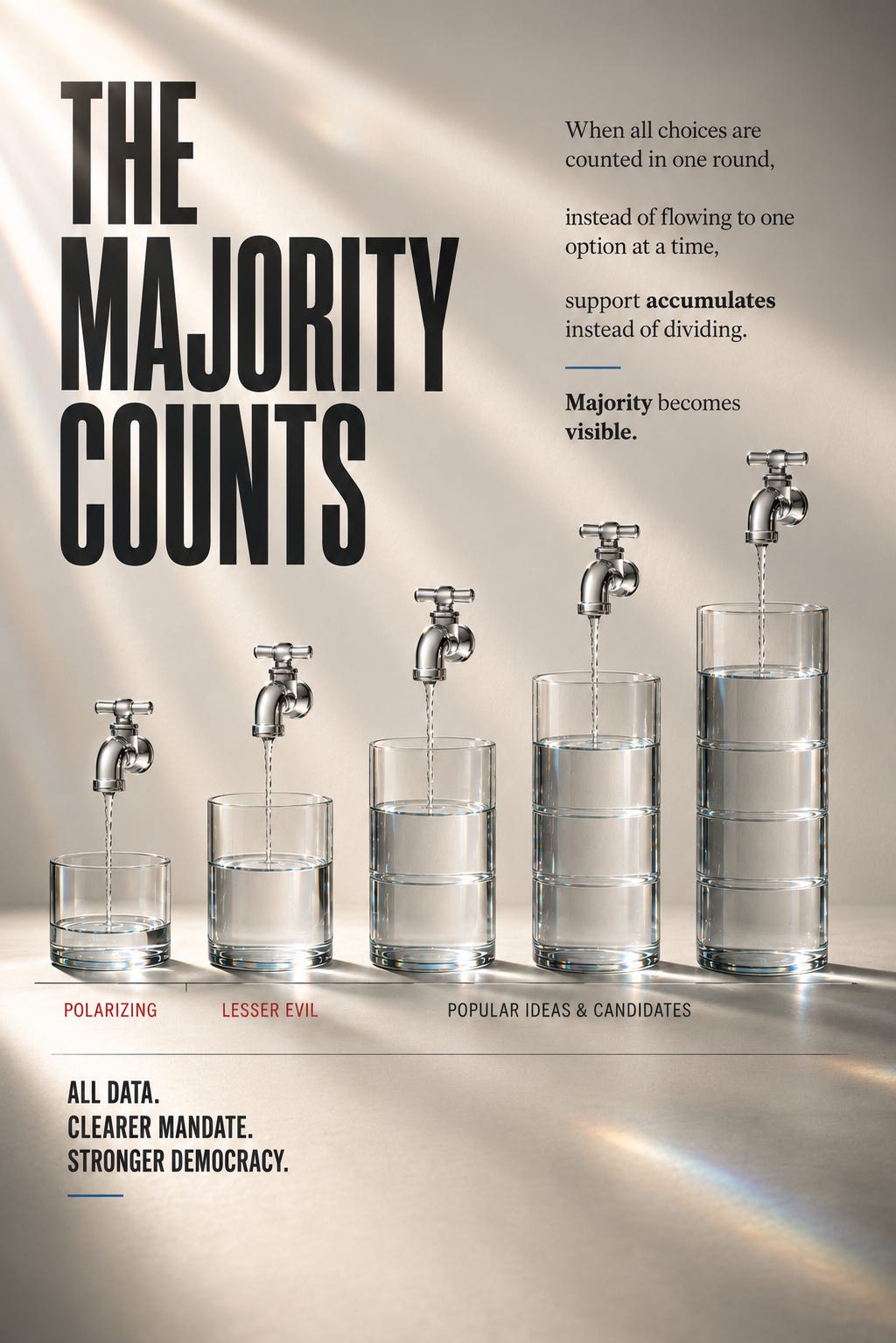
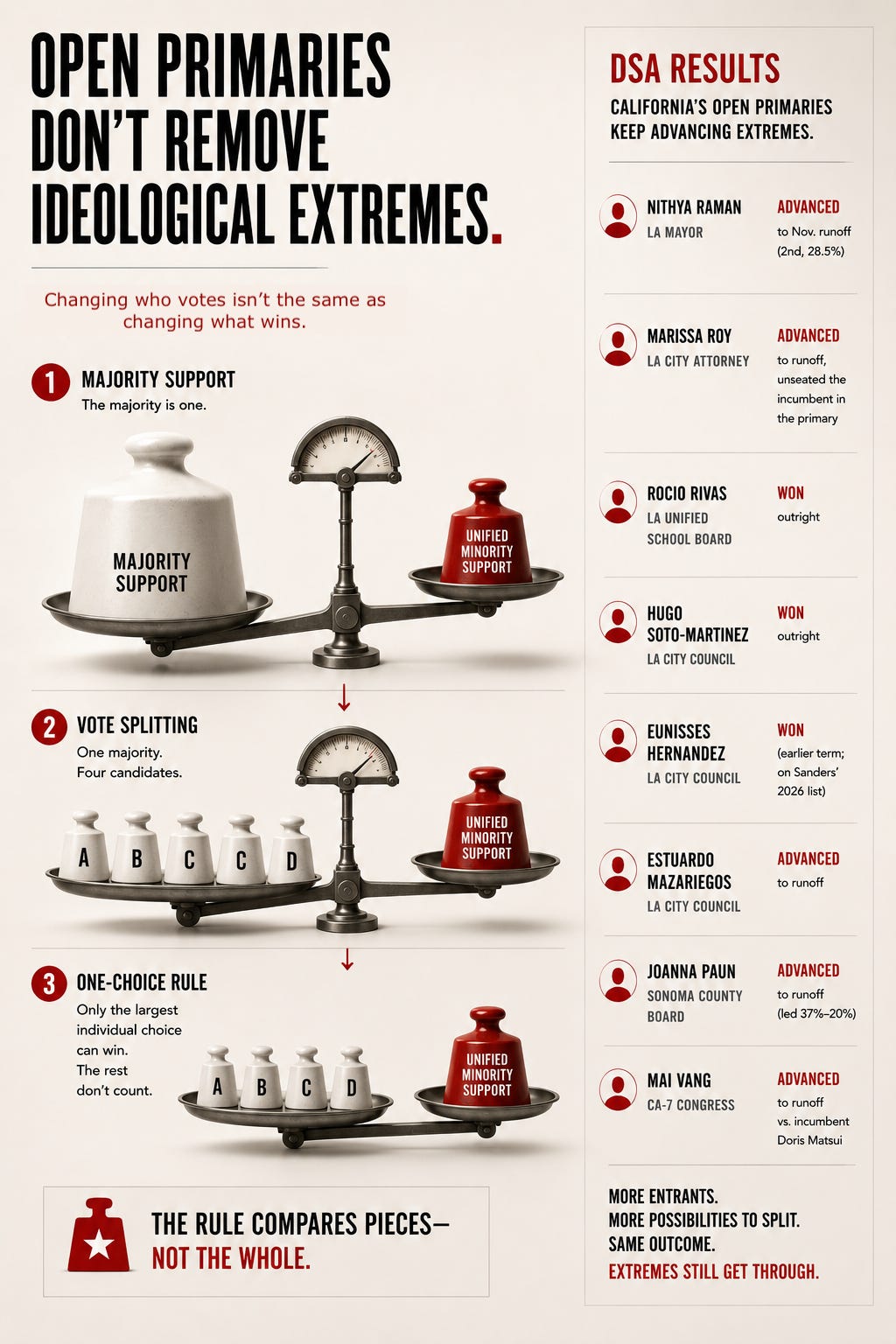
In the count, the majority looks like groups of small percents. The minority looks like a large percent, unified and strong.
The minority wins.
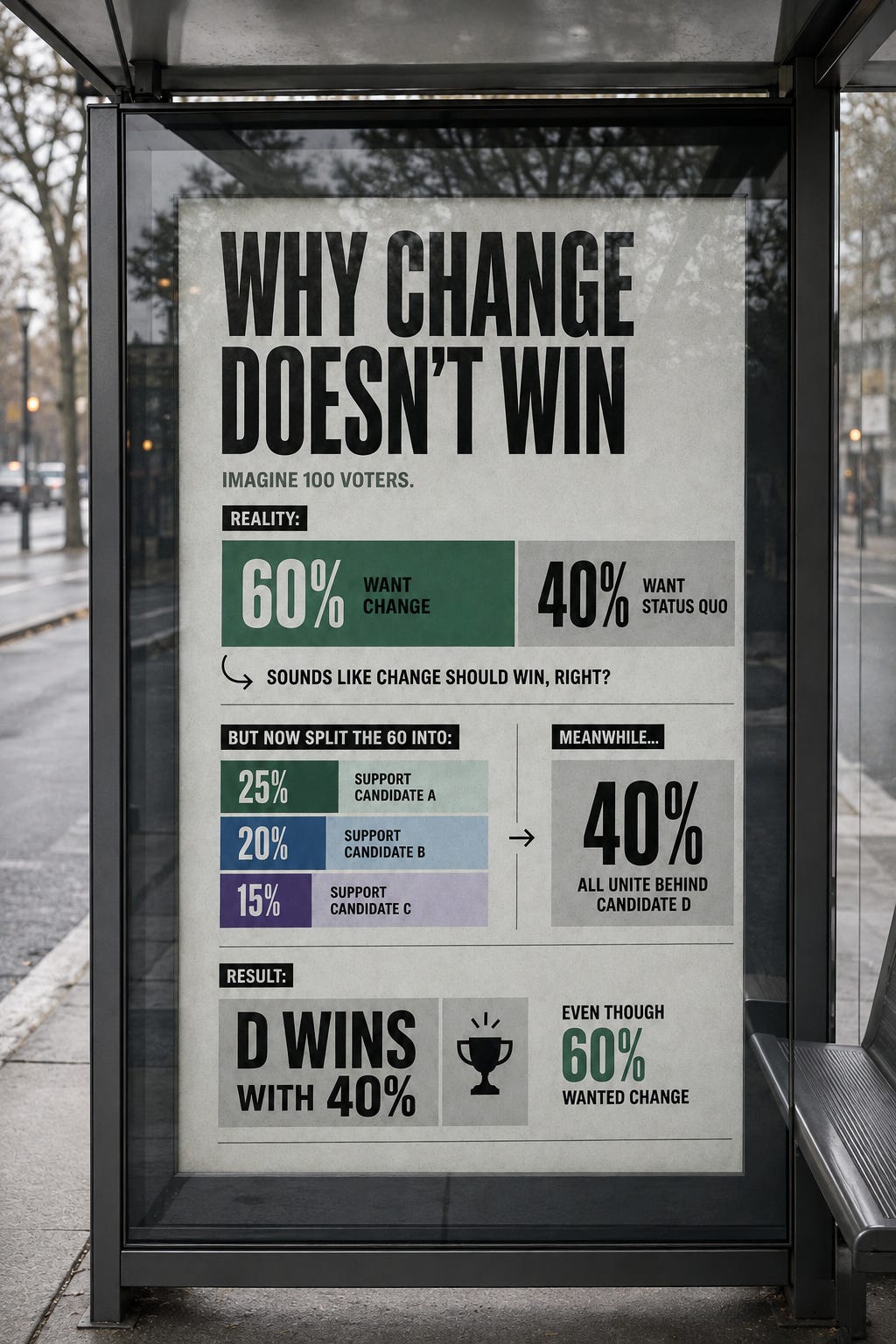

Not because more people wanted them. Because the system measures who survives the split — not how much total support actually exists.
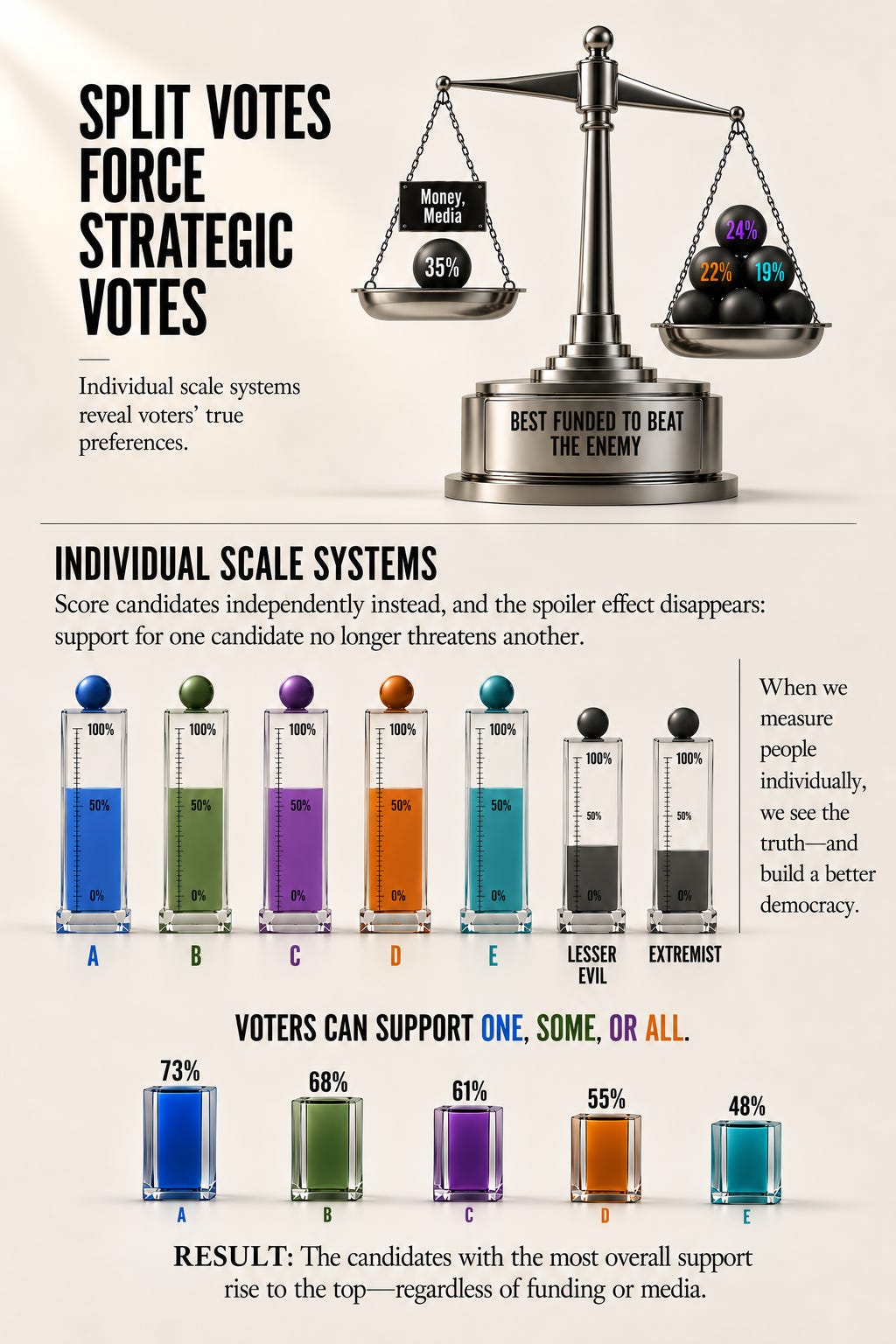
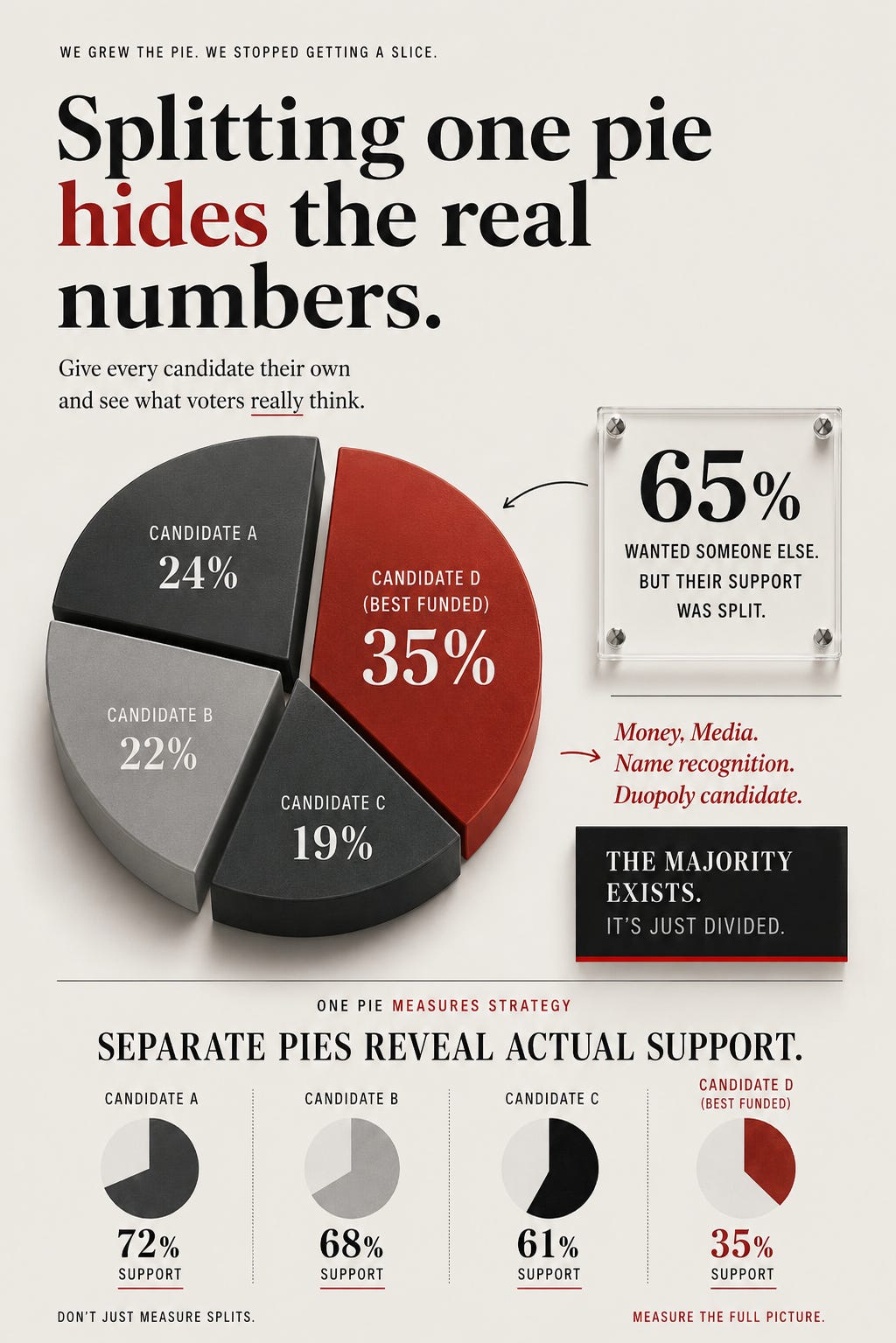
The structure doesn’t change when the percentages move. The dynamic is always the same.
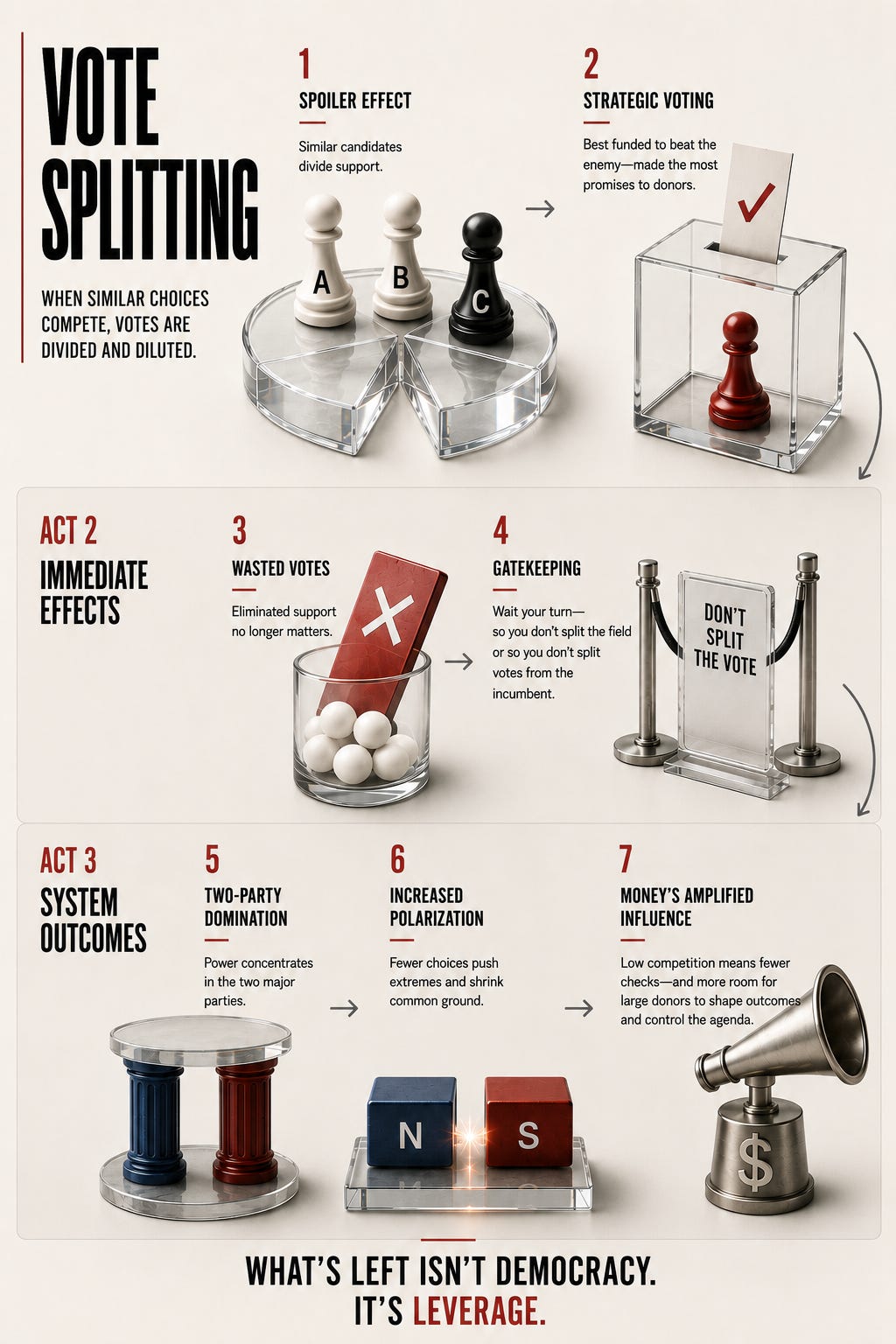
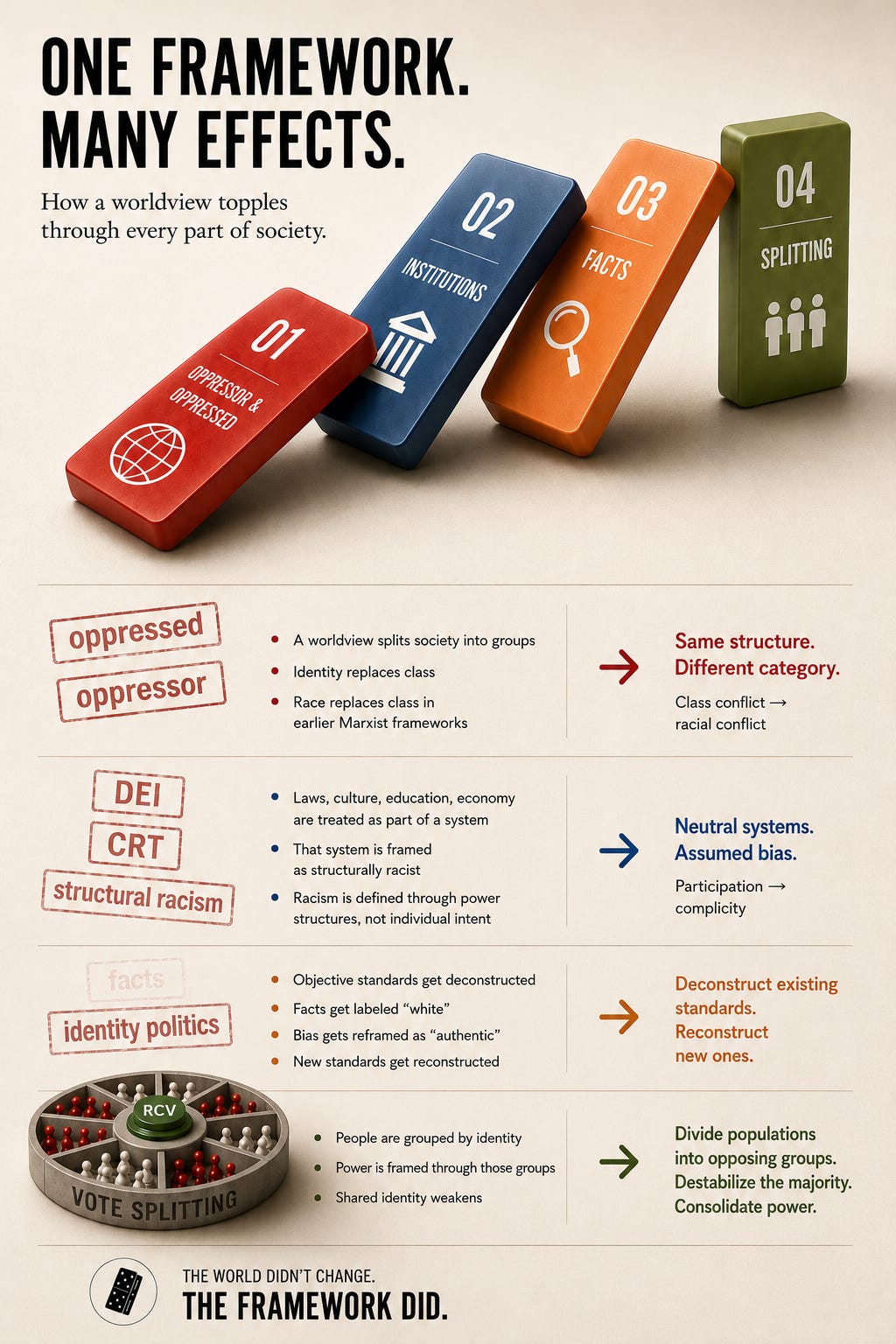
This is vote splitting. And it’s just the first of three ways the count fails before a winner is even declared.
Chapter 2: The Three Ways Systems Fail
Every voting system either solves these problems — or it doesn’t.
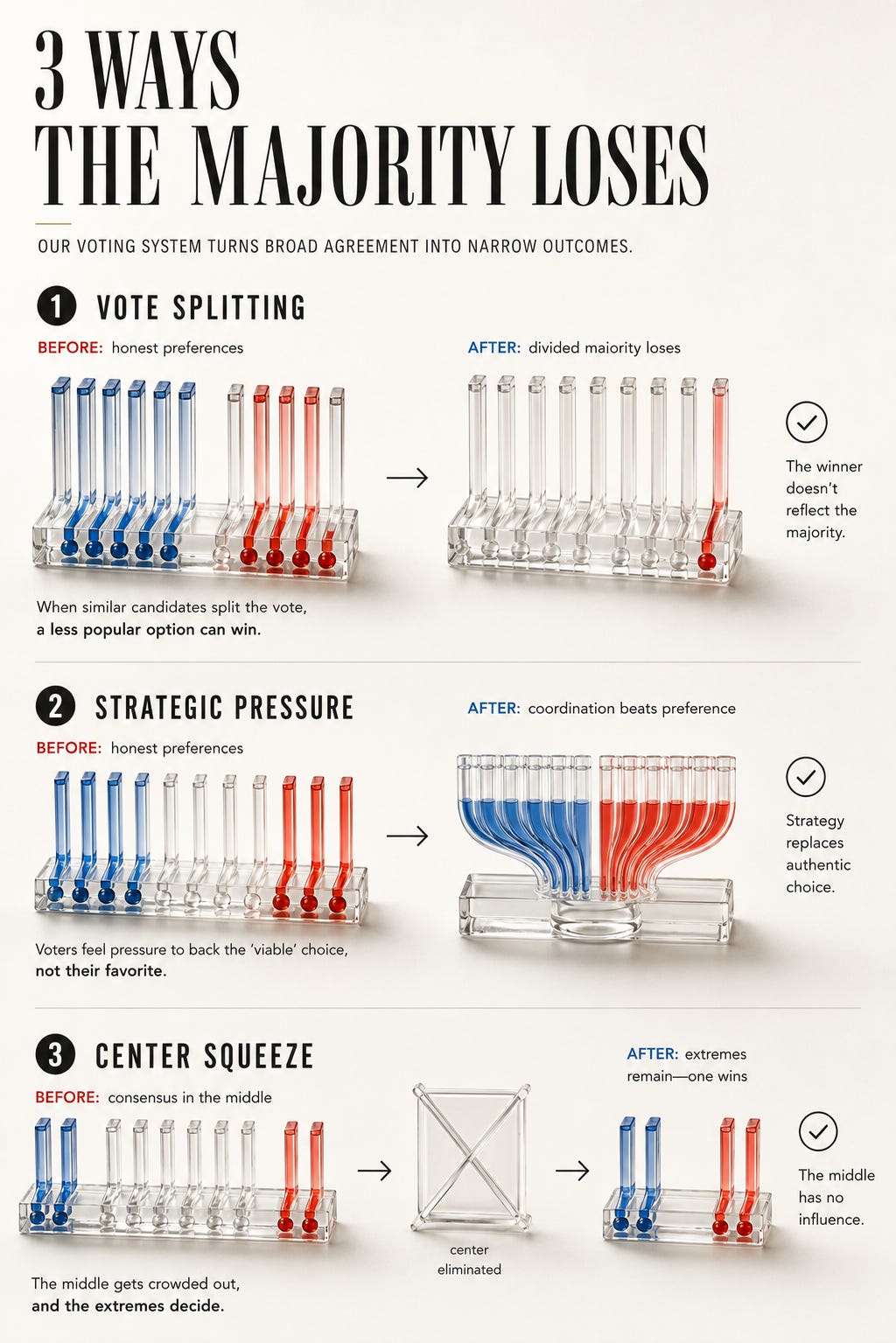
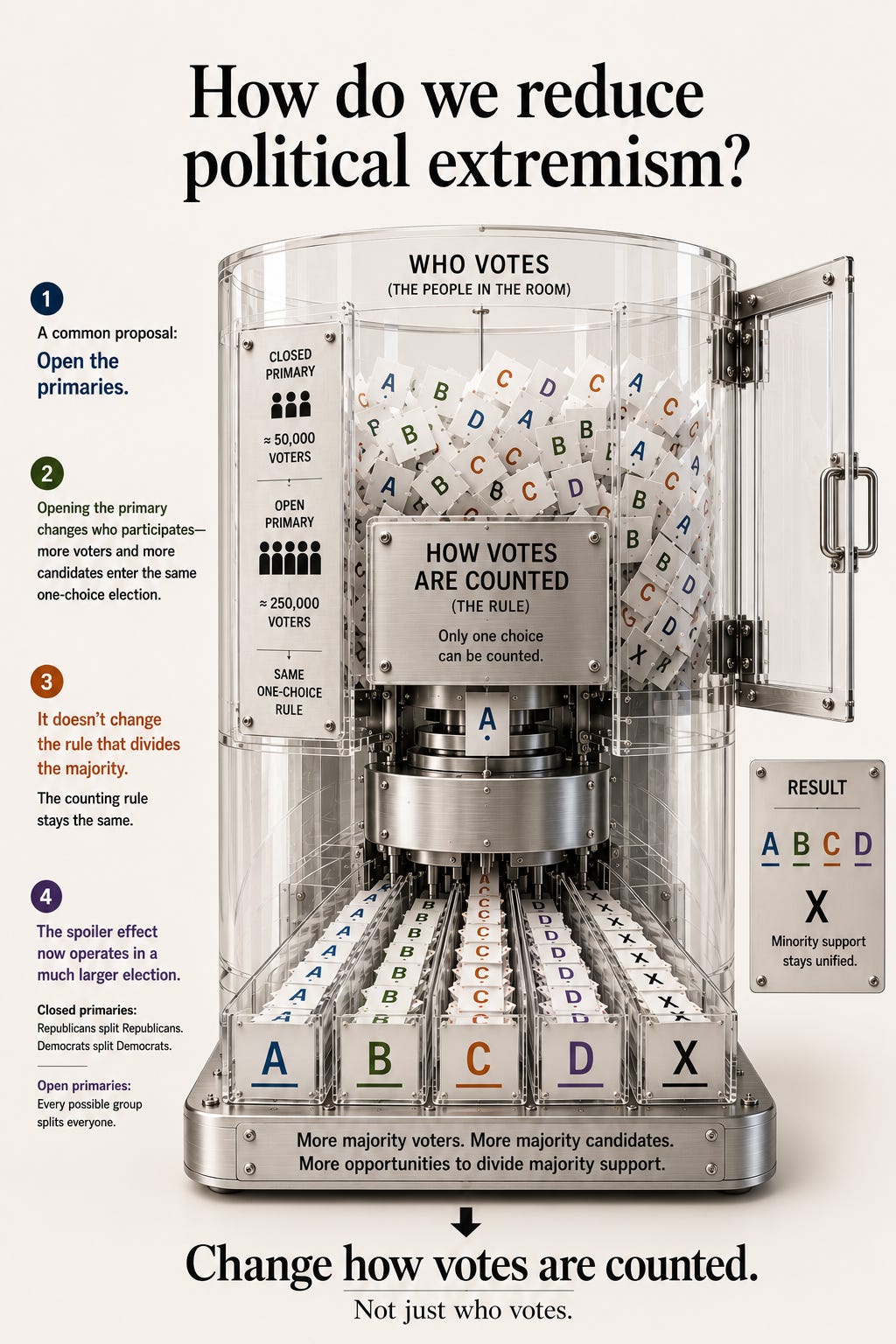
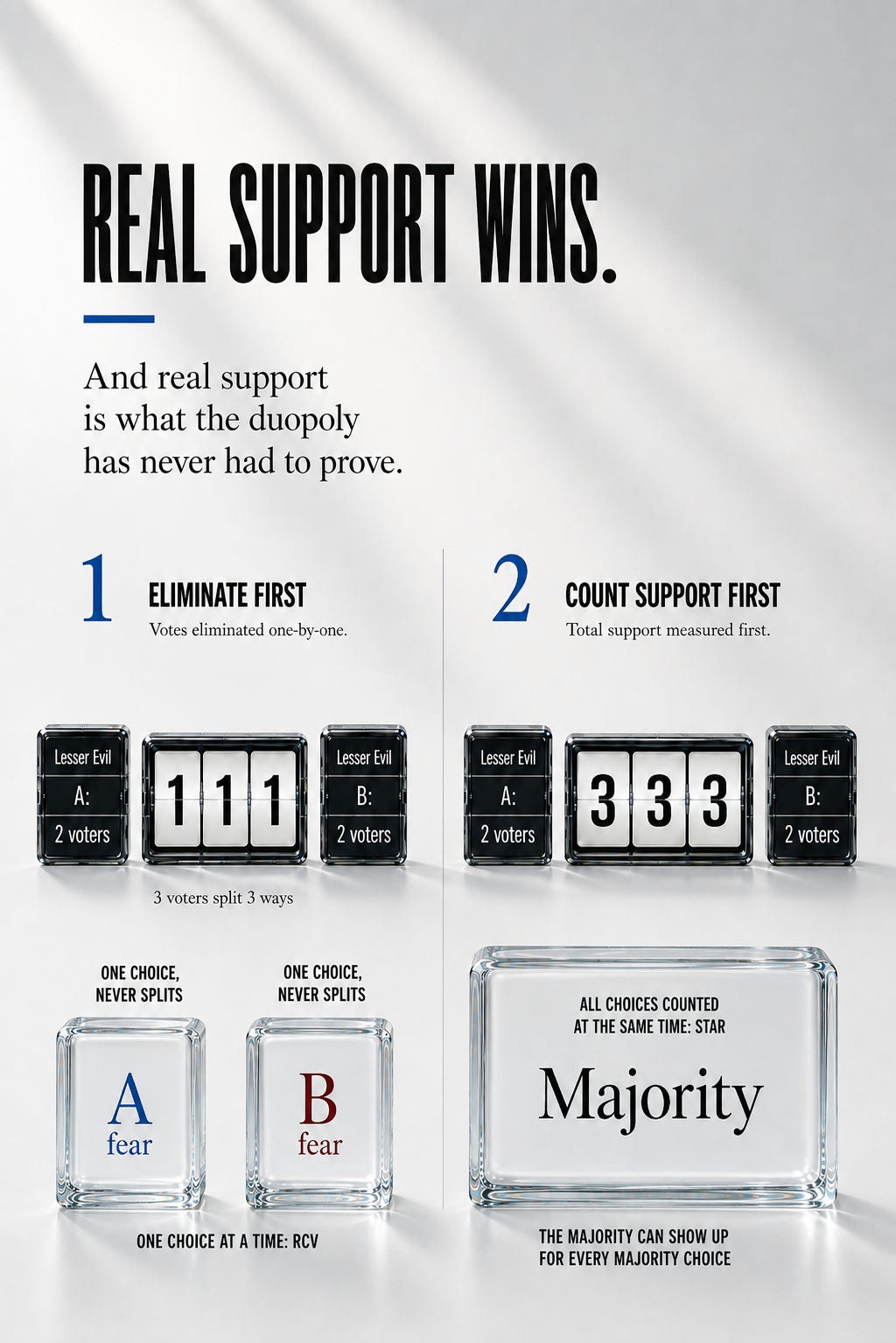
The first is vote splitting: the majority divides across similar candidates and loses to a unified minority that never had more actual support.
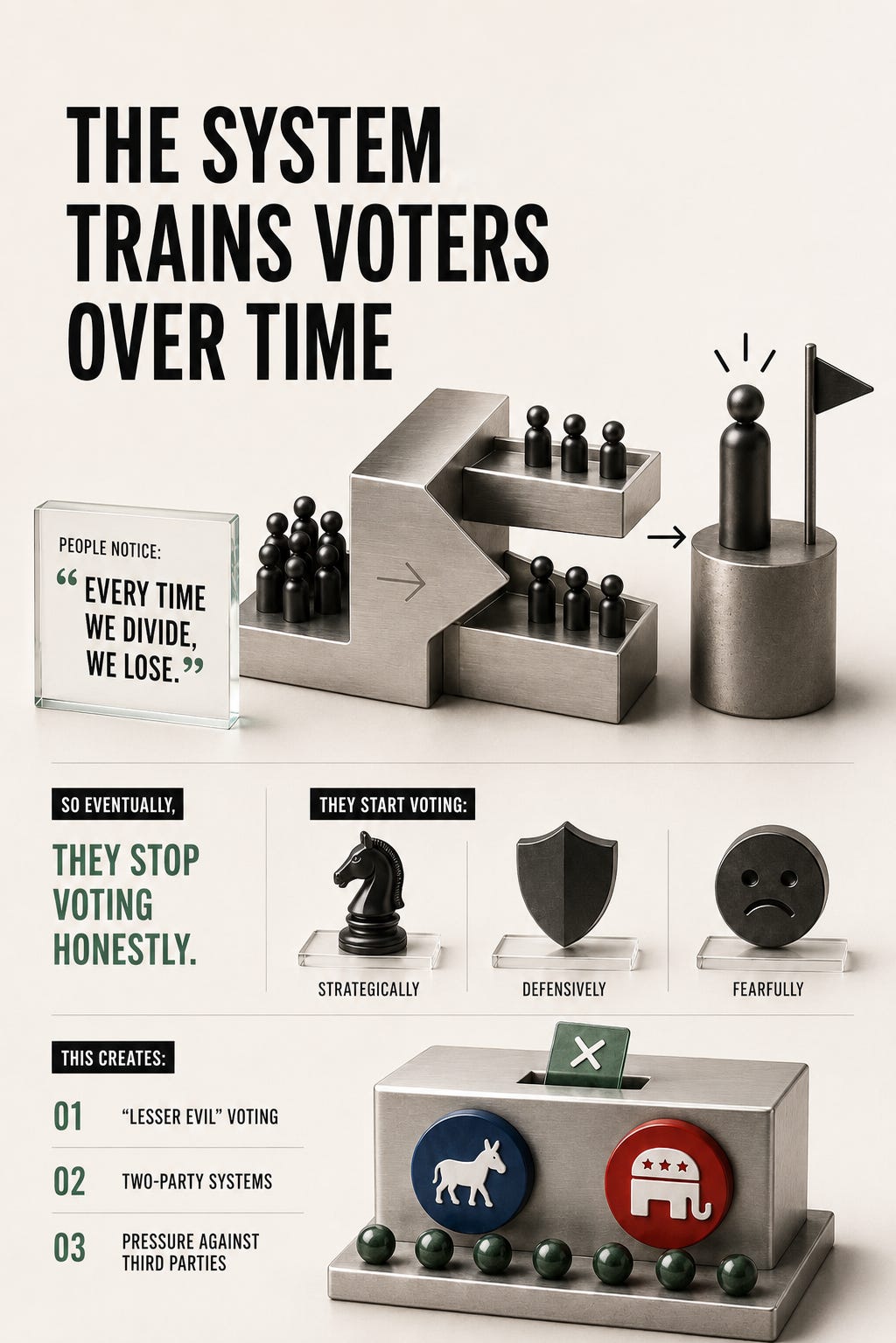
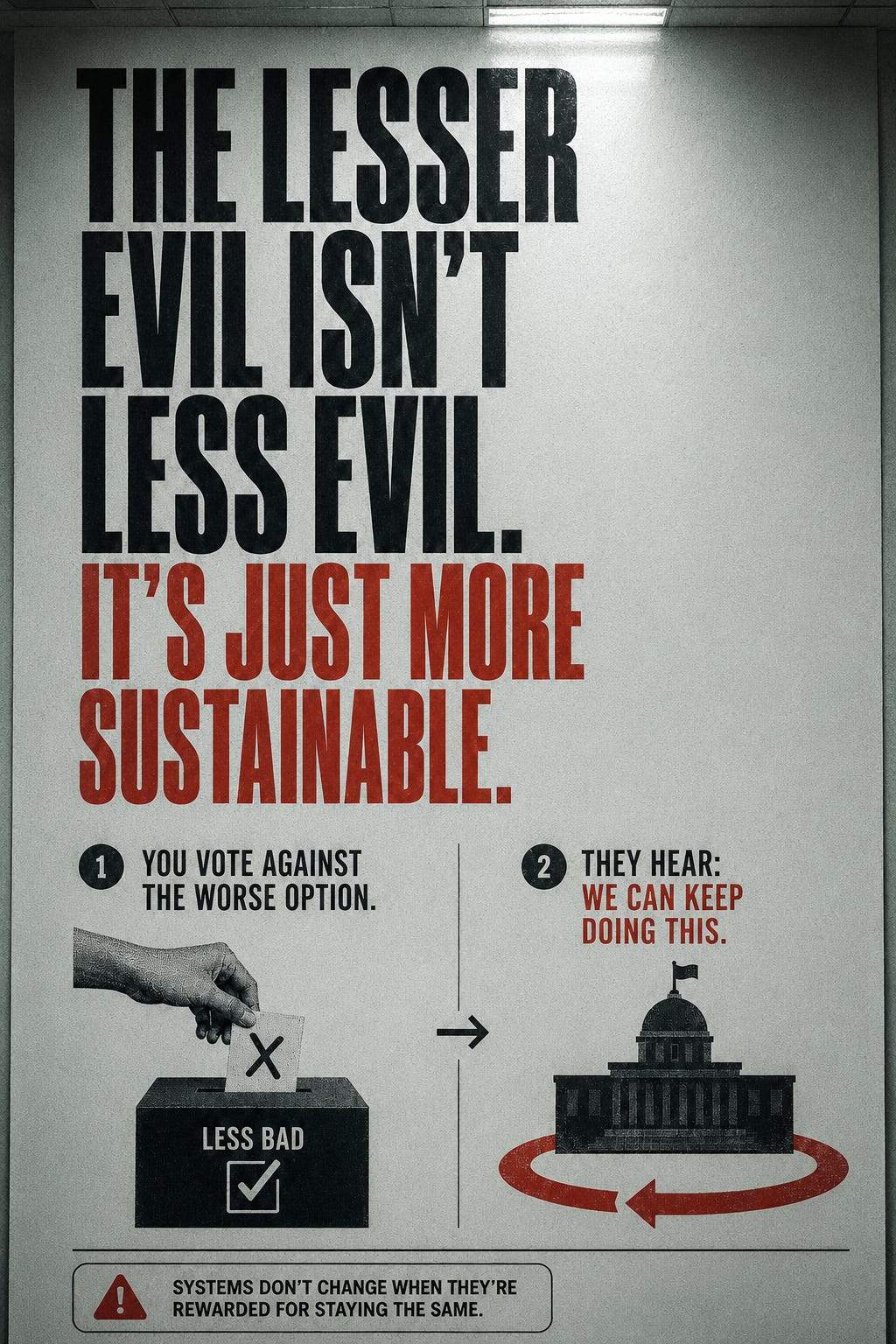
The second is strategic pressure. When the system punishes honest voting, people stop voting for who they actually want.
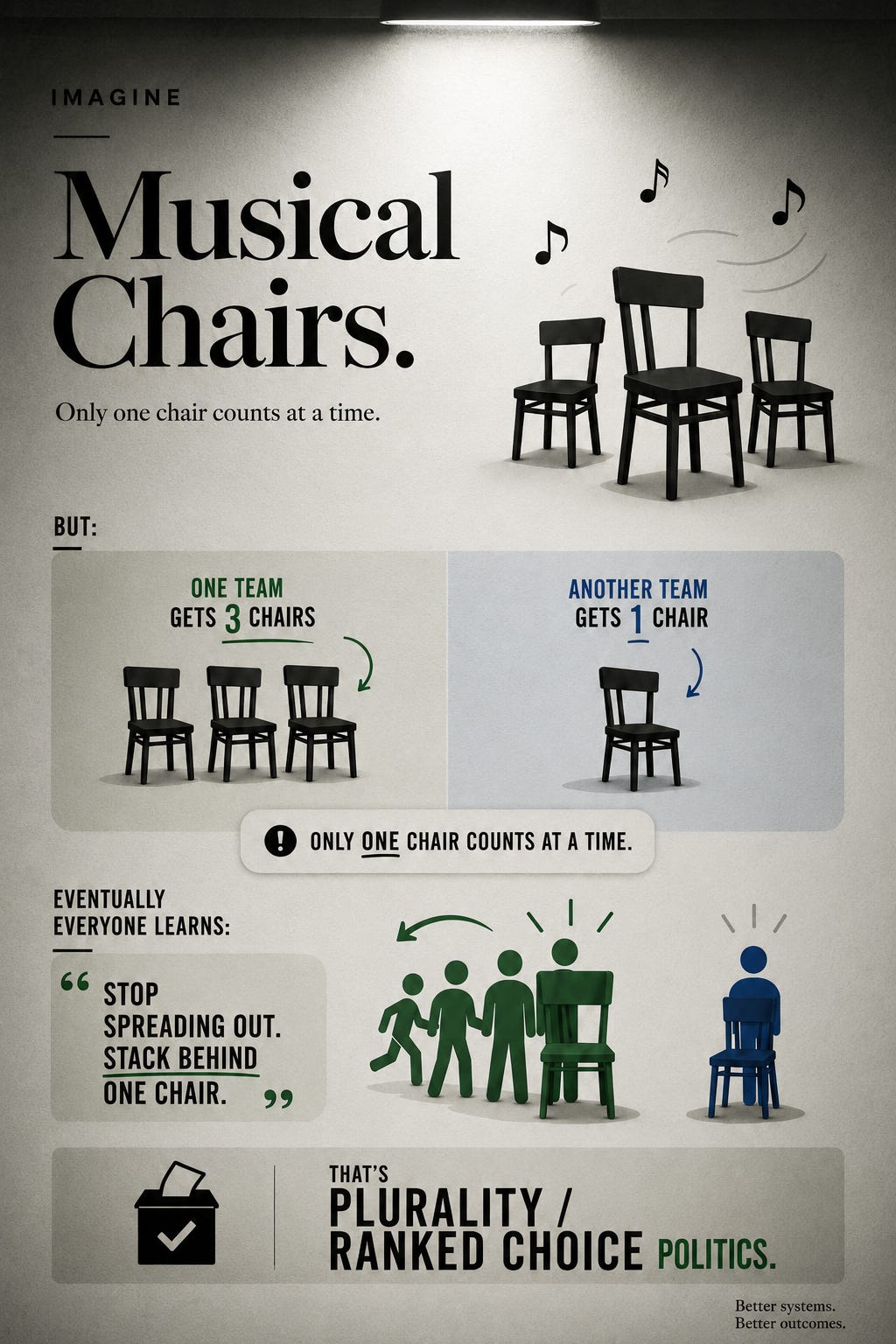
A voter who wants to vote for a candidate they genuinely trust learns quickly that doing so might help their worst-scenario candidate win — so they abandon their real preference and vote for whoever seems safest (and when that candidate breaks trust it’s no surprise).

But strategic pressure cuts both ways. A small, savvy group that understands the system can concentrate their votes on a single candidate while everyone else votes honestly and spreads their support thin. Coordination becomes a weapon. The group that games the rules doesn’t need more voters — they just need more discipline. Elections stop measuring what people want and start measuring who understood the rules well enough to exploit them.

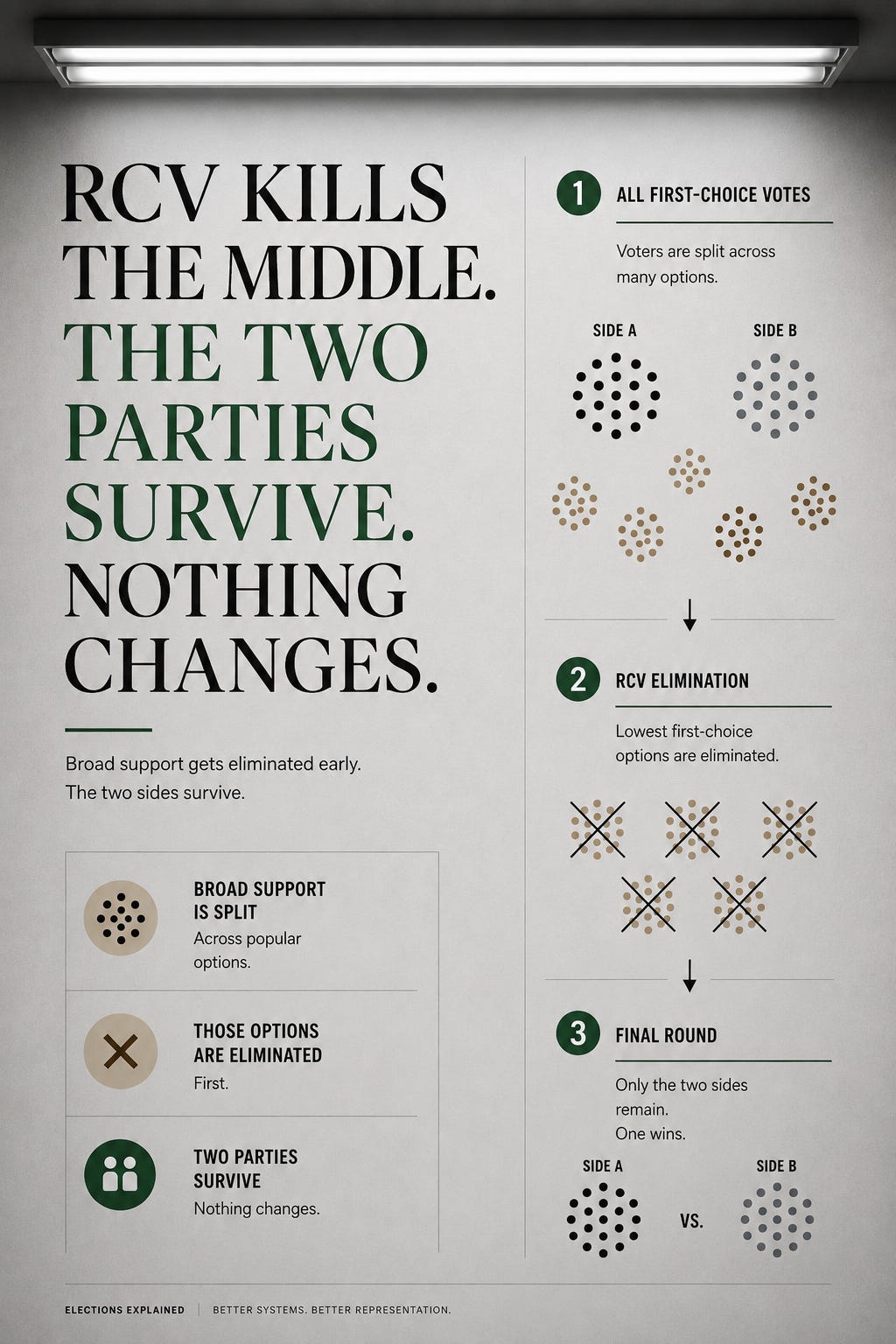
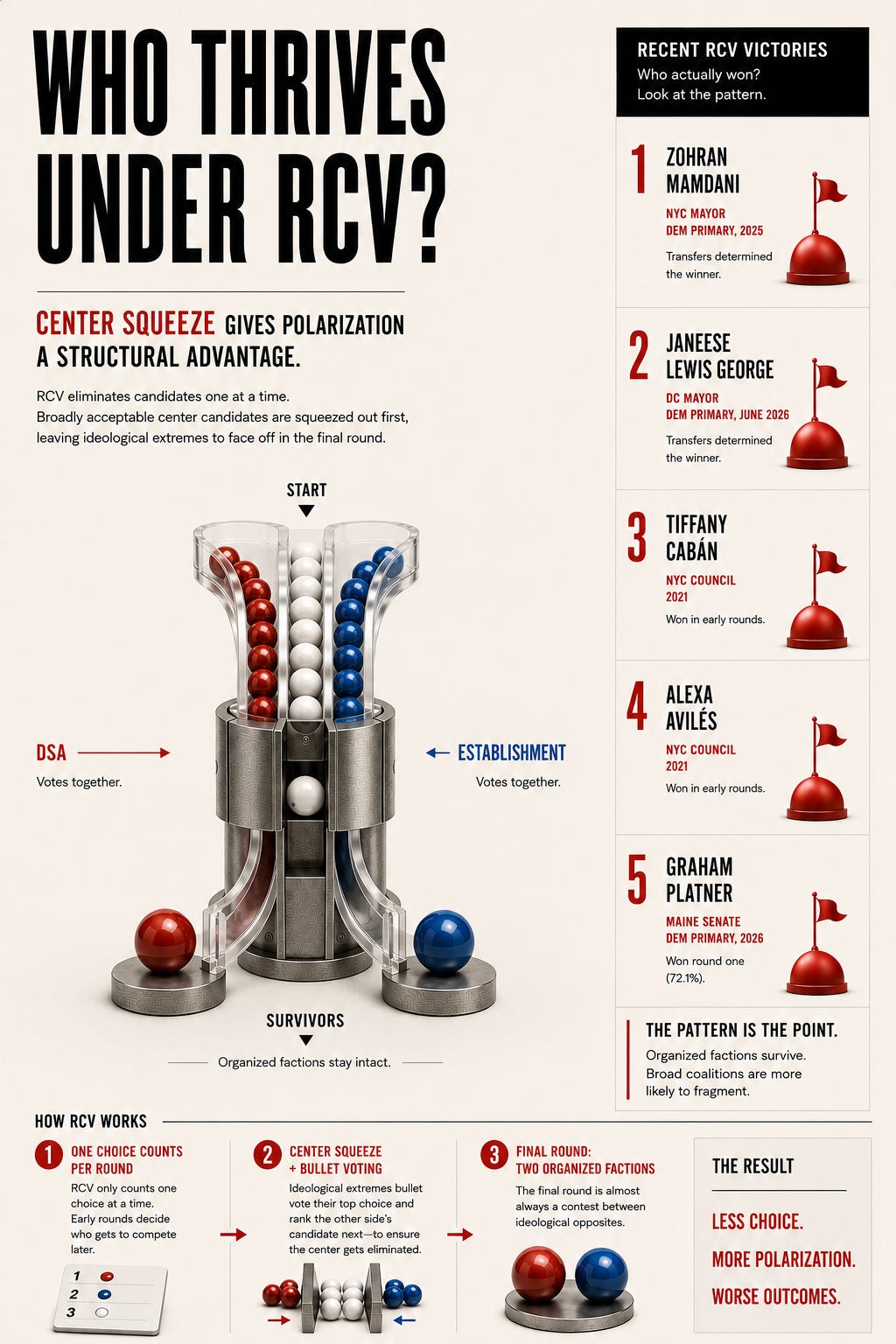
The third is center squeeze: the candidate with the broadest cross-section of support — the consensus choice — gets knocked out early, before they ever get a fair comparison. The polarizing candidates survive. The broadly popular one doesn’t.
Chapter 3: What Each System Actually Does — In Plain English
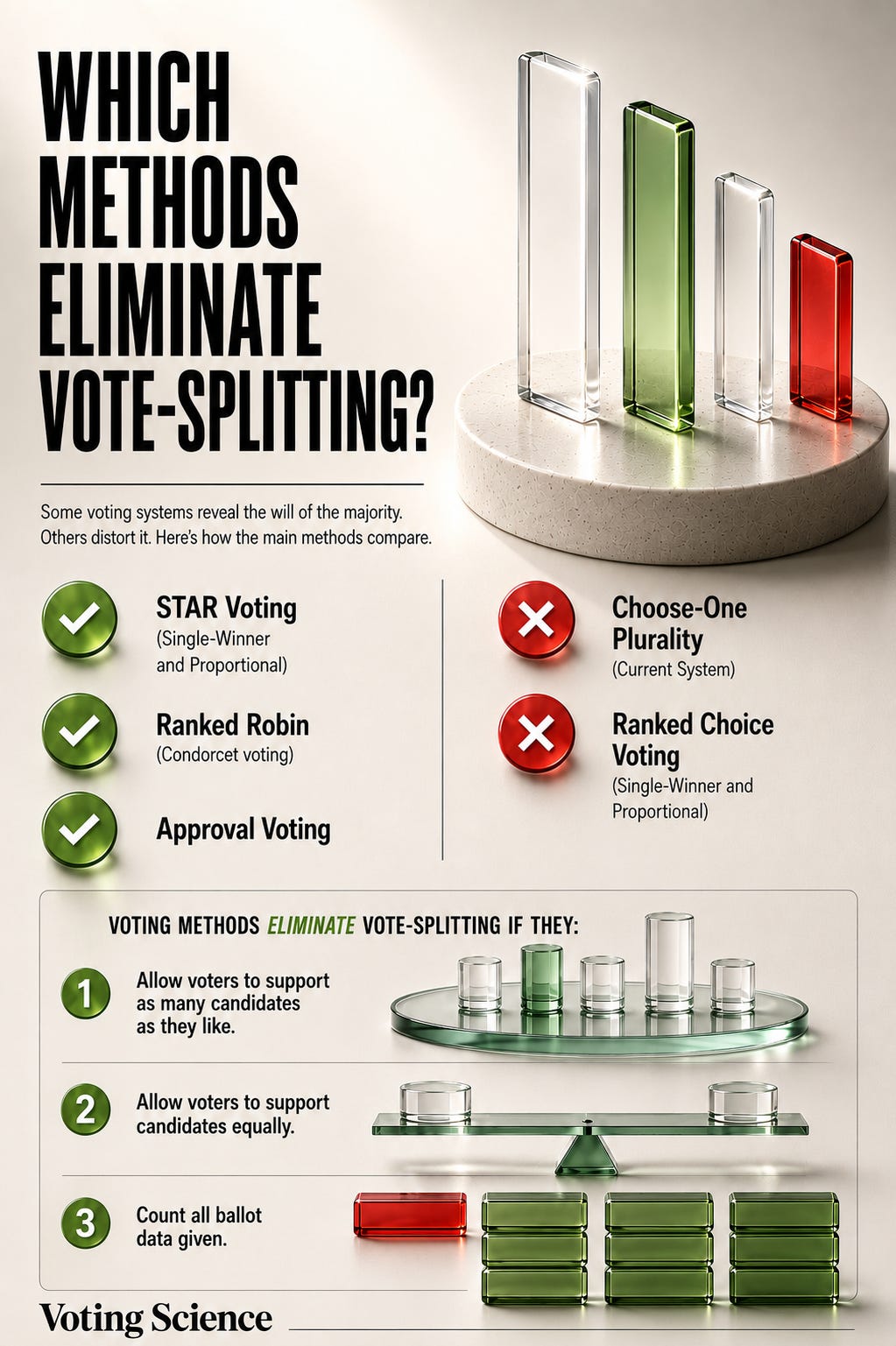
Plurality — Worst
You pick one candidate. Whoever gets the most votes wins, even without a majority.
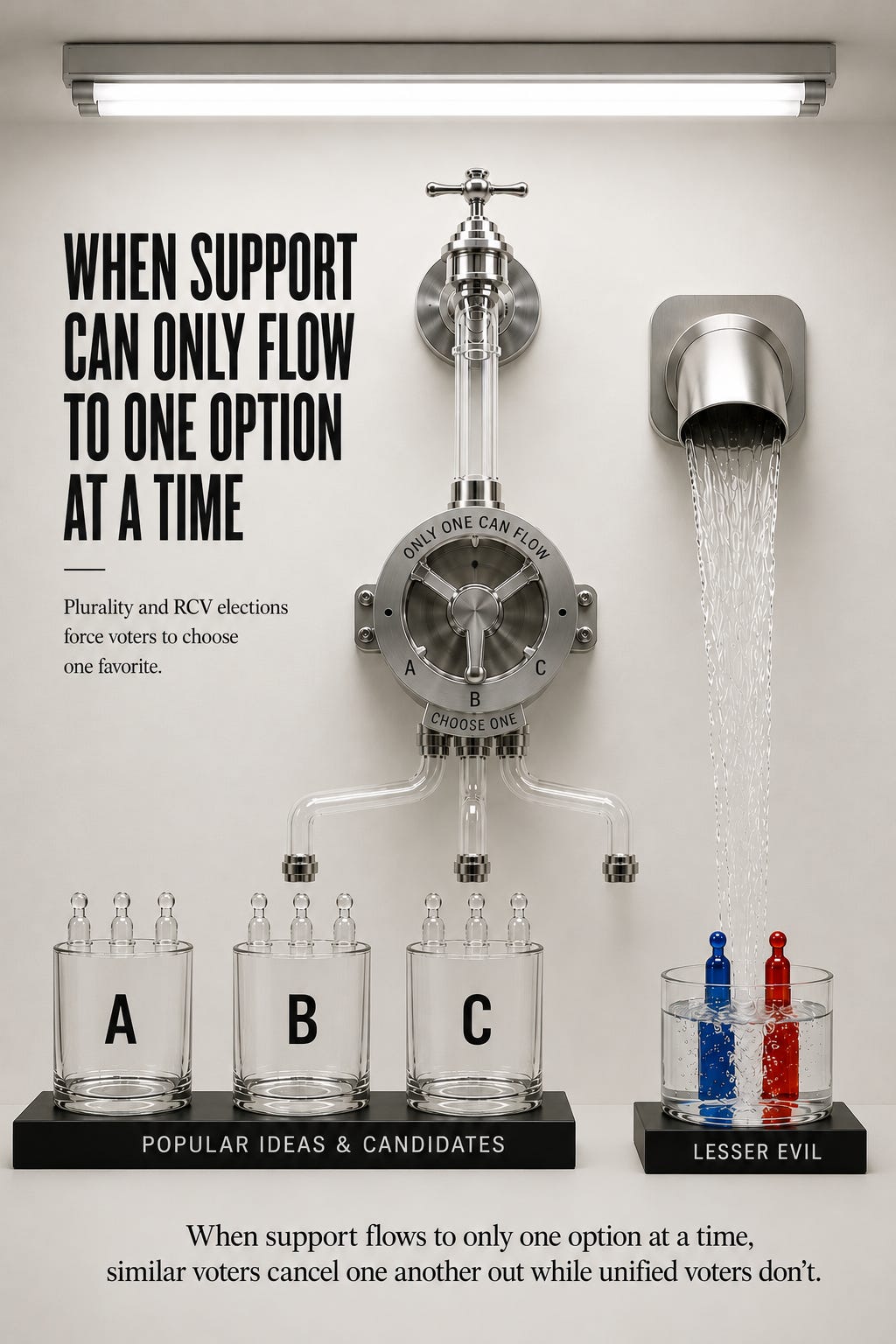
This is the system most elections in the United States currently use, and it fails in almost every competitive multi-candidate field. When similar candidates compete for the same voters, their support divides. A unified minority with a single candidate can beat a fragmented majority that never coordinated. The candidate most voters wanted can lose to the “lesser evil" — simply because their support scattered across too many options.
Plurality doesn’t measure what voters want. It measures who survived the split.
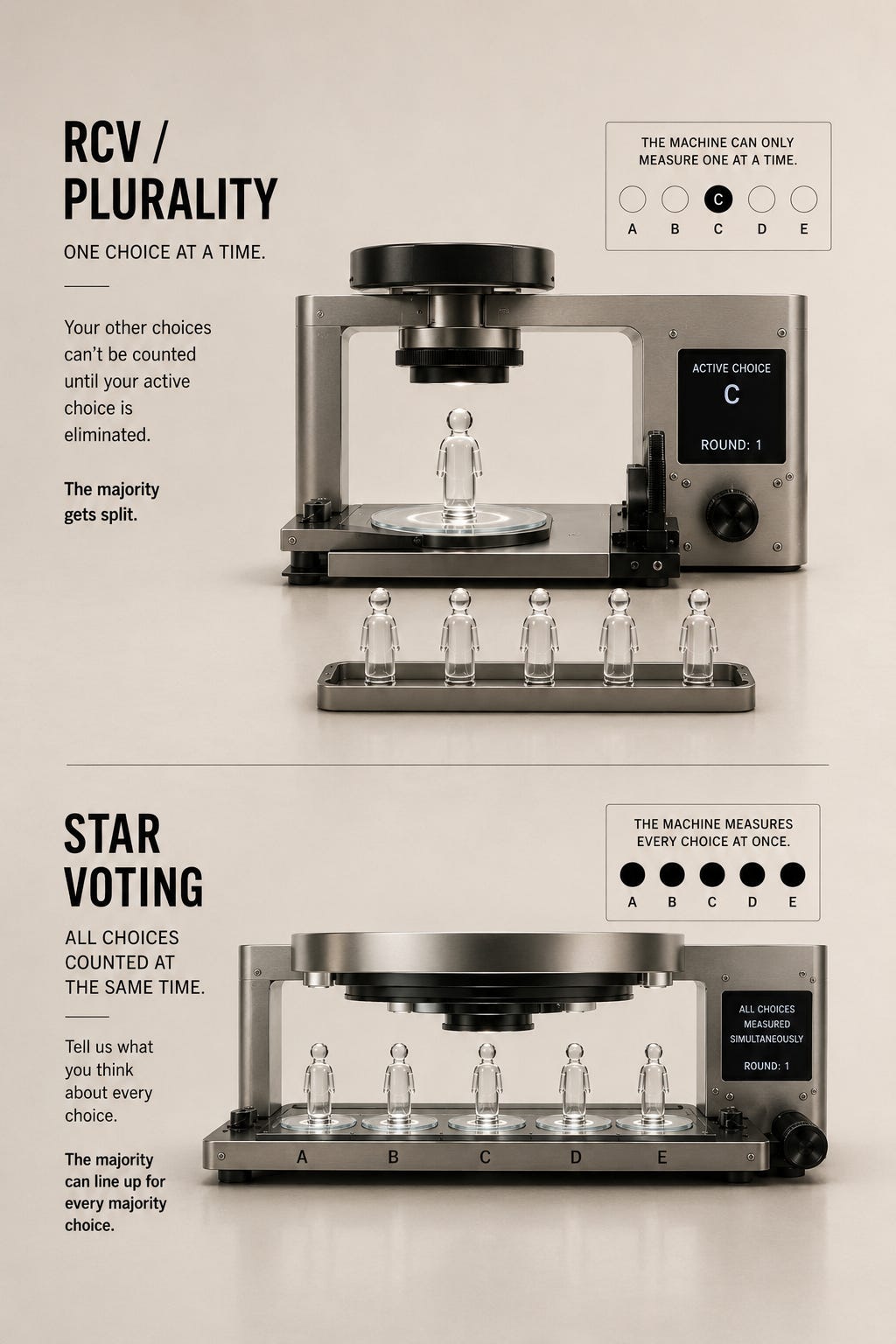
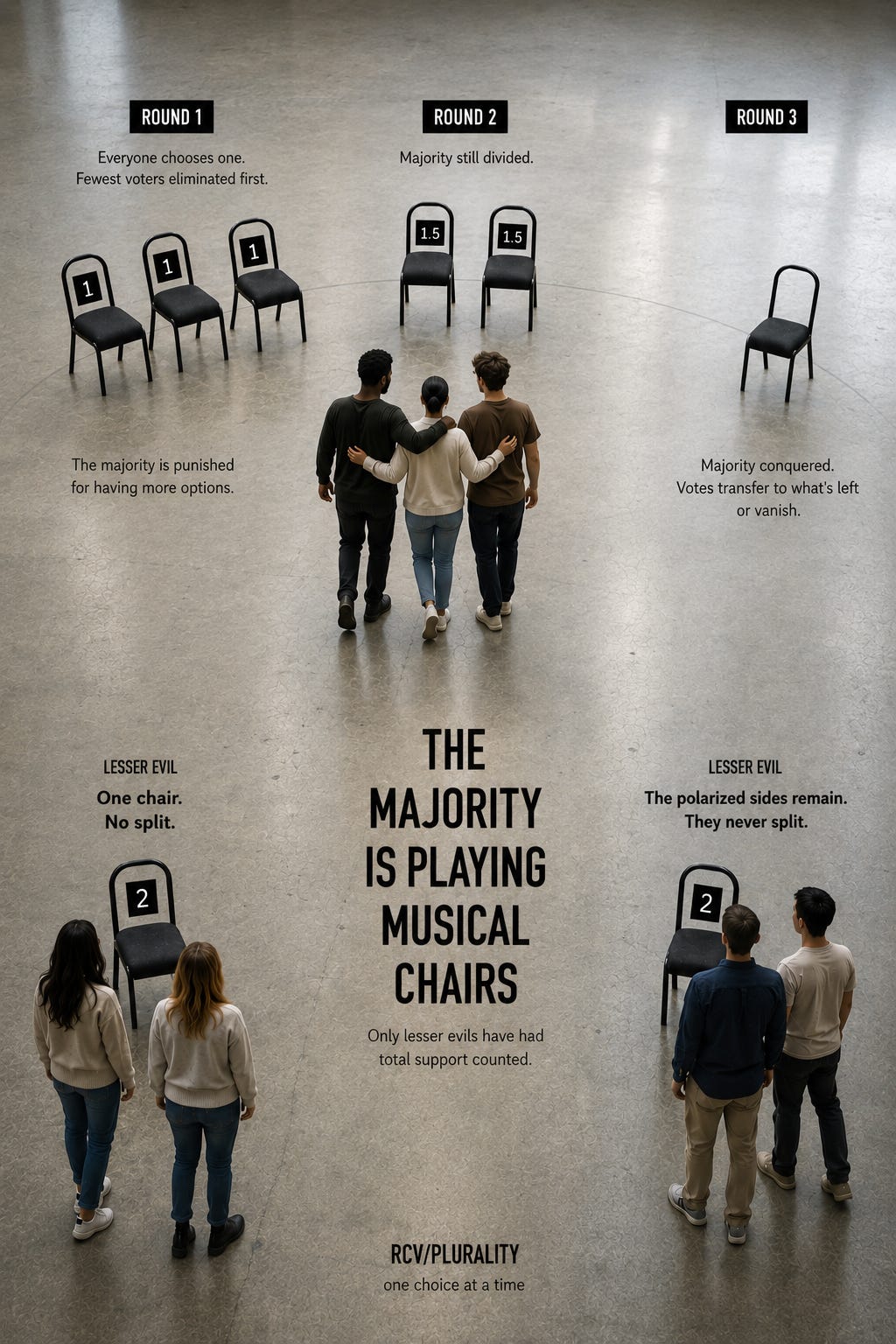
IRV — Eliminates minor spoilers (shielding only the duopoly), keeps you undefended from the big ones. Polarization can increase, and every round is still plurality voting — the thing you were trying to fix.
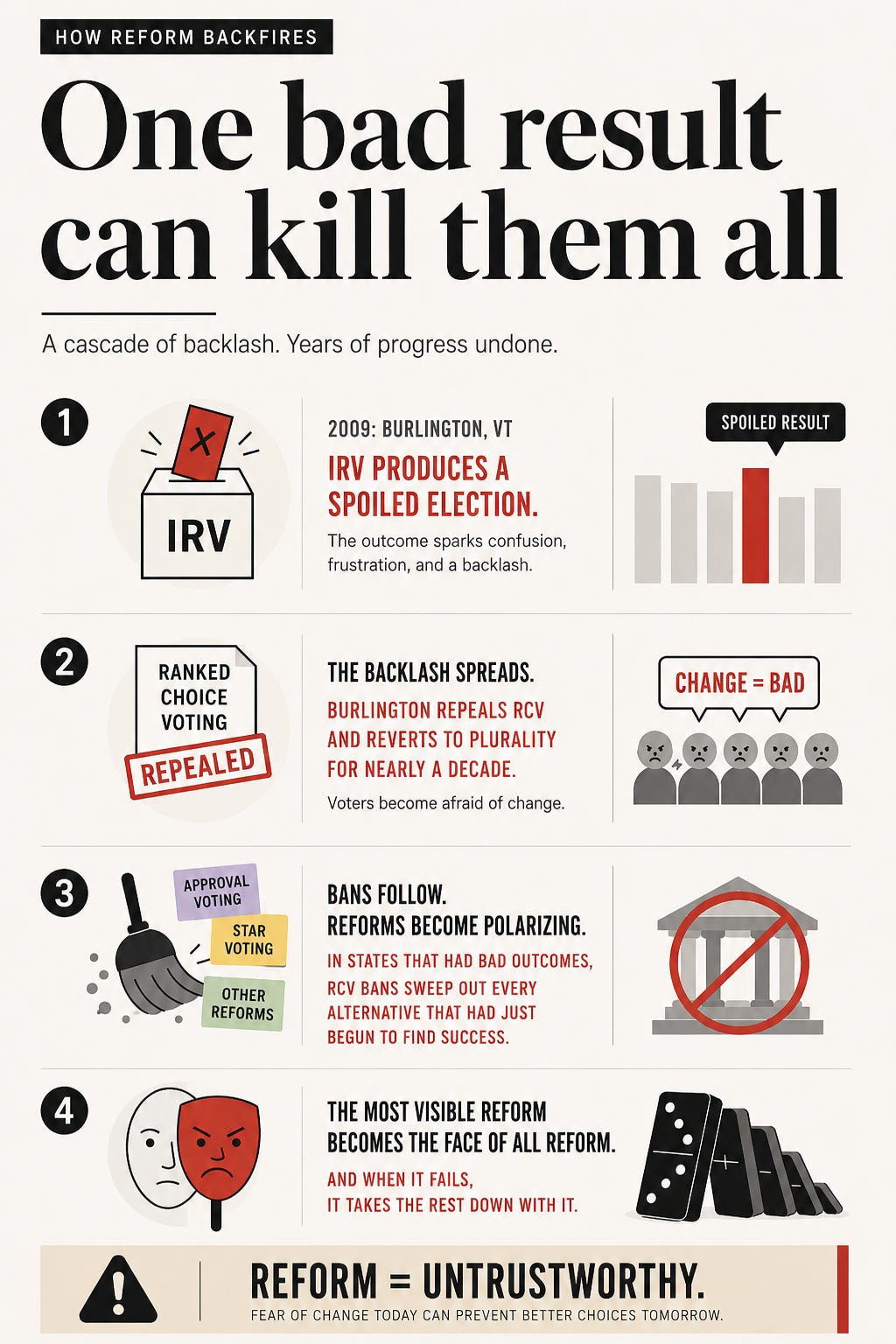
In Burlington 2009, Bob Kiss, a corrupt incumbent, won. Voters split between Andy Montroll and Kurt Wright. The split knocked Montroll out early. Montroll was the candidate most voters actually wanted. He came third.
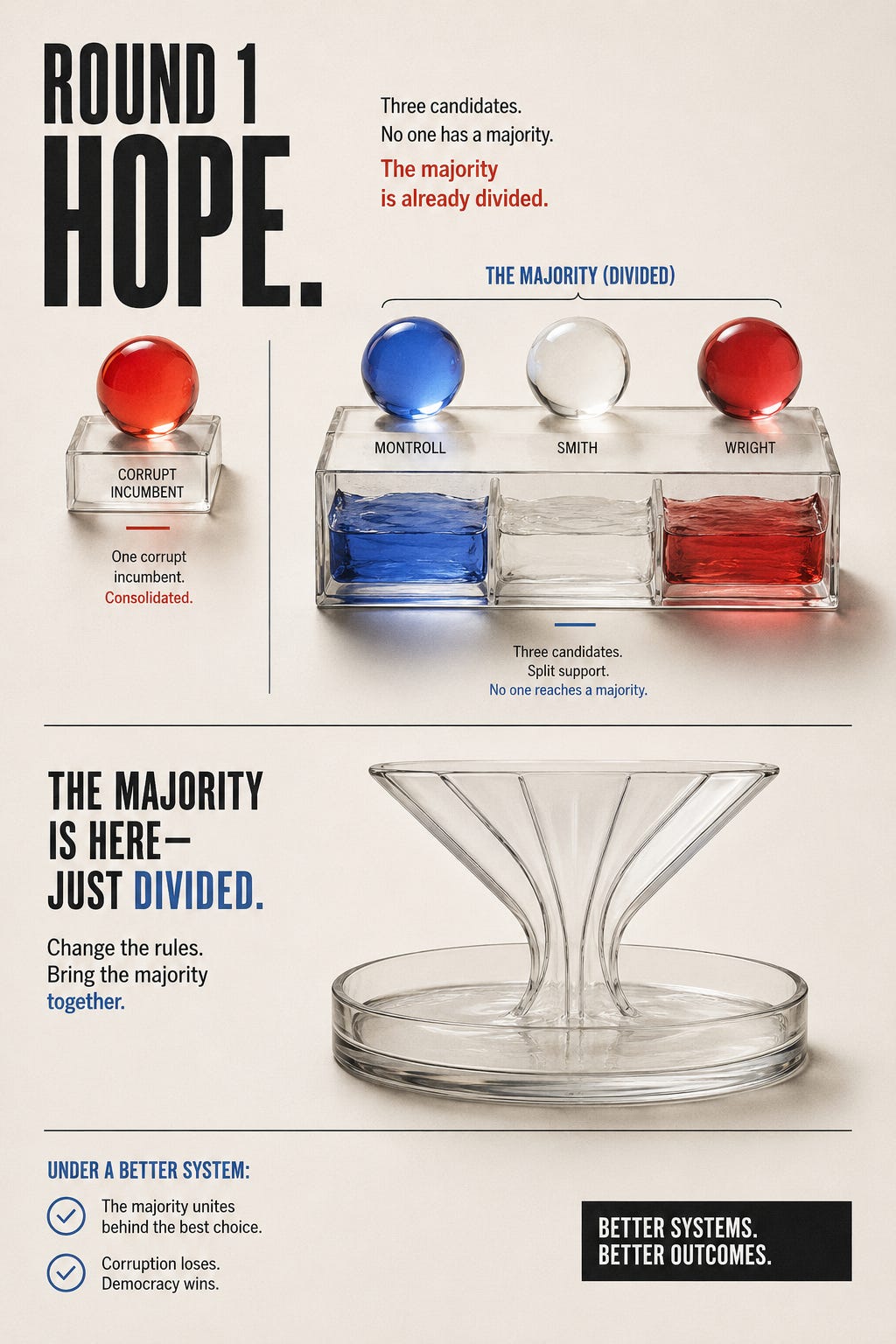
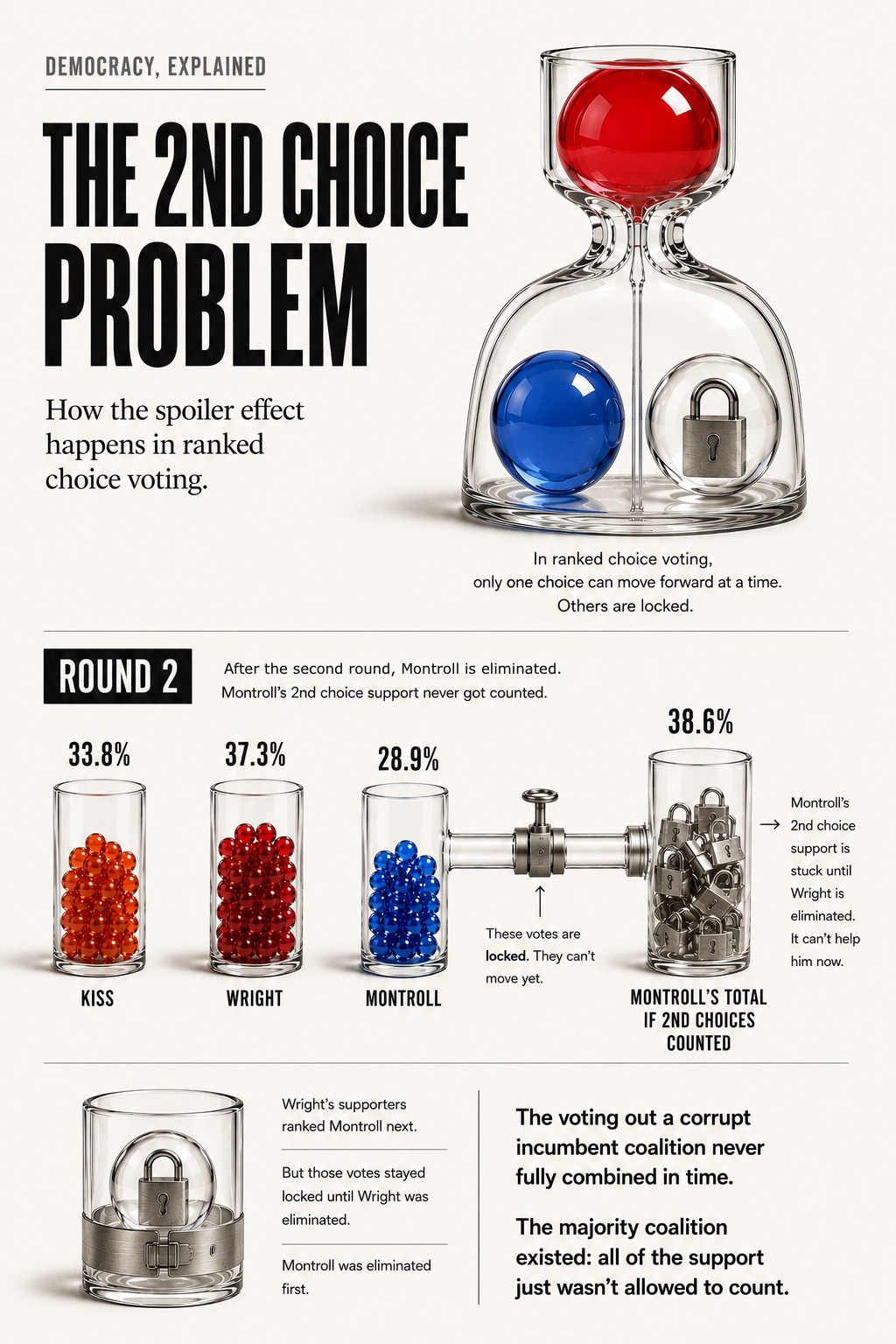

Burlington 2009 is the case study RCV advocates don't love to discuss. Wright entered, split the majority vote, and Montroll — the candidate who would have beaten Kiss head-to-head — was eliminated before he got the chance. His voters didn't go home to Wright. They went to Kiss. The plurality candidate won a ranked choice election. The method failed not because voters did something wrong, but because elimination order is fragile — and RCV's results depend on it entirely. STAR doesn't. The scoring phase surfaces broad support before anyone is eliminated. Montroll's preference to nearly everyone would have shown up in the scores. He would have made the runoff. He would have won.
Kiss had misused city funds resulting in lawsuits, ~$33M owed to Citibank, and a credit rating downgrade. His unpopularity wasn’t abstract, trust issues were real. People felt the outcome violated common sense. Backlash was so strong it killed the voting system. The election result was widely criticized. Burlington repealed ranked-choice voting in 2010.
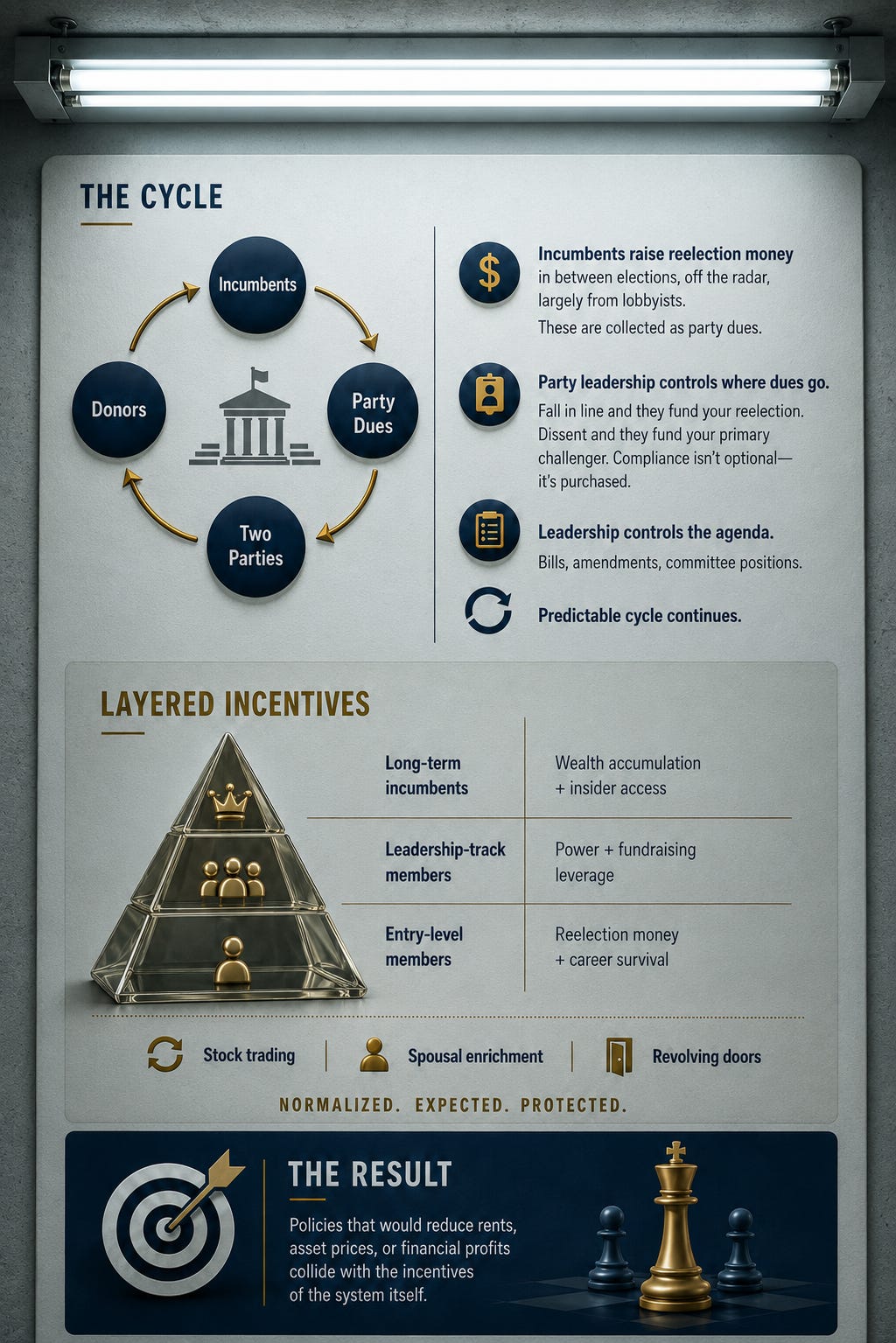
But here’s the deeper problem: these aren’t just individual election failures. Ranked choice voting’s center squeeze spoiler problem are the mechanism that maintains the existing two-party system and prevents anything from breaking through it.
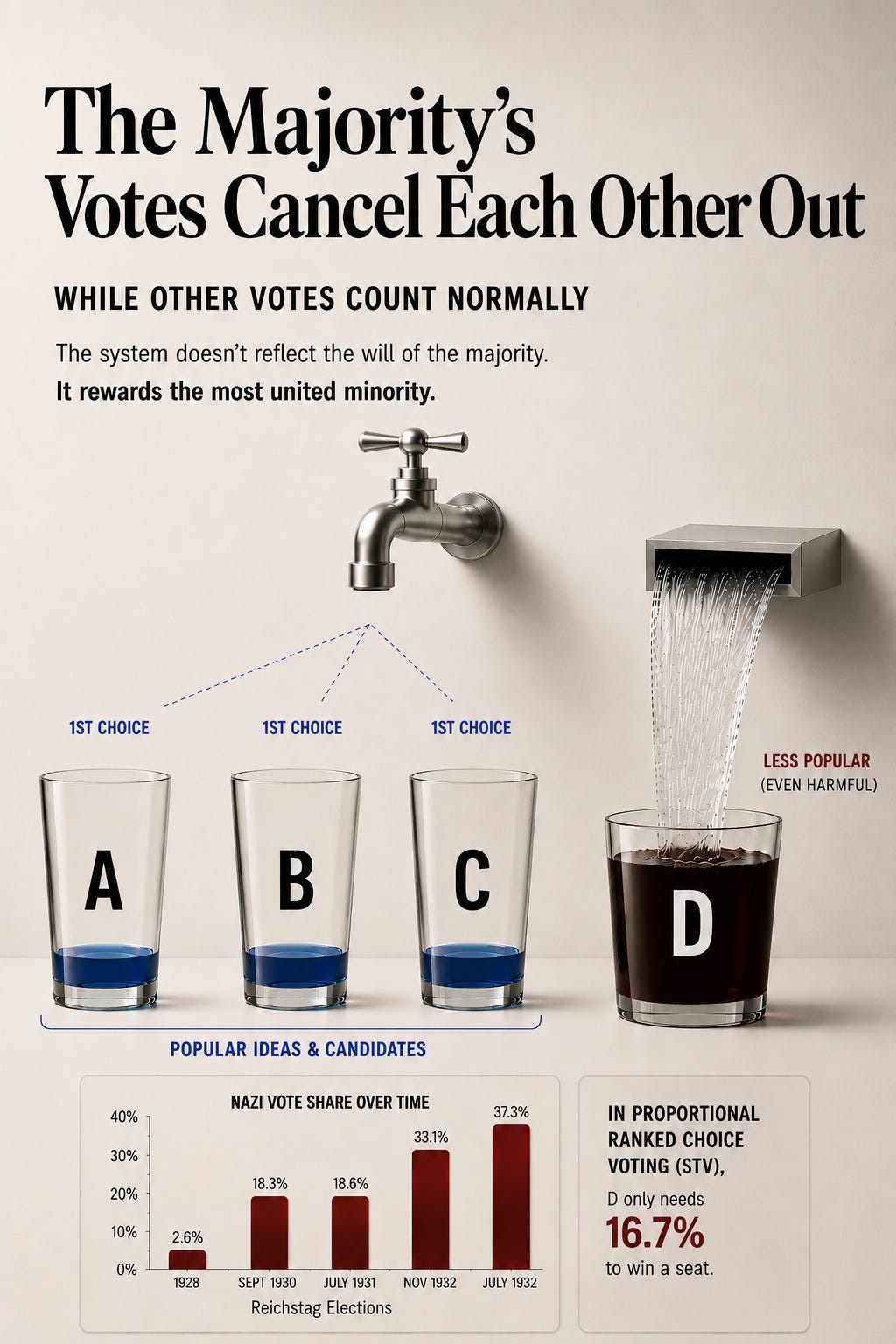
Bring up ranked choice voting’s duopoly problem and proportional ranked choice voting will almost always be the answer you get. But a system designed to broaden representation can also broaden it in the wrong direction — giving a foothold to harmful parties even when most voters, up to 83%, are united against them.
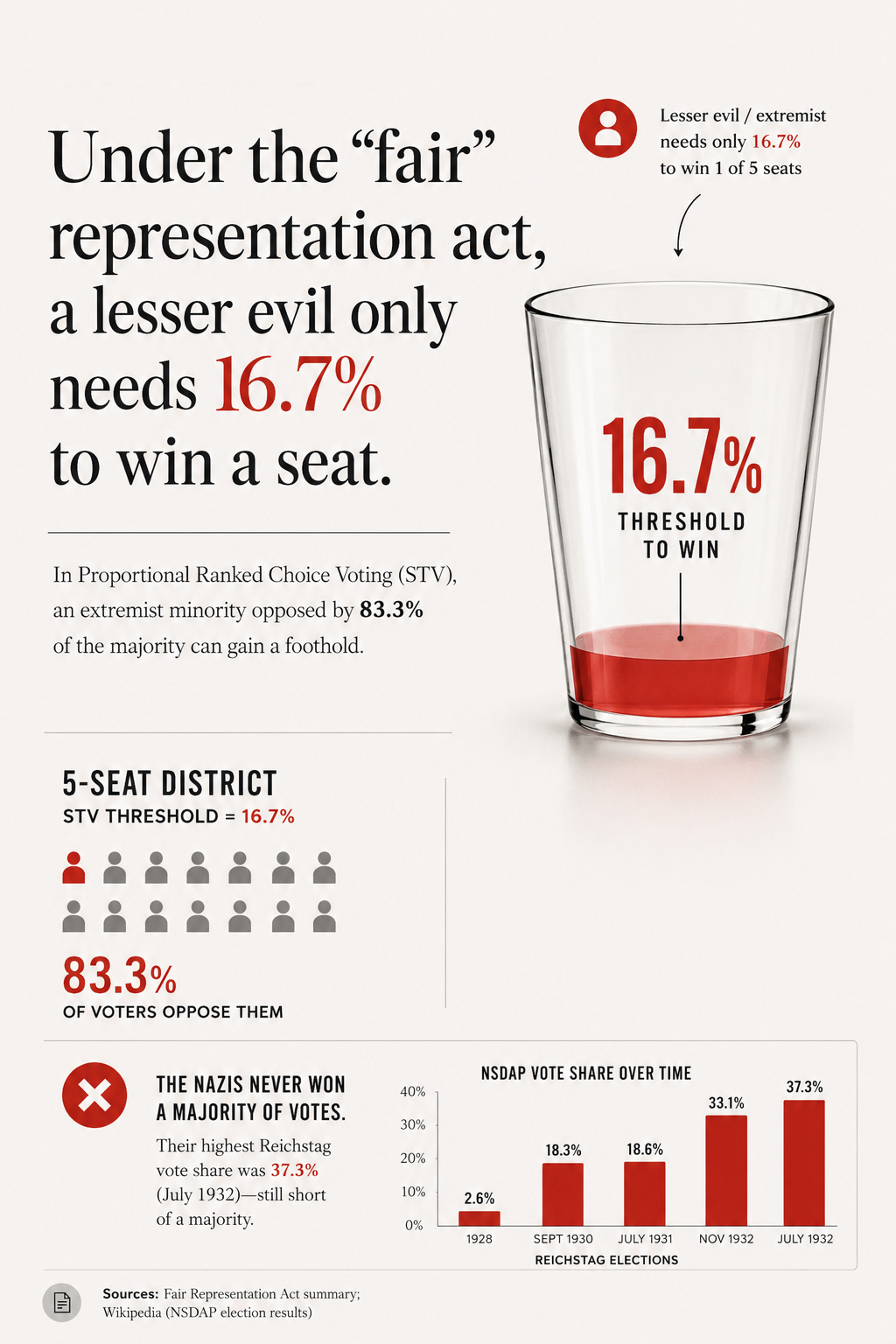
And here’s the thing: some aren’t trying to break the duopoly — they’re trying to gain leverage within it.
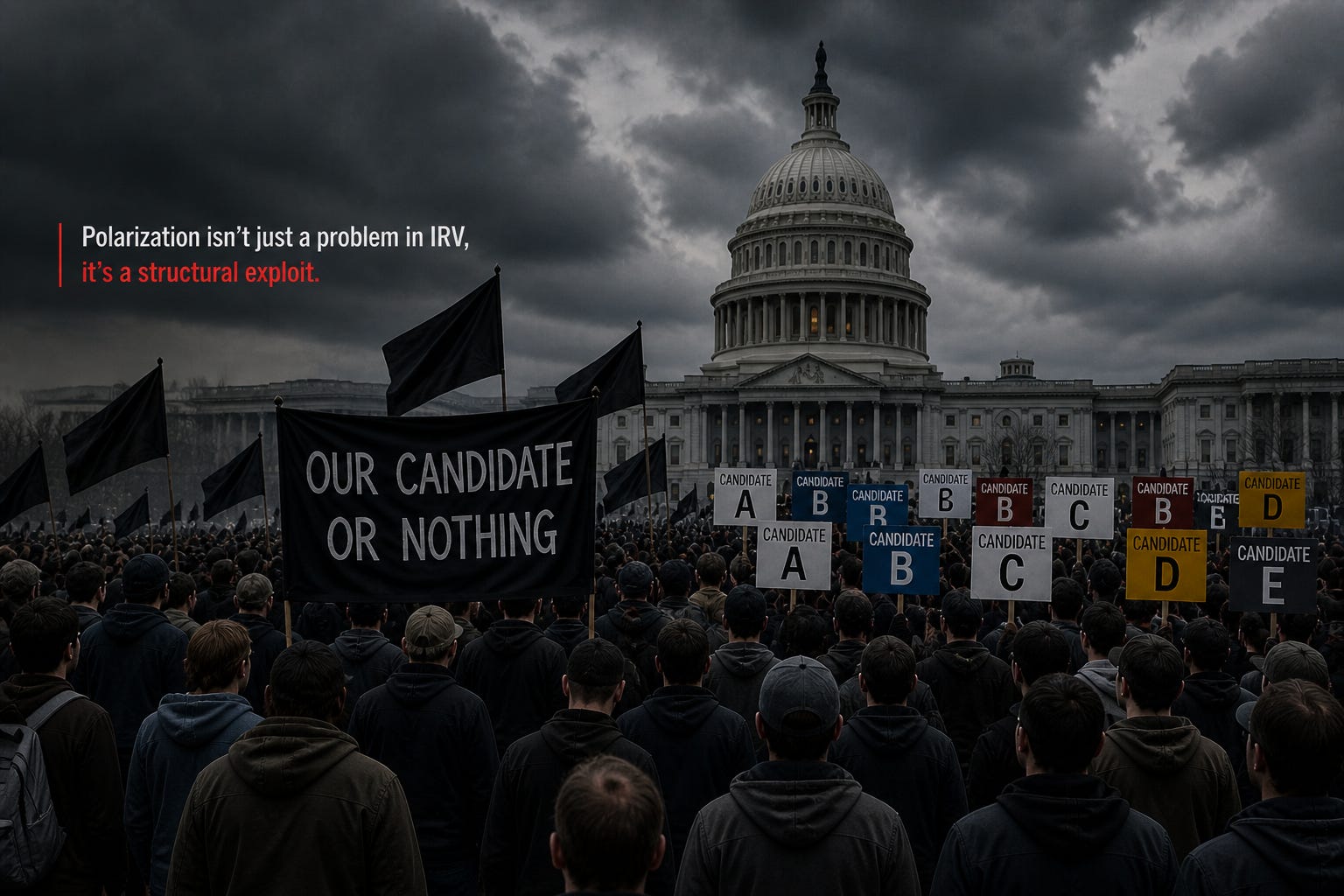
In IRV, polarization is a structural advantage. Everything downstream flows from whoever survives that first count. A radicalized bloc that ranks only their candidate and leaves everything else blank never splits, never transfers, and never dilutes. Their first-round count stays intact through every elimination. The broader the majority’s appeal, the more candidates represent them — and the more their votes scatter across those options in round one, while the radical bloc’s pile stays untouched.

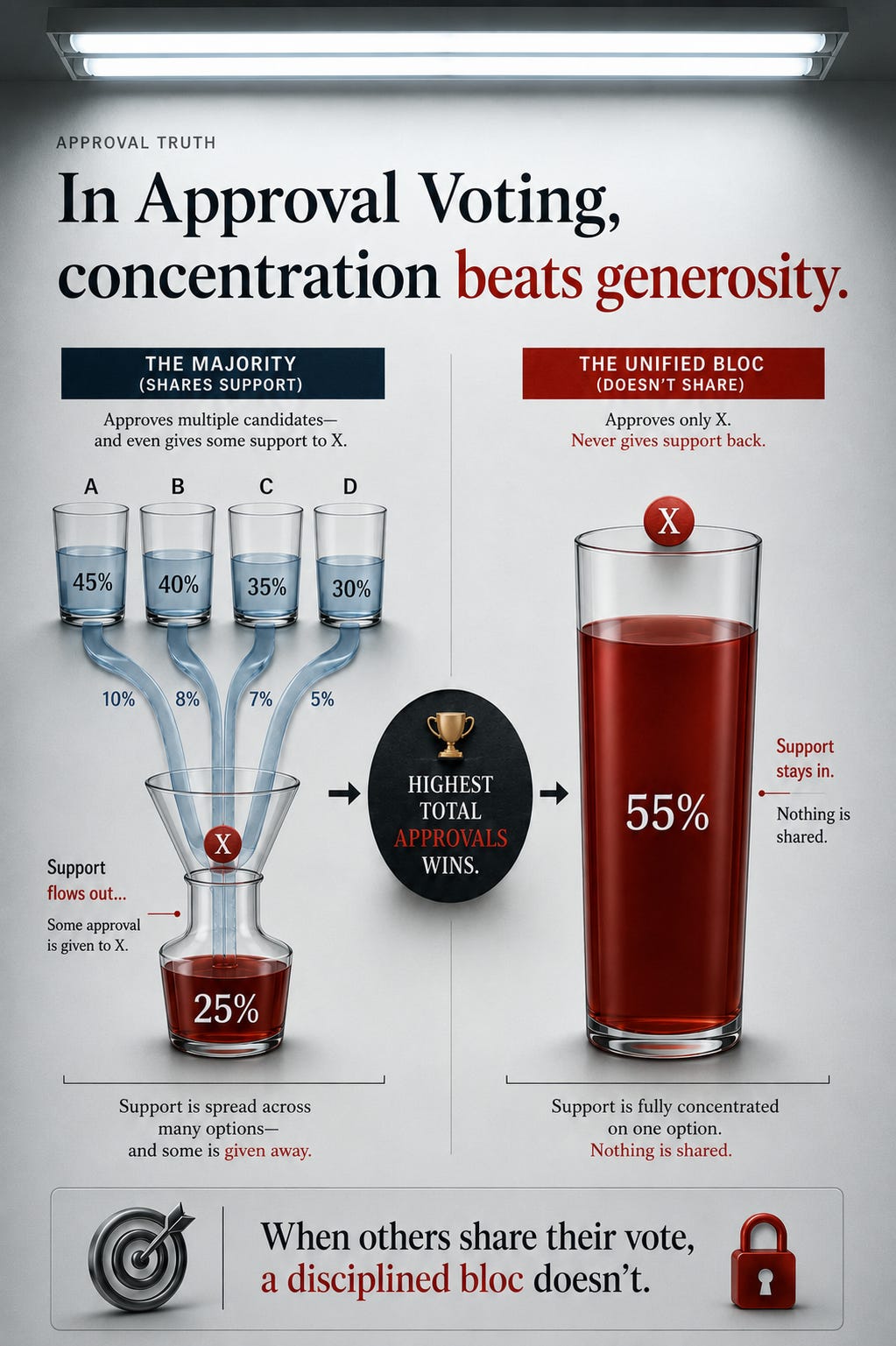
Approval — eliminates traditional vote splitting, introduces another kind
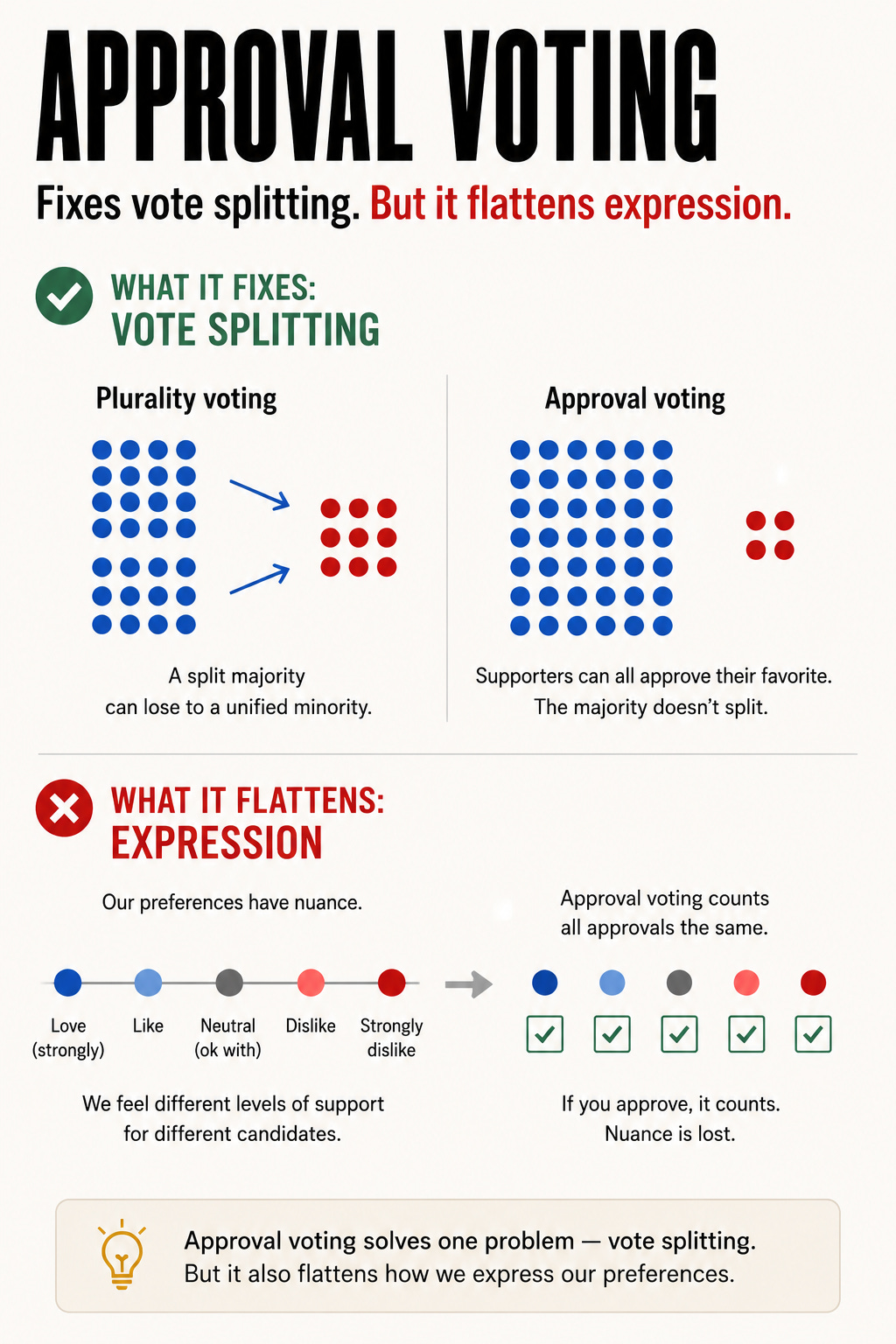
You can vote for as many candidates as you want. Whoever gets the most approvals wins.
This solves the spoiler problem — your favorite can’t be penalized just for running. But it replaces one trap with another. Instead of asking “should I abandon my favorite?” you’re now asking “can I afford not to approve this frontrunner?”
And that’s just the beginning. You still have to draw a line: who do I approve? Approval forces a yes-or-no on everyone. That sounds simple, but it means every voter is quietly making a strategic decision, whether they mean to or not. Approve too many and you’re helping your favorites’ competition. Approve too few and you risk irrelevance.
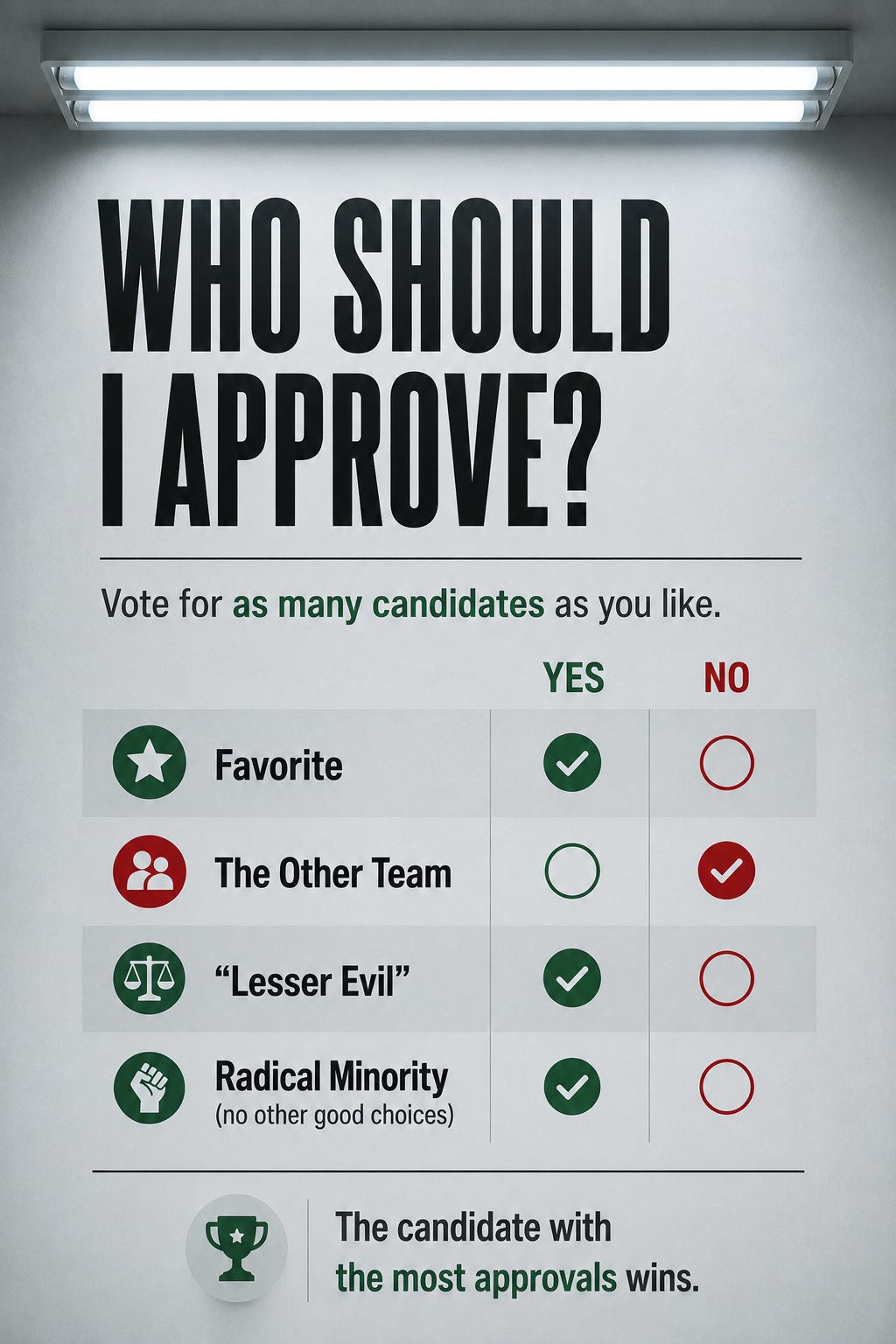
This is where binary expression starts to favor certain kinds of groups over others.
A passionate minority stacks all their approvals on one candidate. Radical ideology voters have faction coordination, ideological commitment, and asymmetric risk tolerance. They’ll be more disciplined, more willing to “play the game”, more aligned, more brazen because they feel like they don’t have a dog in the fight whether a Democrat or a Republican wins.
A broader majority spreads their approvals across several, including their desperate approval for the radical minority on their side of Left vs Right.
The minority’s pile is taller. The counting method rewards pile height, not coalition size.
You could call this a new kind of vote-splitting. Accurate support (more/less) is missing because expression is limited.
When you can only say yes or no, every yes has the same value as a barely acceptable polarizing one. The majority gets flattened into the same weight as an extreme faction.
The majority’s outweighing support for what could’ve been, is missing.
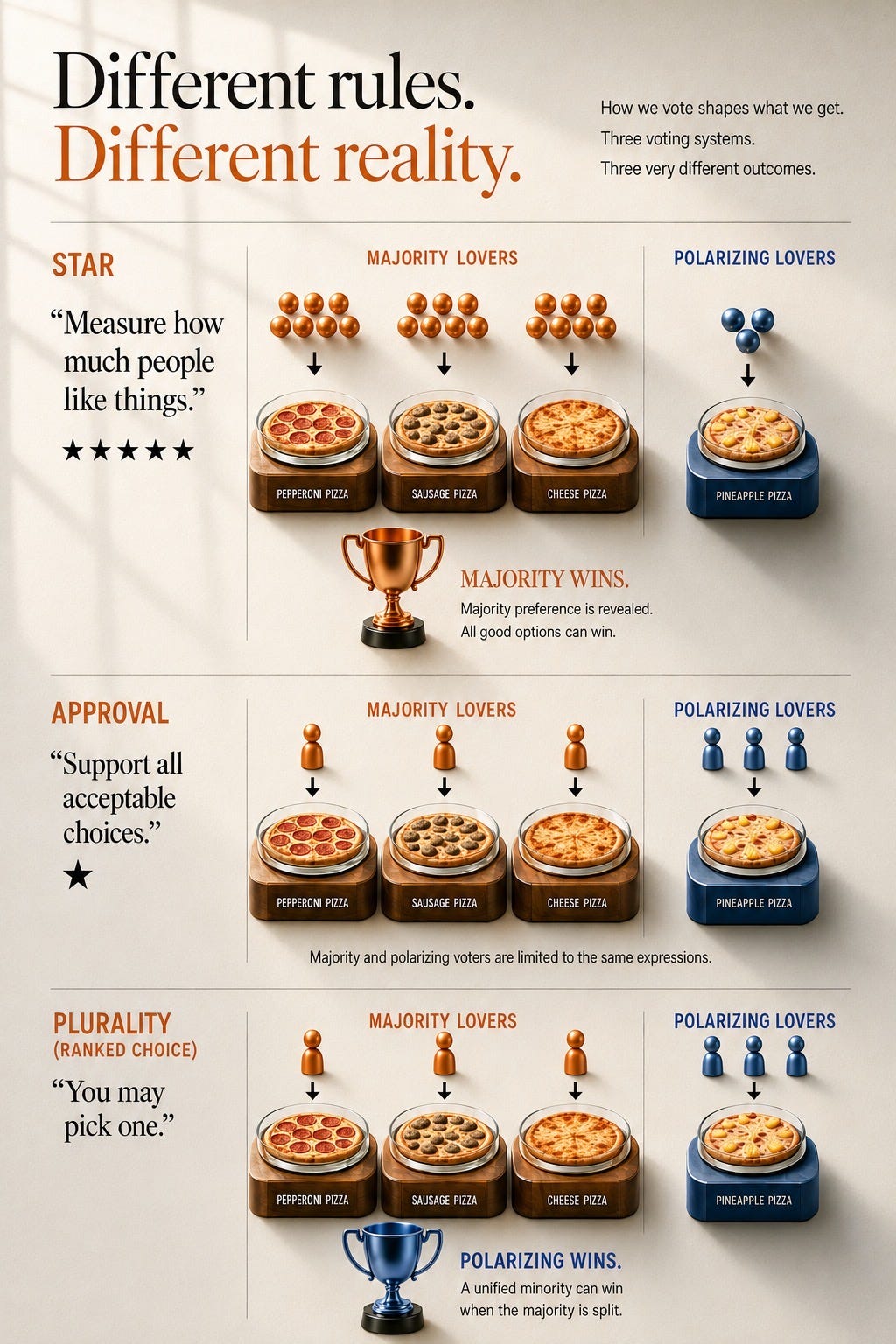
Approval is secretly doing this:
“Favorite” = 1
“Lesser Evil” = 1
“Barely acceptable/polarizing” = 1
Those are very different signals being treated as identical.
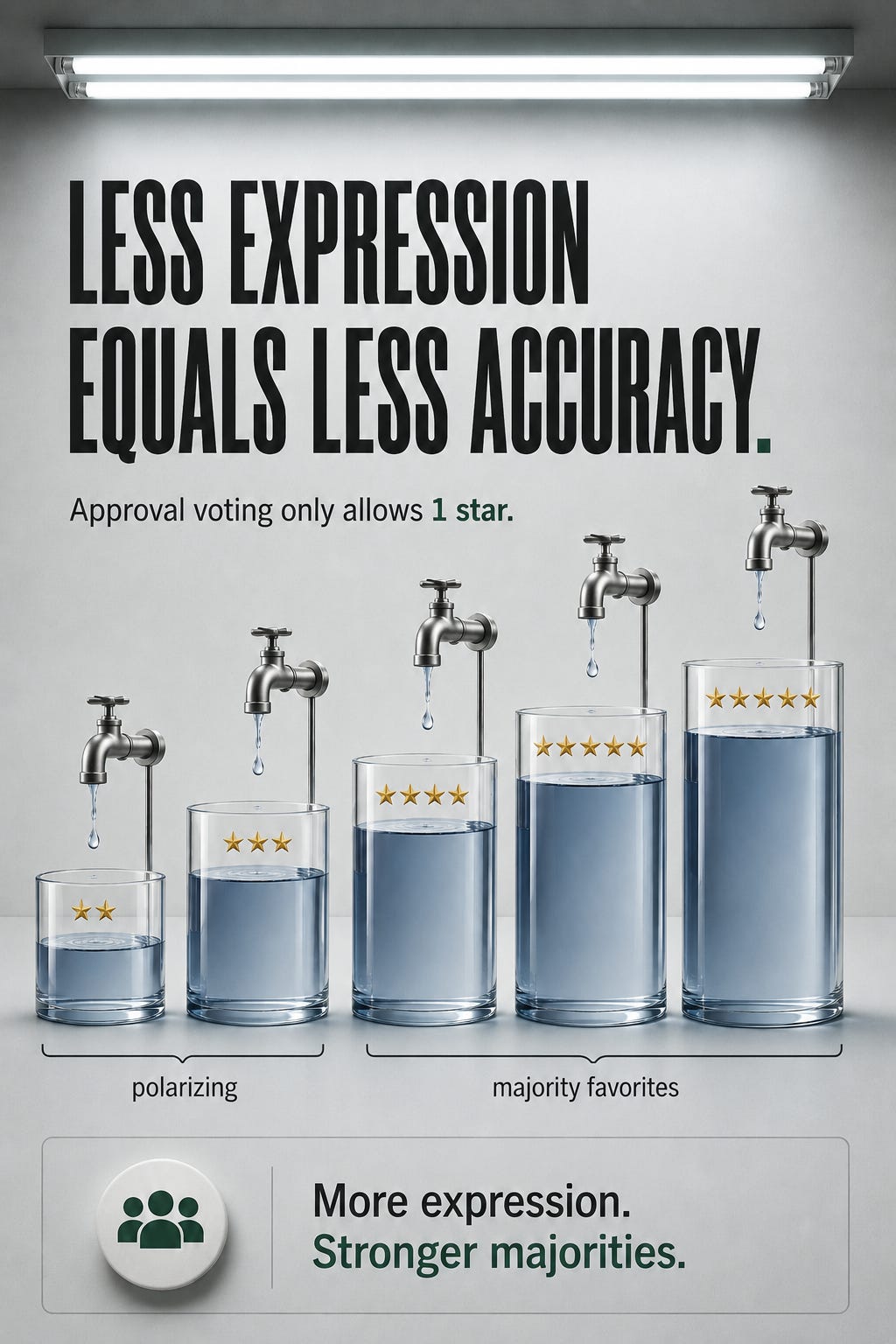
So what happens?
Broad coalitions lose their counter-correction to strategic minorities
Tight coalitions keep their full signal strength
That asymmetry creates a quiet distortion. Approval can inflate support for fringe candidates — not because people love them, but because a yes-or-no doesn’t let you say how reluctantly you’re saying yes. If you’re trapped choosing between two corrupt establishment parties, one that wants to eliminate government entirely, and one that wants to switch markets to something ideological, approval forces you to either swallow hard and approve something that mixes majority issues with radical agendas, or stay pure and lose influence entirely. Your desperation and your enthusiasm look identical on the ballot.
Nuanced preferences are very important.
Extreme groups win in simple systems.
Broader groups win in expressive systems.
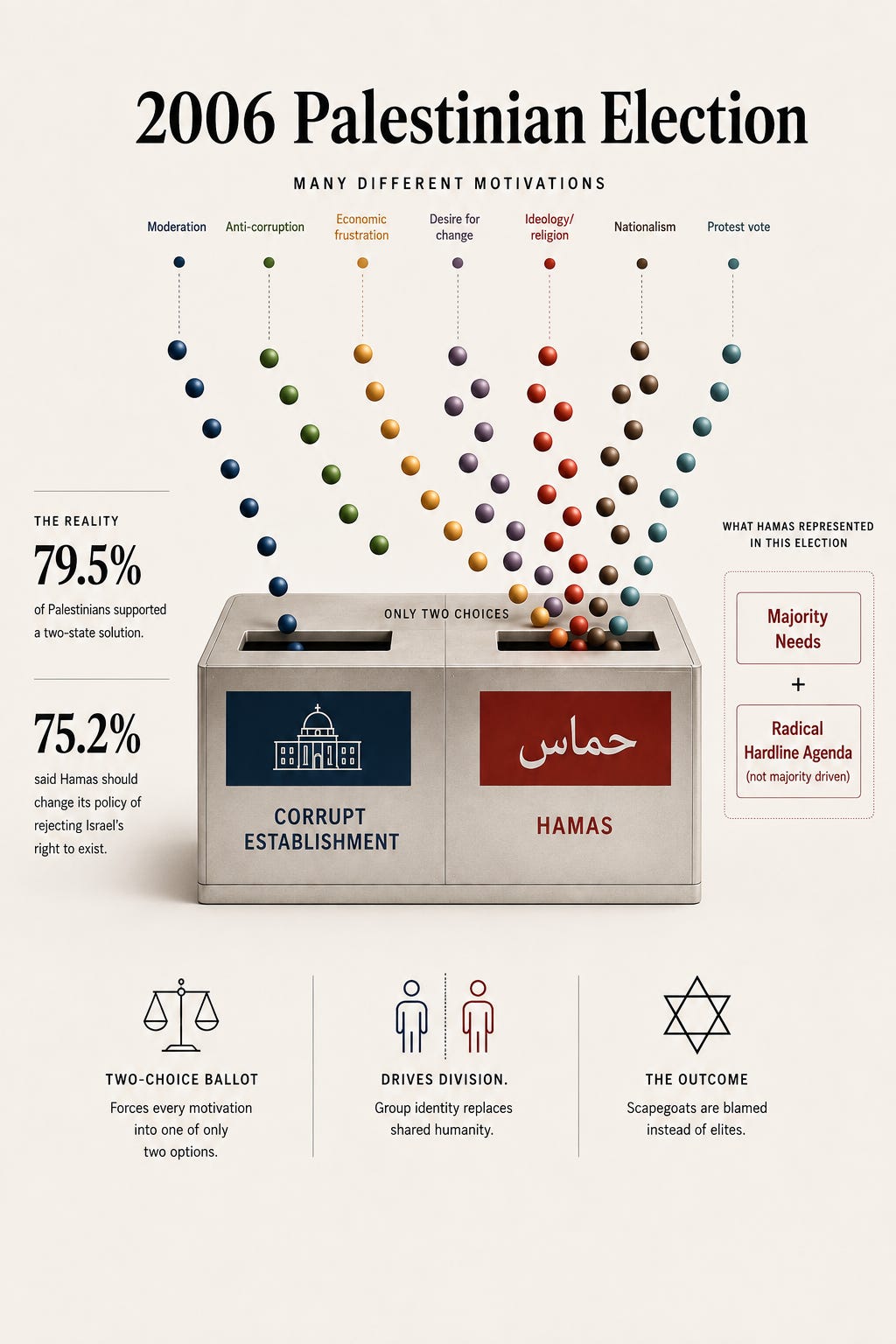
World Peace Isn't That Polarizing, Actually.

Chapter 1: We Exported Plurality Voting To Palestinian Elections. It Elected Hamas. We Still Use It Here. Connect The Dots.
Even 10–20% coordinated voters can tilt results especially when the majority is polarized or without great options, and minority is aligned.
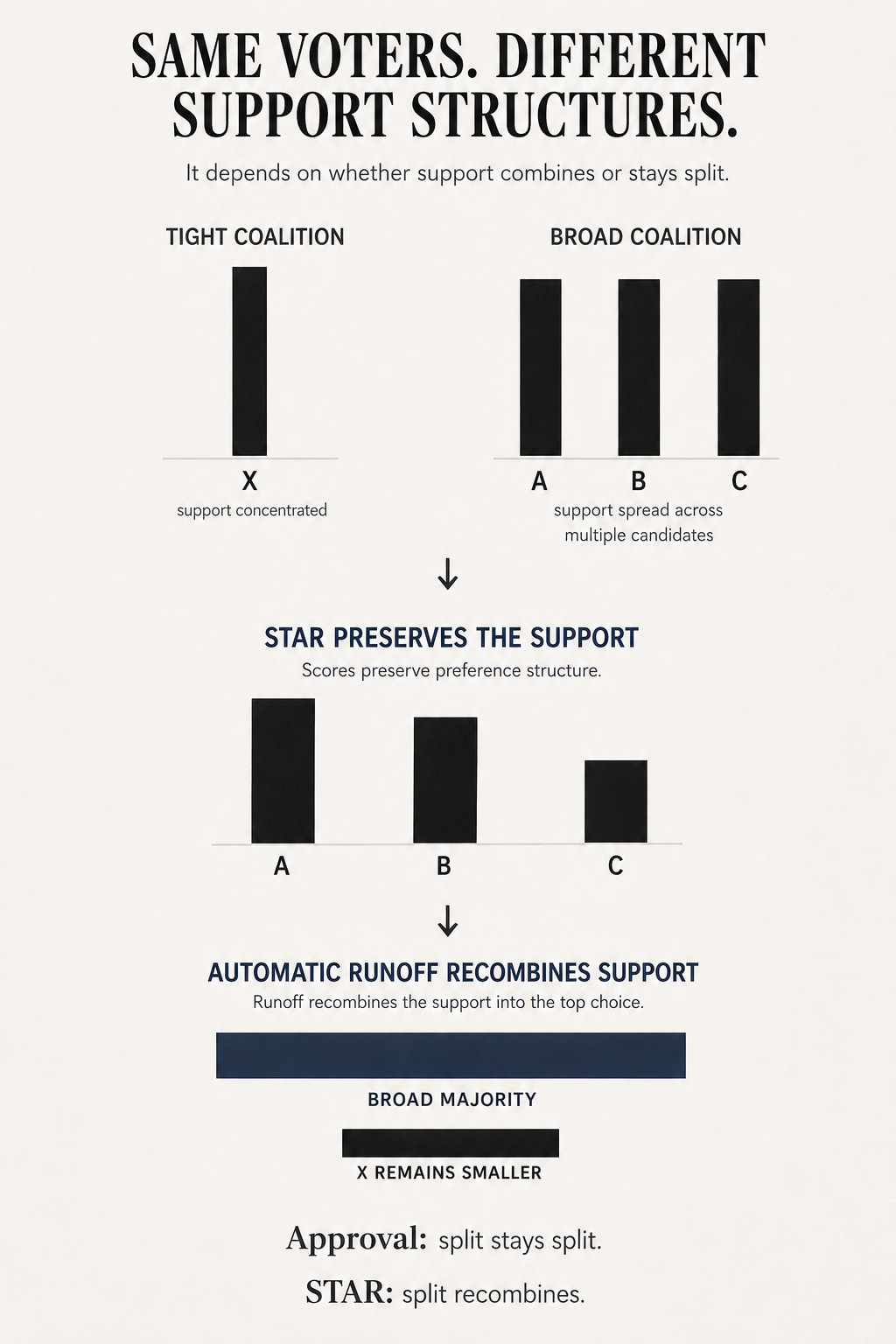
Approval voting rewards the loudest pile, not the biggest coalition. A majority can lose to an organized minority — and a majority party that hasn't formed yet never finds out it could have.
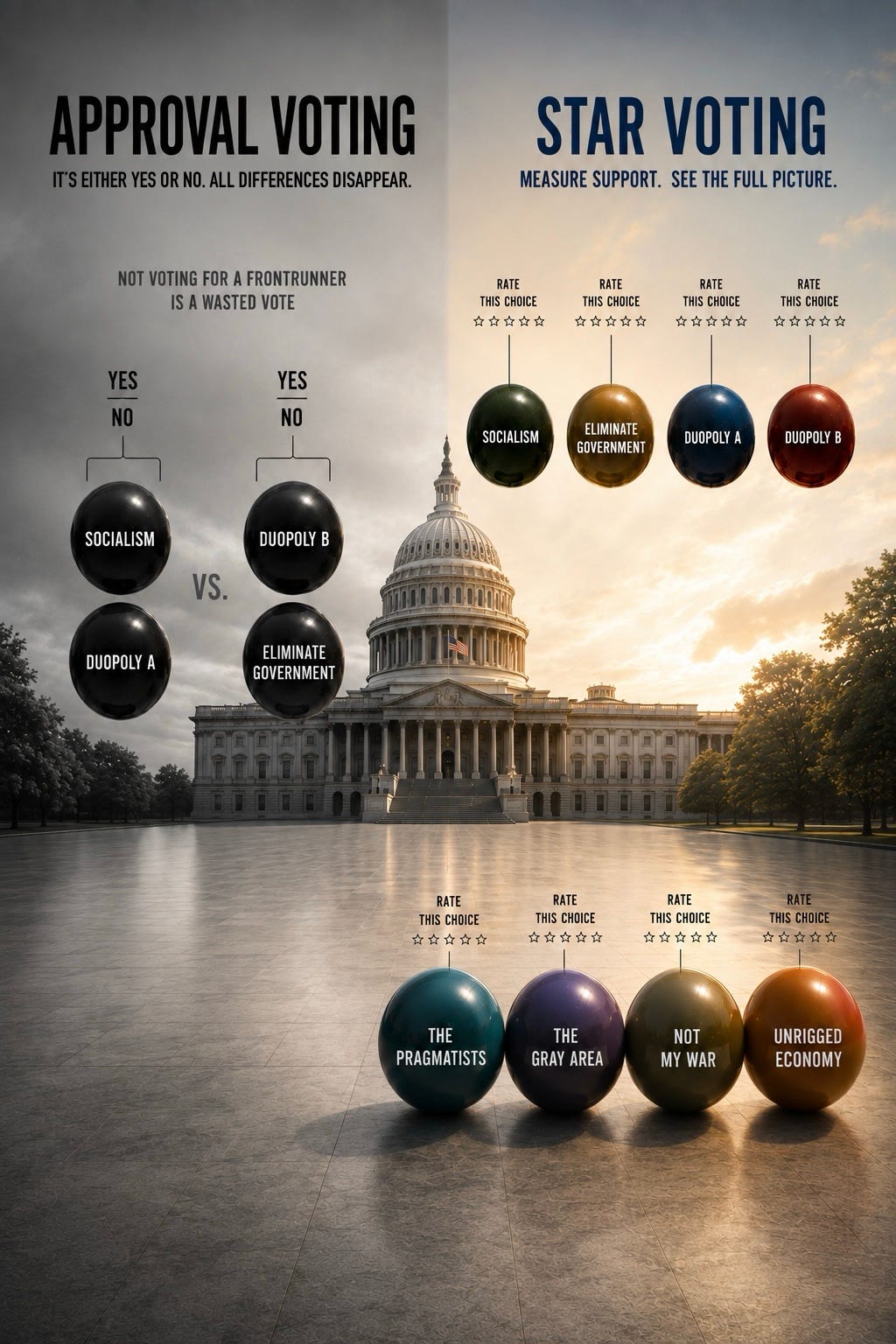
The limitation of Approval voting is that yes is still just yes. When a system can only say yes or no, it stops measuring preference and starts measuring tolerance. A vote that can only say 'less bad' will never produce 'good. That missing information matters most when the field is competitive and the differences between candidates are real — which points toward systems that let you say not just who you approve, but how much.
STAR — best for the exhausted majority
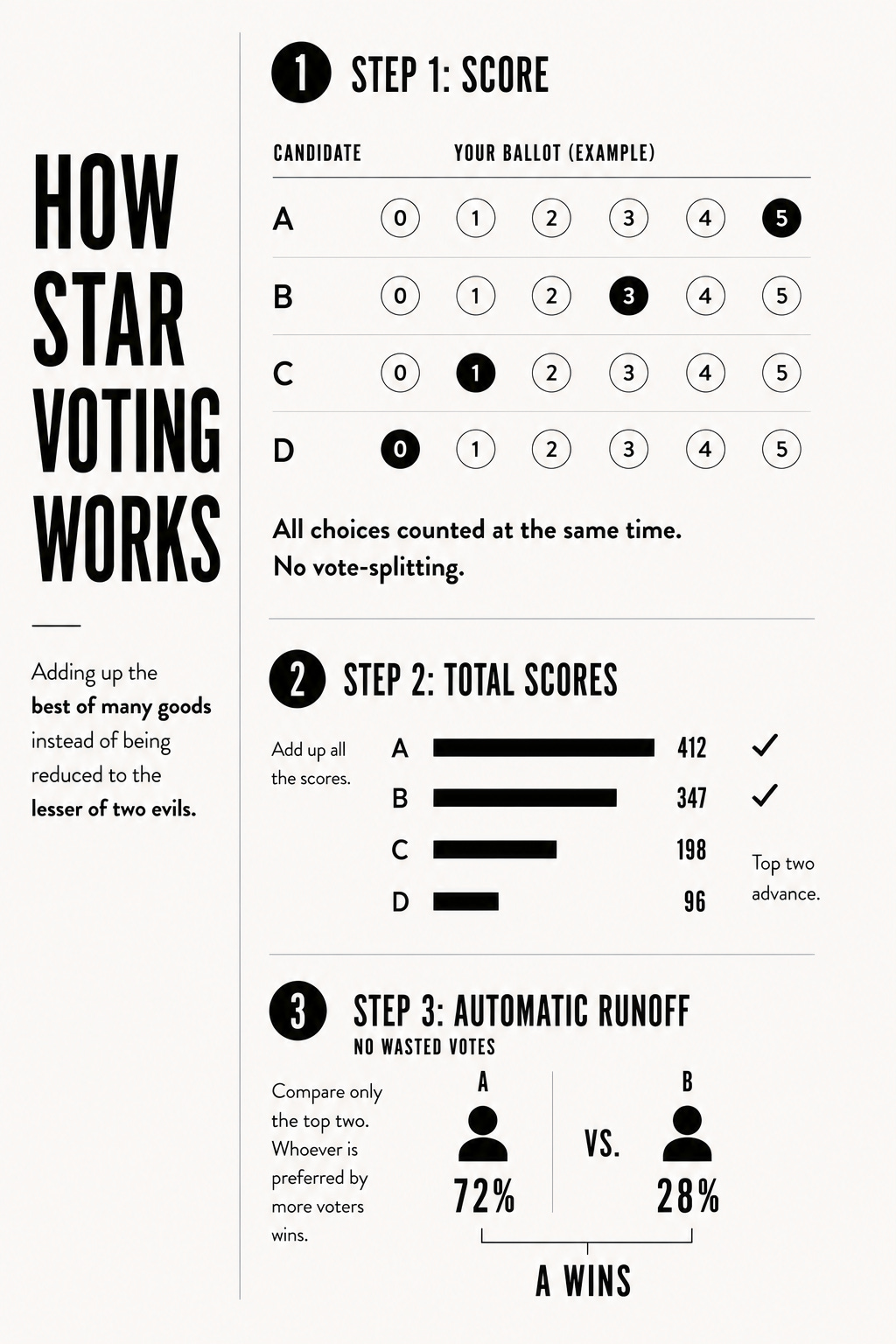
You score every candidate from zero to five. The two highest scorers go to a final runoff. In the runoff, every ballot counts as one vote for whichever of the two that voter scored higher.
This captures more information than any system making it the most accurate. You can give two candidates the same score if you like them equally. You can show intensity — a five means something different than a three. And because voters can score multiple candidates highly, similar candidates don’t split support. They both accumulate it.
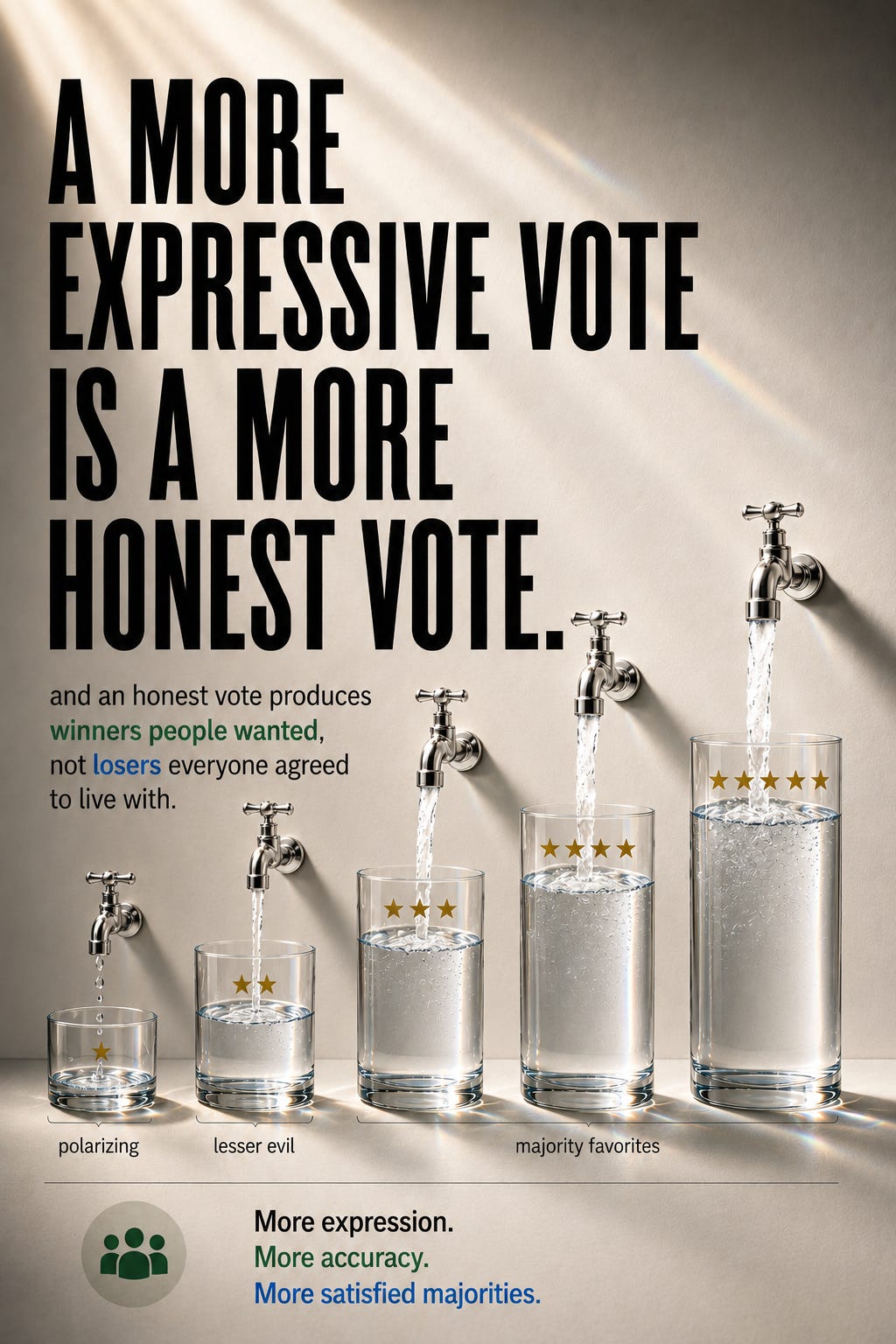
Give voters more ways to express themselves and you get a result that makes most people genuinely happy, instead of a result that makes everyone equally unhappy.

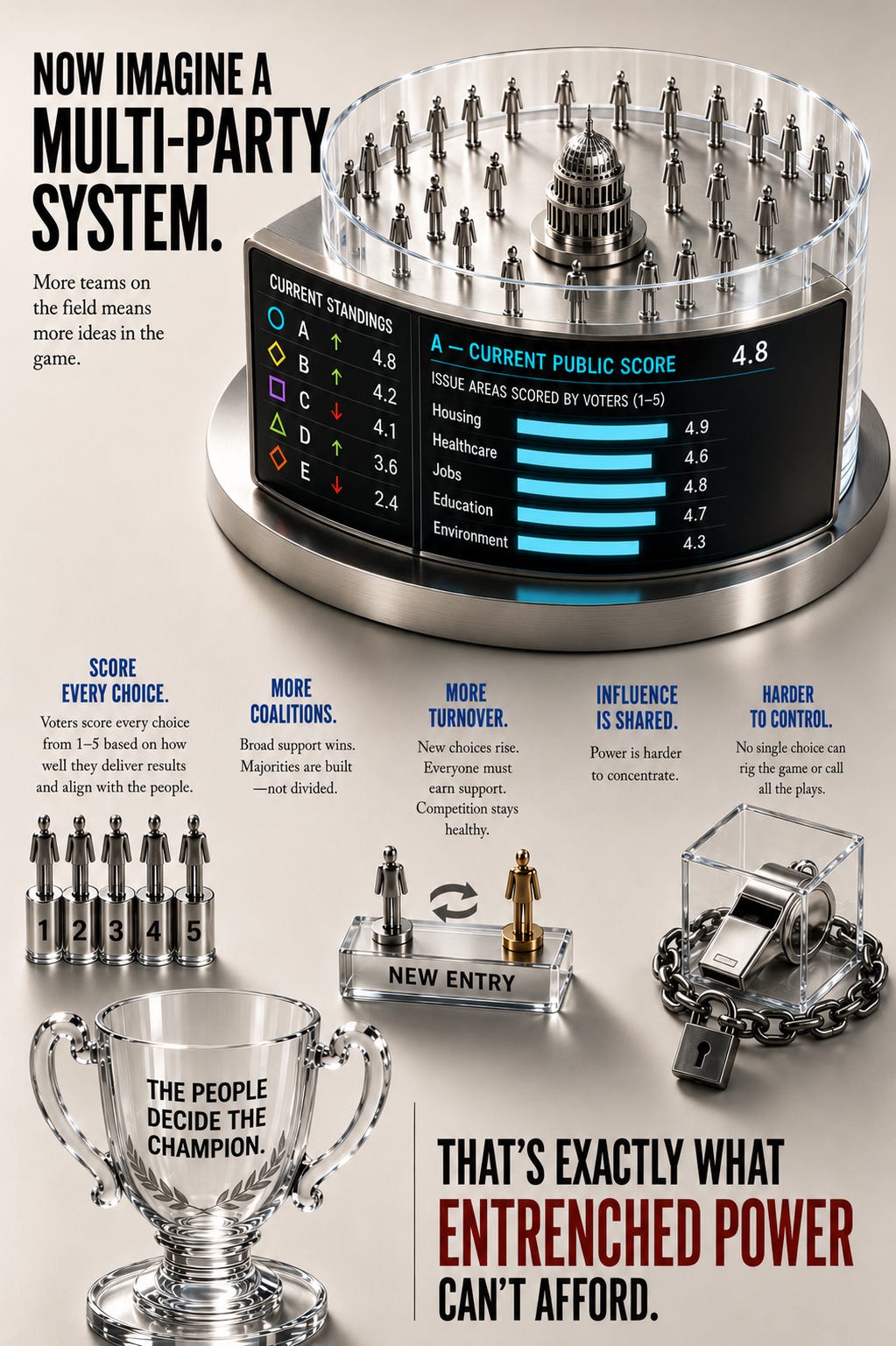
The runoff creates a powerful incentive toward honesty. Because you don’t know in advance which two candidates will make the final round, you want your scores to reflect your real preferences across the whole field — that way you have a meaningful say in any possible matchup.
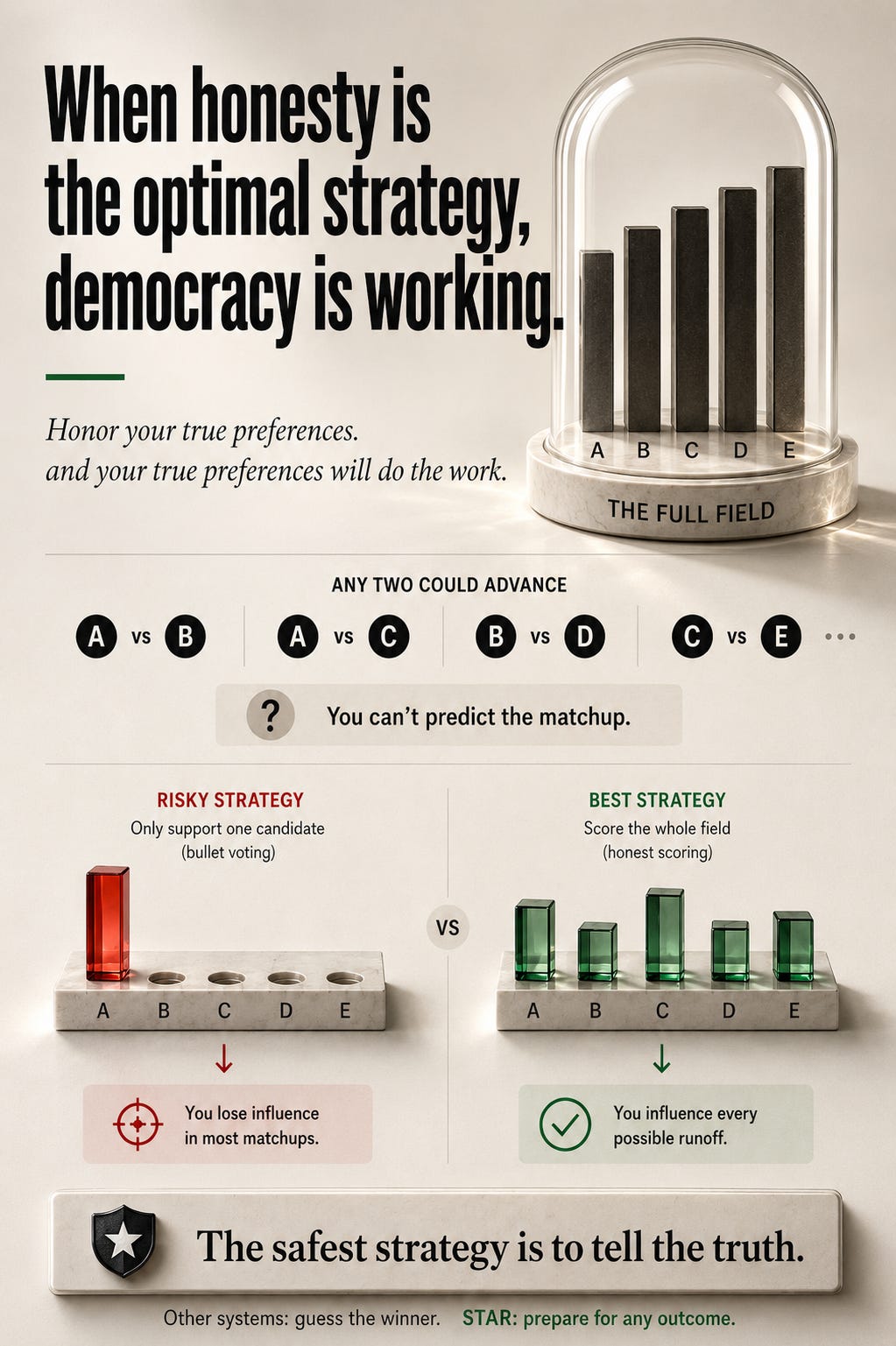
STAR discourages the two habits that make elections exhausting — worshipping a single candidate and in-fighting against everyone else. Both strategies backfire. STAR quietly punishes in-fighting and rewards voters — and candidates — who took the whole field seriously.
The minority stacking strategy is self-limiting once the field gets competitive. If you vote only your polarizing choice and it loses, you’ve had zero say in the outcome. The more viable candidates there are, the more dangerous it becomes to vote too narrowly.
Even with noise, consensus still shows up because the majority’s high scores can always outnumber the minorities’ high scores.

In most systems, voting your conscience and voting strategically pull in opposite directions.

In STAR they point the same way — what you actually feel is also your best move. In STAR, the safest thing you can do is just tell the truth. Finally, your heart and your strategy agree. Vote how you actually feel — and for once, that's enough.


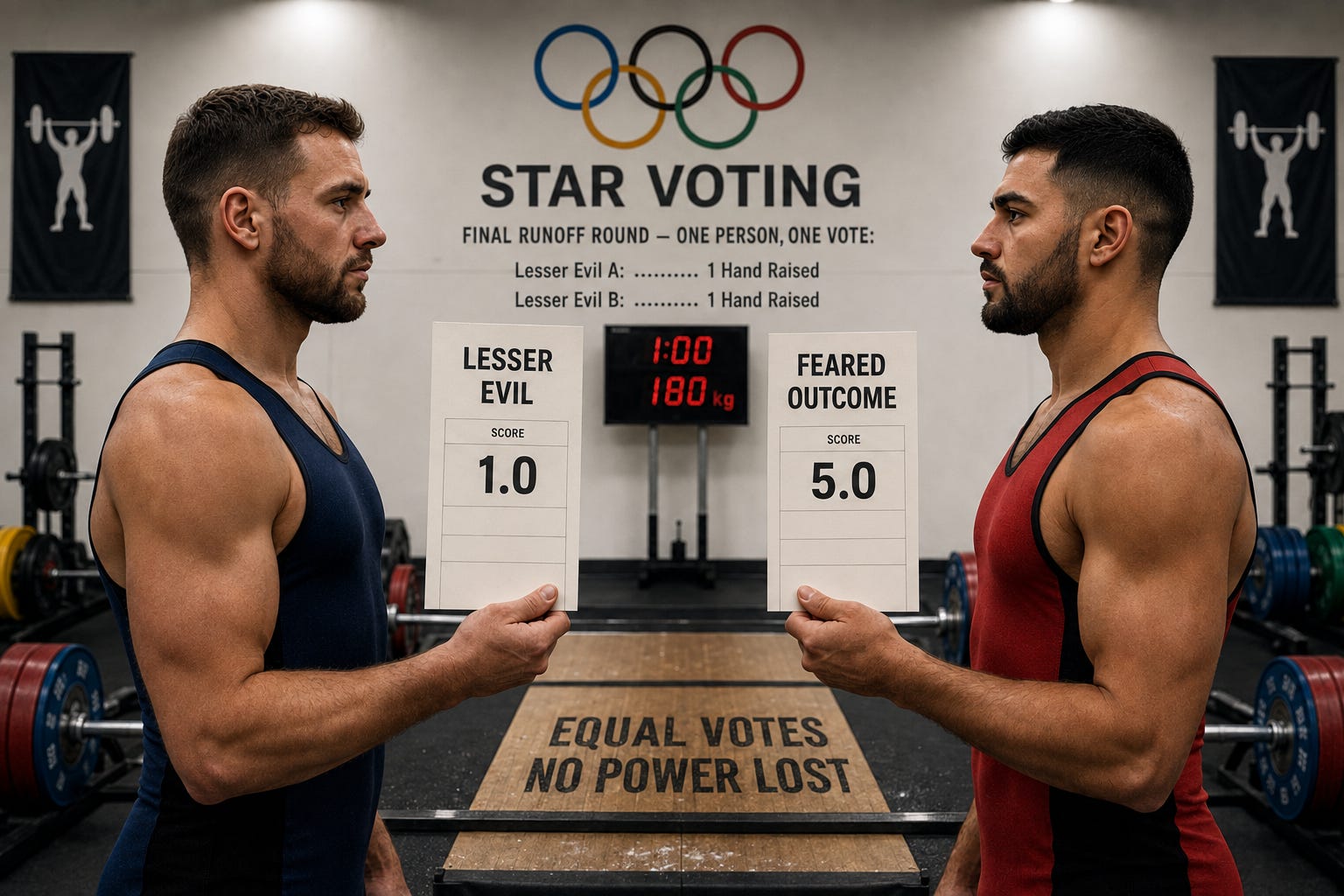
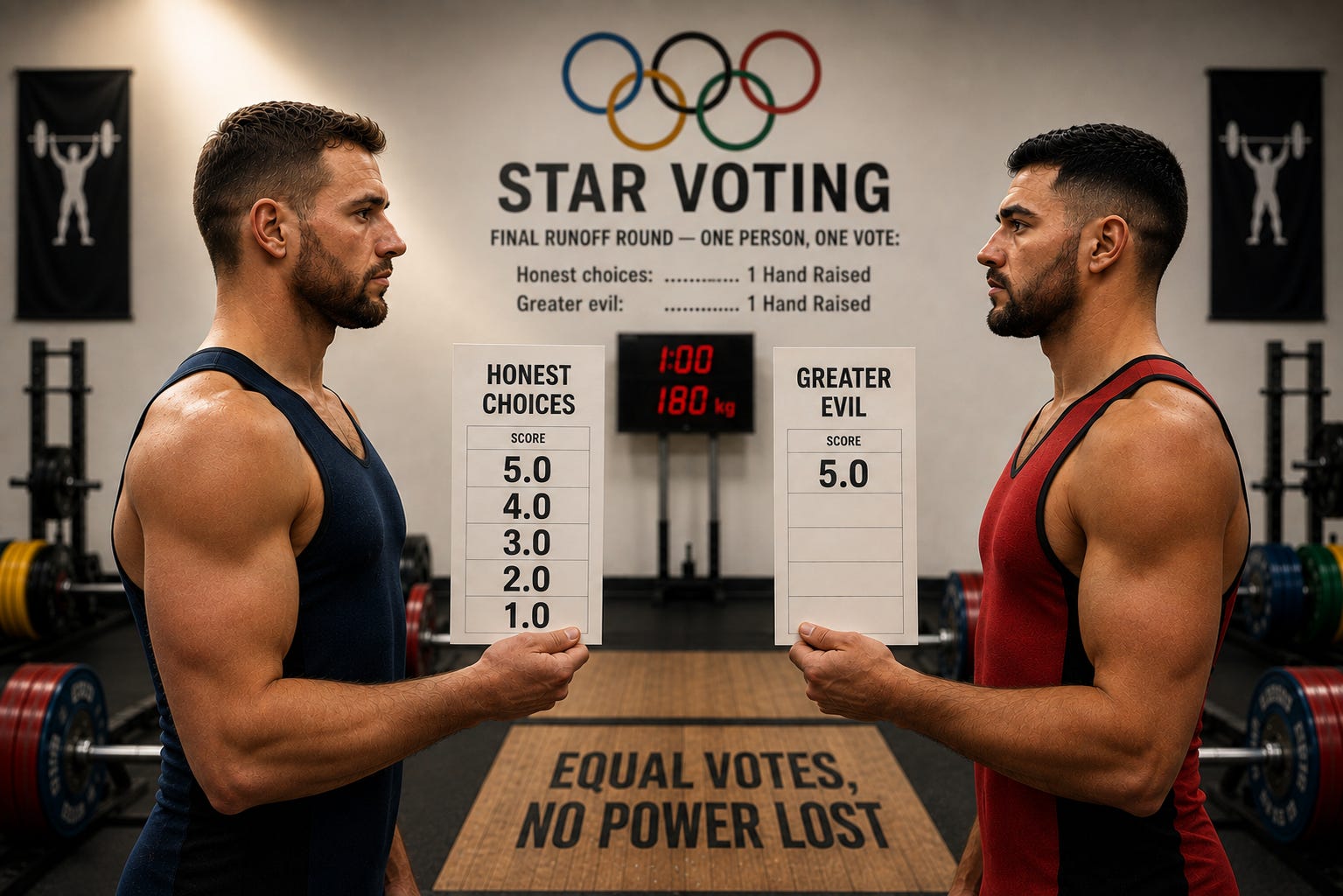
5 for your favorite. 1 for the lesser evil. Safe, either way — your runoff vote counts the same as theirs.
Equal votes, no power lost — and the financial advantage multi-million-dollar campaigns count on disappears. ‘Vote for whoever’s best funded to beat the enemy’ only works when your vote has to go all-in on one basket. STAR ends that.
STAR voting neutralizes the funding and ‘electability’ effect. No more fear of wasting your vote. No more money deciding who’s ‘viable’ before a single ballot is cast. It helps better candidates win.
Change the system. Break the cycle.
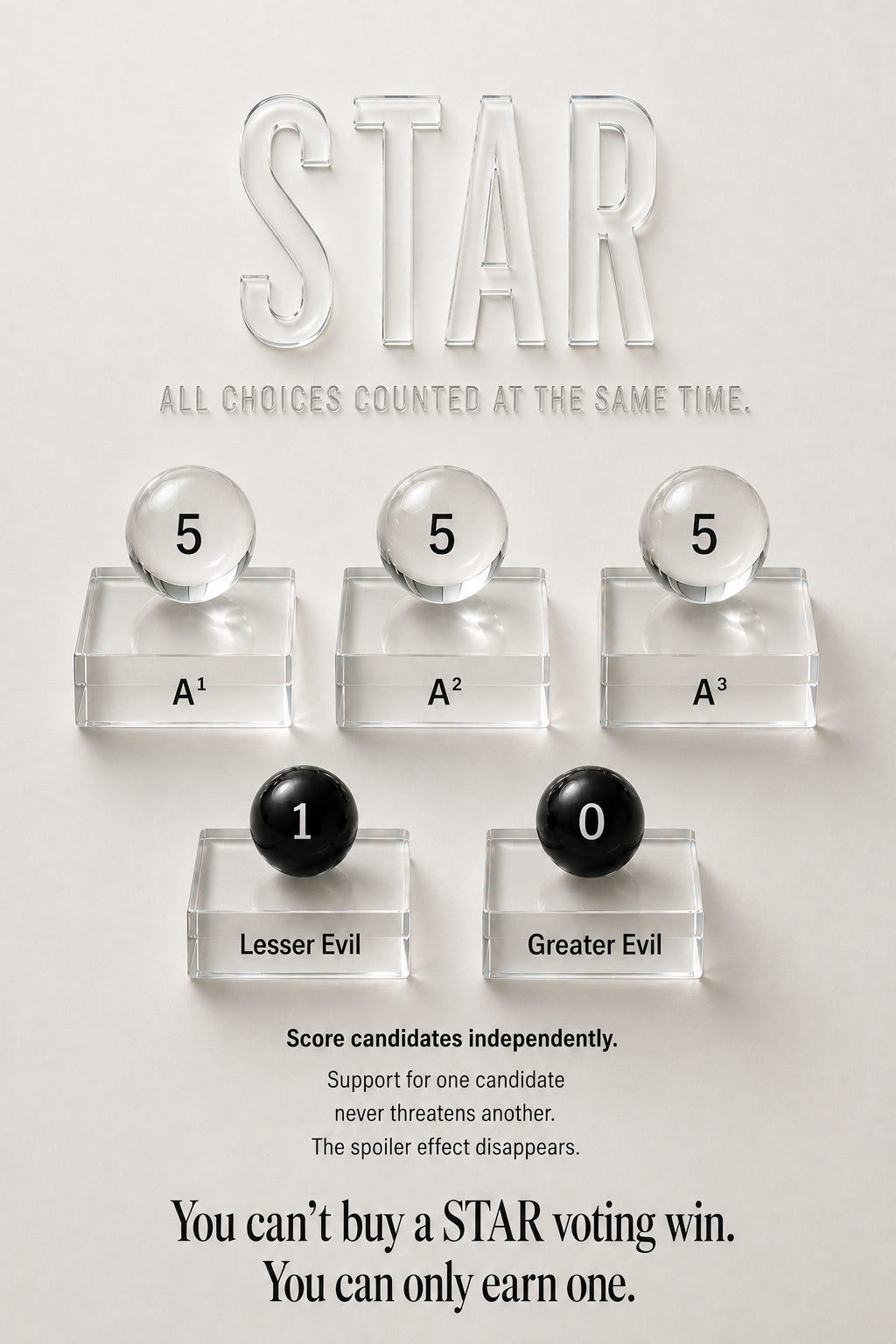
Condorcet — Knows who you prefer. Has no idea how much. The winner isn’t the most loved — it’s the least rejected. Which is another way of saying the candidate nobody chose.
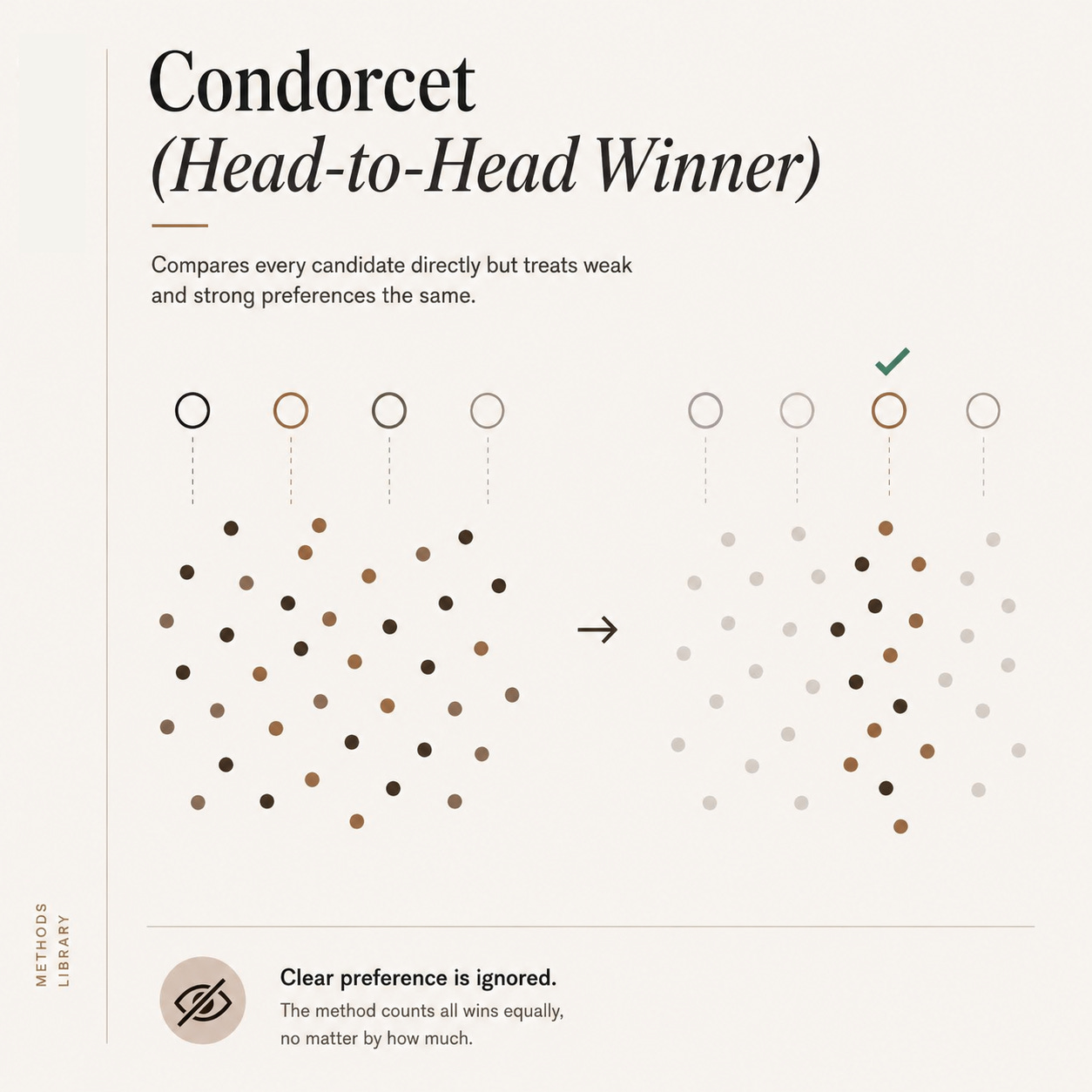
It beats center squeeze and replaces it with center beige. Technically undefeated. Never actually wanted.
Every candidate faces each other one-on-one. The winner is whoever wins the most head-to-head matchups. No vote-splitting, no center squeeze, and strategic voting is largely disincentivized — all your rankings matter in every matchup.
But Condorcet only reads the order of your preferences, not their intensity. It treats margin as noise.
Consider two candidates:
Candidate A — the platitude candidate. Barely beats everyone. Never excites anyone. Rarely receives a top ranking. Almost nobody hates them.
Candidate B — the reform candidate. Inspires enormous enthusiasm from many voters. Faces real opposition from others. Loses a few head-to-head contests — narrowly.
Under Condorcet, A wins. A is considered the most legitimate winner regardless of margin, enthusiasm, or how close those contests actually were. A win by 1 vote counts the same as a win by 1,000. A loss by 1 vote counts the same as a loss by 1,000 — and B gets nothing for it.
No intensity carries over. No narrow losses are nuanced. The information simply disappears.
A score-based system would ask a different question: are A’s razor-thin victories really more meaningful than B’s much stronger overall support profile? A candidate who squeaks past everyone 51–49 is treated identically to one who wins 80–20. That’s a choice — and it’s a choice to throw away information.
Think of Condorcet as asking: who would beat every other candidate in a one-on-one race? And largely stopping there.
By ignoring intensity, Condorcet systematically advantages broadly tolerated candidates over intensely desired ones. That asymmetry has a pattern. The broadly tolerated candidate is sometimes a moderate compromise. Sometimes an establishment figure. Sometimes just the status quo with better manners. Condorcet doesn’t favor them by accident — it favors them by design, because the design treats “nobody strongly objects” as the highest possible signal, and “many people urgently want this” as irrelevant.
That’s a political choice dressed as a technical one.
STAR doesn't just rank preference in the runoff — it measures how much you actually want it. That's what decides who faces off in the final two: the two best choices the most people actually want the real contest to be between. Before its runoff, STAR incorporates something closer to a population-wide satisfaction measure — it asks not just who beats whom but how badly do people want this? Not the status quo — who's genuinely wanted in the room.

That distinction matters most on the questions the exhausted majority actually cares about:
Housing. Healthcare. Affordability. Anti-corruption reform.
These are fundamentally intensity questions. How urgently do people need this? How strongly do they want it solved? Condorcet is deliberately agnostic about that dimension. STAR is explicitly designed to measure it.

For voters whose needs are desperate — who care enormously about whether rent is affordable, whether they can see a doctor — a method that can’t register that desperation is leaving something morally relevant on the table.
A system that mistakes “few enemies” for “broad support” will keep producing candidates who are acceptable to everyone and transformative for no one.

Mass poverty. Oligarchic grip. A two-party system that serves itself. A climate that doesn’t wait. Accelerating AI. Wars that never end. The crises of our moment. This moment needs clarity of choice.
STAR is built for hard problems. Condorcet is built for comfortable ones.
STAR is a decision mechanism. Condorcet is a preference-smoothing mechanism. The stakes favor the former.
There’s a second problem: Condorcet sometimes produces no winner at all.
When every candidate loses to someone else in a cycle, the method stalls. Someone has to break the tie. And someone decided is not a sentence democratic legitimacy can afford right now — not when trust in institutions is already this thin. A system that occasionally manufactures its winner through a contested tiebreaker is a fragile thing to stake elections on.
Condorcet shares with STAR the important properties of eliminating the spoiler effect and strategic voting pressure. But it has to resolve ties by deciding among complex and many arguable methods, discards intensity entirely, and is difficult to explain to voters who need to trust what they can’t fully see.
Condorcet mistakes tolerance for legitimacy. STAR measures both — and knows the difference.
Chapter 4: Who Each System Helps
This is the question most voting reform advocates avoid answering directly. But if you follow the mechanics honestly, the predictions aren’t hard to make.
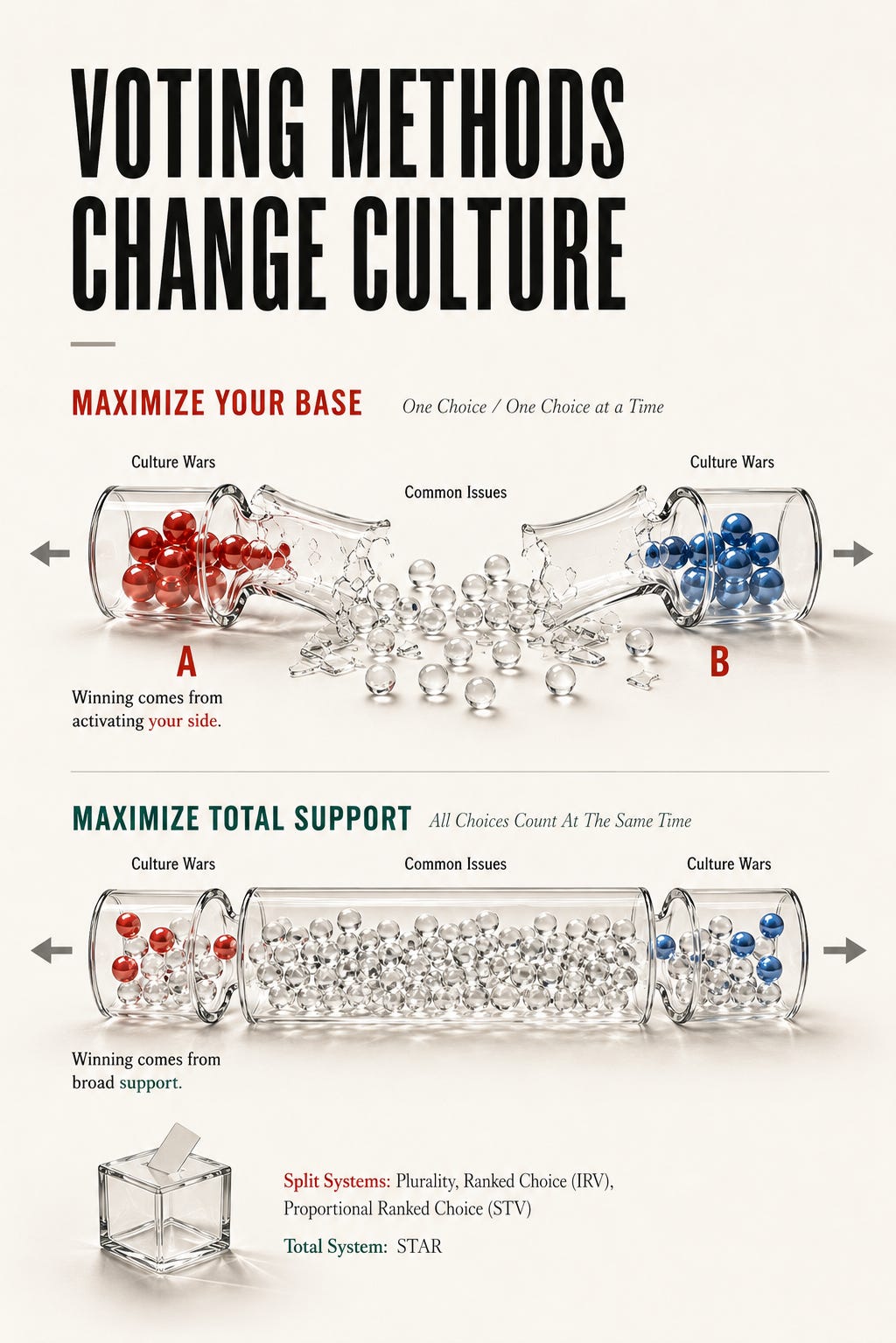
Plurality: one choice only. Vote-splitting and spoiler effect. The best-funded, most established, most unified bloc wins. Outsiders, reformers, and candidates with broad but distributed appeal lose — not because fewer people want them, but because their support scatters while unified blocs hold together.
IRV: one choice at a time only. Plurality ranking with vote-splitting and spoiler effect. The most cohesive blocs survive elimination — polarized candidates over consensus ones. The candidate nearly everyone could live with gets squeezed out. Ideological minorities can win by capturing a major party from within, while majority-representative third parties are filtered out before they can compete. The duopoly is preserved by design. Meanwhile, business and elite interests benefit from polarization, gridlock, and predictable lobbying pathways frozen in place in a two-party system.

Condorcet: ranked choice without center squeeze. The candidate most voters prefer in direct comparison wins — but quality of support is invisible. A candidate who weakly wins can beat a change candidate who was more honestly supported. Honesty isn't just moral — it's optimal. The goal isn't just the baseline of who wins the most neutral head-to-head comparisons. It's finding the outcome that produces the highest average satisfaction across everyone — the highest peak happiness, rather than a flat compromise that leaves everyone equally underwhelmed. The system is neutral but incomplete.
Approval: not ranking, but a yes/no on each candidate. That sounds simple, but it becomes deeply strategic. Not traditional vote-splitting — a new kind. When your only options are yes or no, you can't really be honest; approval ballots can lie by omission. Supporters point to simulations showing the most broadly wanted candidate wins — but only under conditions that don't hold in the real world: voters aren't polarized, nobody votes strategically, good majority parties already exist (they don't — no voting method has ever let one become viable), and the majority faction turns out at high rates. Good luck finding all four.
STAR: no vote-splitting, no spoiler effect, no center squeeze, and strong enough to break a duopoly. Ranking and scoring in one action. How much you care counts. Similar candidates accumulate support rather than cannibalizing each other. Cross-coalition appeal is rewarded. The most broadly liked with genuine depth of support wins. Quantity of voters and quality of support both matter. The strategic move and the honest move point in the same direction. Of all the widely proposed reforms, STAR’s mechanics most directly benefit the kind of candidate the exhausted majority describes wanting — someone who can build real coalitions without being a lowest-common-denominator compromise.

Some systems are more honest and accurate than others
Every counting method makes a choice about how much information matters and what gets filtered out.
Most systems only ask: who do more people prefer? STAR asks something different: who do more people prefer AND who produces the most satisfaction across the whole electorate? Both quantity and quality of support matter. People who are suffering should have a system that can say how much you care, because that's what you'd want if the situation was reversed— and for an exhausted majority that doesn’t just want change but desperately needs it, that difference matters enormously.
How we feel isn’t flat. Choose-one, ranking, and approvals don’t let you say how much you actually support a candidate or a party. Voters that barely care shouldn’t necessarily override voters who care enormously. Especially when wealth stacks, and majorities split.
That’s not anti-democratic. It’s a more honest theory of what democracy is actually trying to do — maximize wellbeing across the whole electorate.
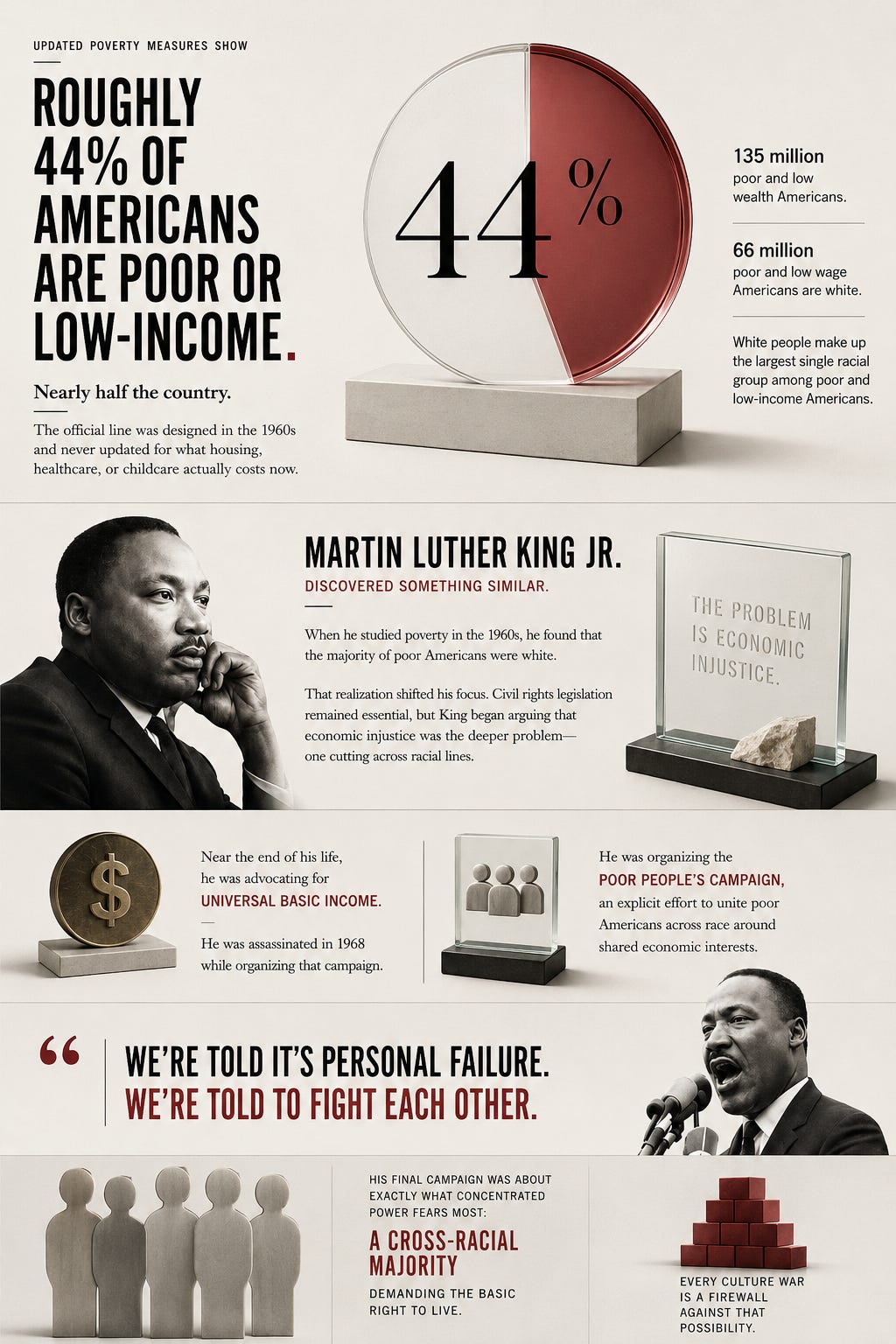

MLK Knew The Coalition That Could Actually Change Things

Chapter 1: The Economy Looks Great. So Why Does Everything Feel Broken?
You’ll find edge case arguments, misleading voting criterions, and denial of science against every system on this list made by supporters of certain systems who want to smear the alternatives. They follow a recognizable playbook: take a scenario that’s mathematically constructable but practically implausible, present it as a defining characteristic of the system, and use it to manufacture equivalence between something deeply flawed and something meaningfully better.
The honest standard isn’t whether someone can prompt an AI to engineer increasingly bizarre scenarios until something technically breaks. It’s how the system behaves in the real world. If you have to beg a computer to construct the scenario, it isn’t a flaw — it’s a proof of robustness. A failure mode that requires an AI to engineer it isn’t a characteristic of the system. It’s a characteristic of the argument against it. These small groups benefit from confusion — whether motivated by the exploits they enjoy under the status quo…

or the exploits radical ideologies are willing to weaponize.
Socialist Project 2025

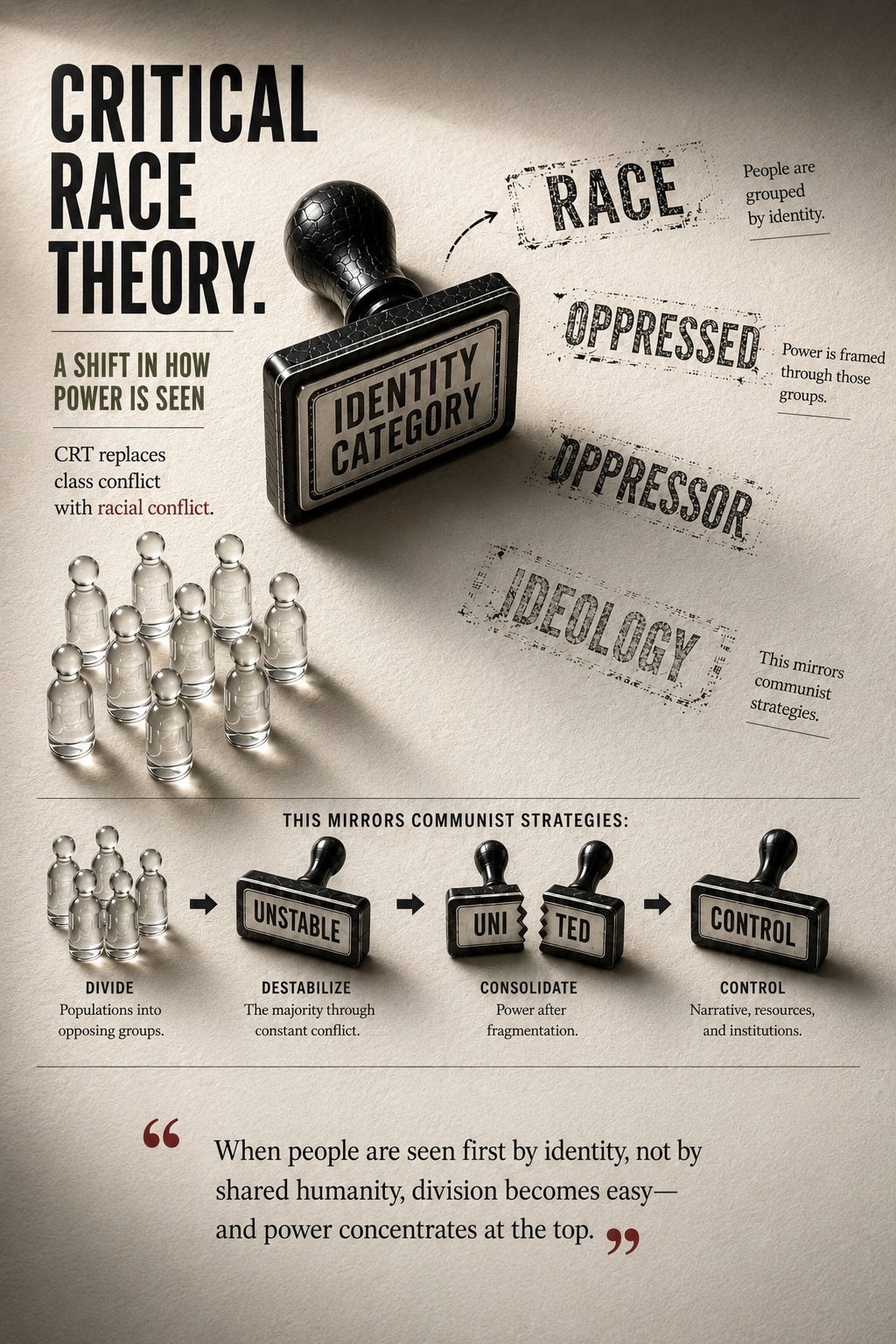
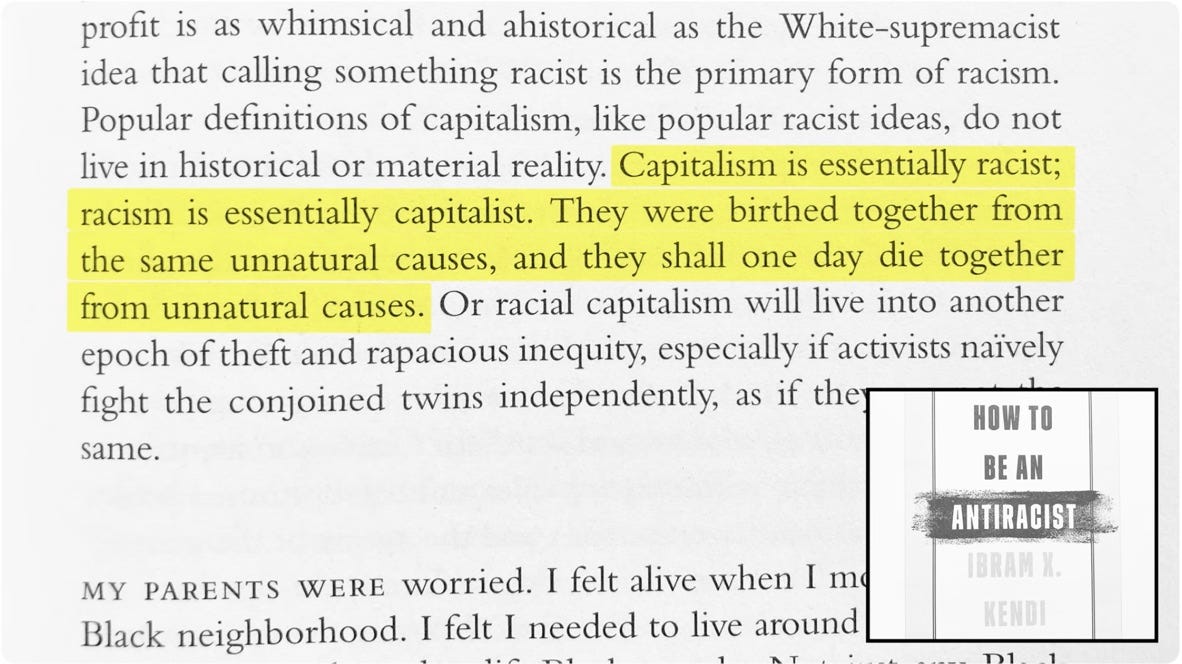
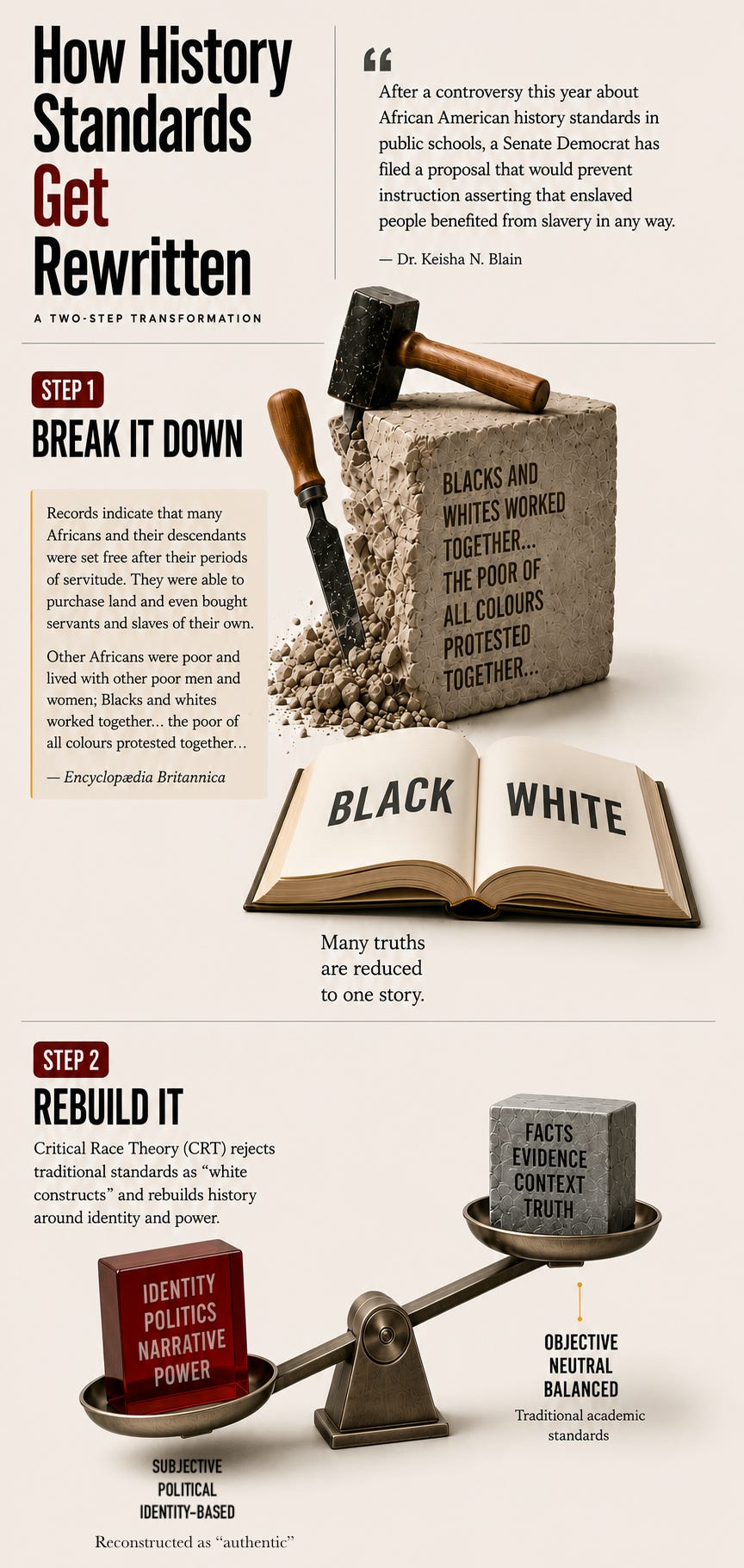
Left-wing commentator Kyle Kulinski, speaking at a Progressive Victory rally attended by DSA-aligned politicians, argued that weakening Iran would cut off funding to Hezbollah, Hamas, and the Houthis.
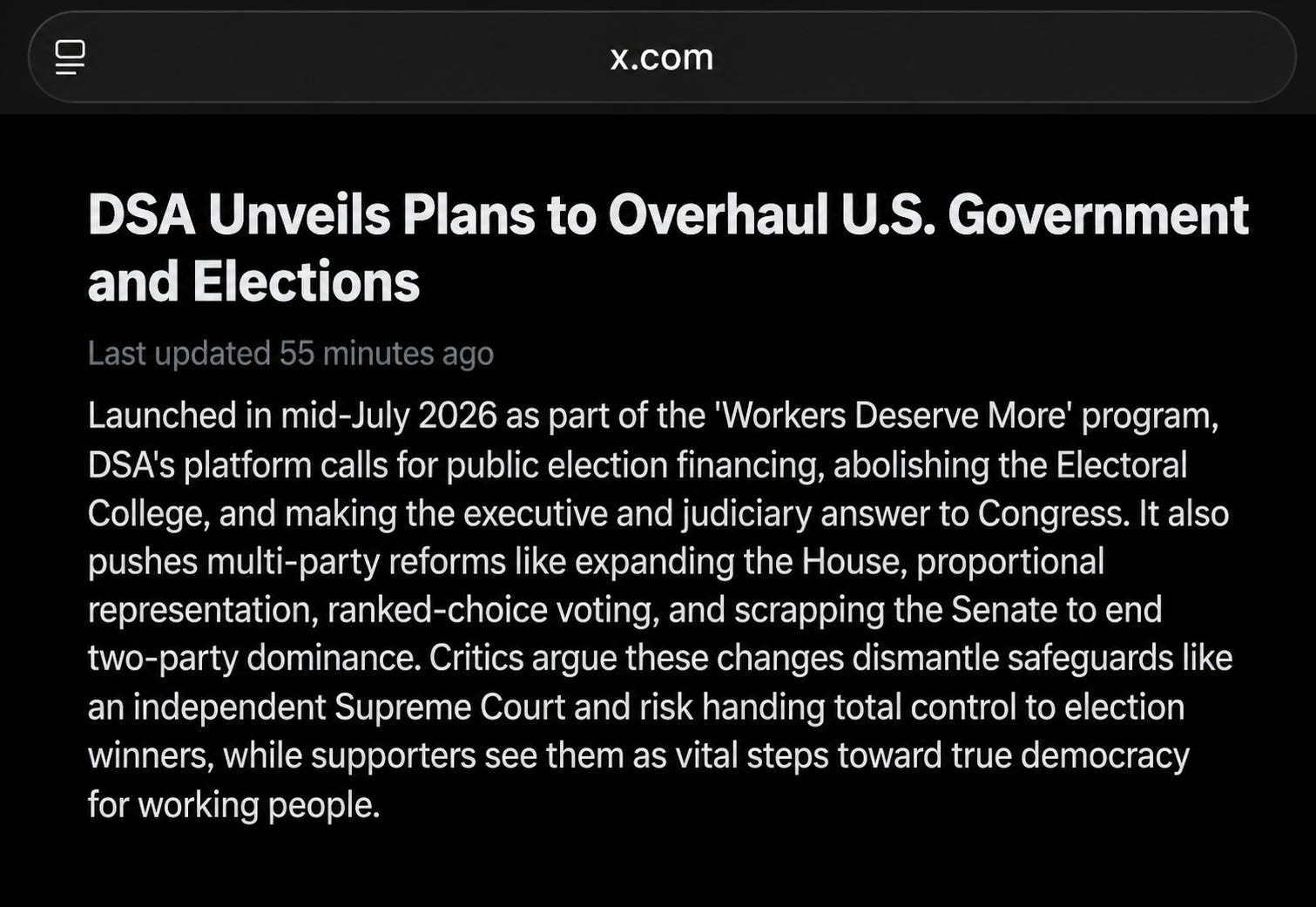
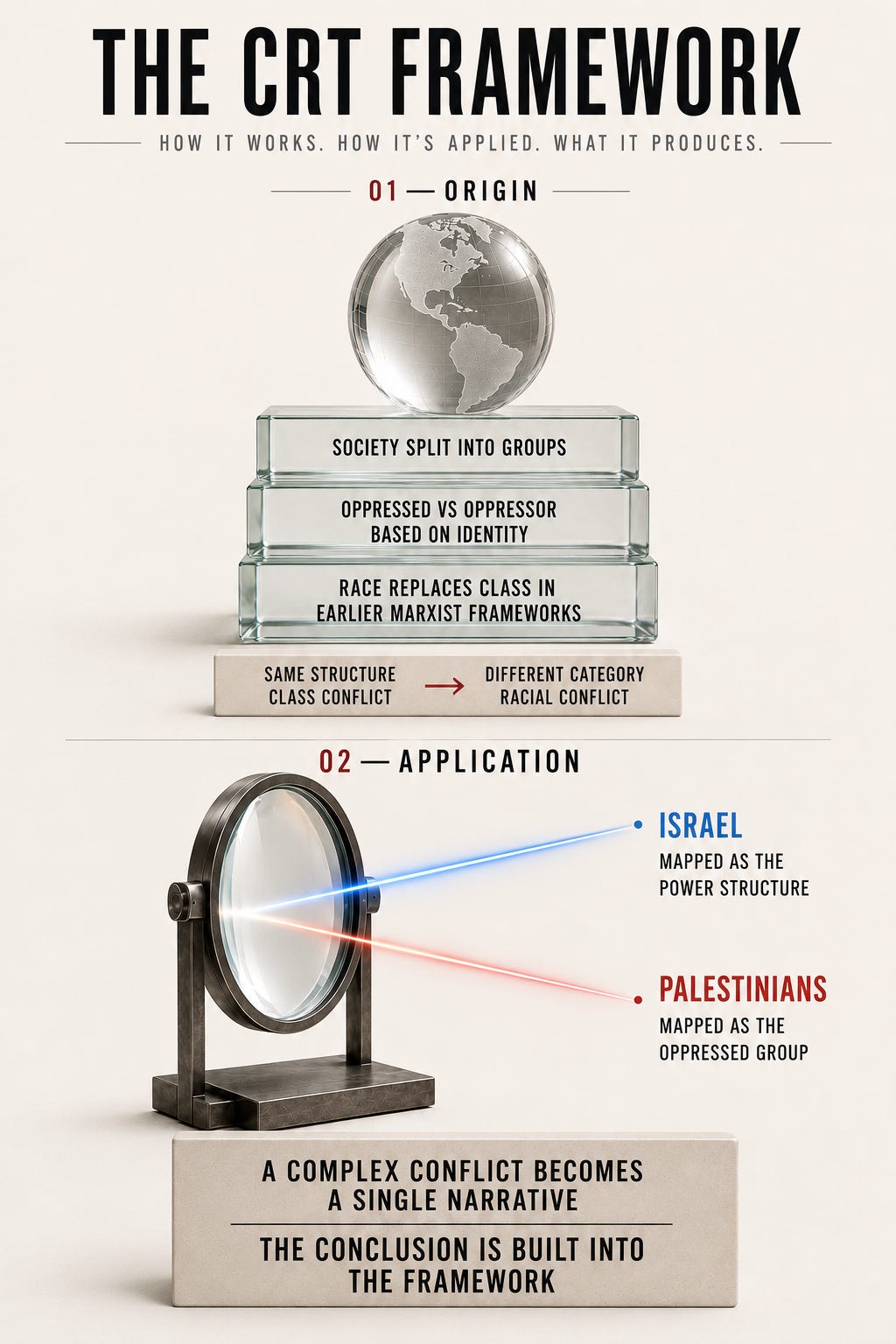
After enough time undercover in these voting forums, the cast of characters becomes familiar: libertarians and socialists who've each worked out which system produces the most favorable math for a minority position. They agree on wanting to win without earning it — and divided, bitterly, on which formula that is: Ranked choice voting or Approval.
With Ranked Choice, radical minorities take over a major party from within.
With Approval, they become one of several parties the majority settles for. Approval voting doesn't end the lesser-evil problem. It just adds more evils and lets the radical minority bullet-vote its way into the lineup.
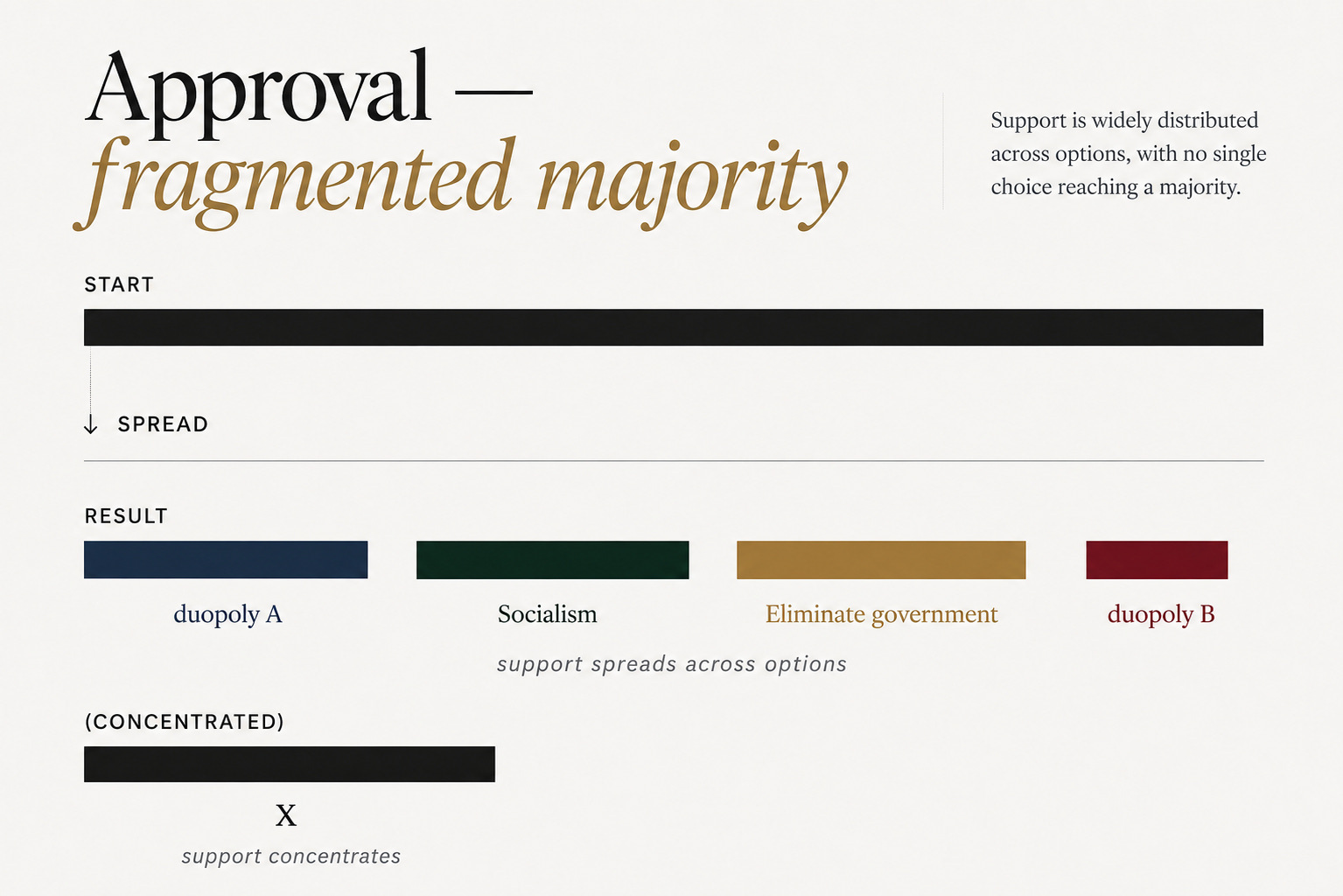
They share a destination: winning without a majority. They just can't agree on the tradeoffs. The edge cases and circular voting criterions are how they fight each other. The rest of us are just collateral.
Every voting method has an advocacy organization. No voting-method organization (including STAR) is led by — or made up of — the exhausted majority.


Chapter 5: What you’re really seeing
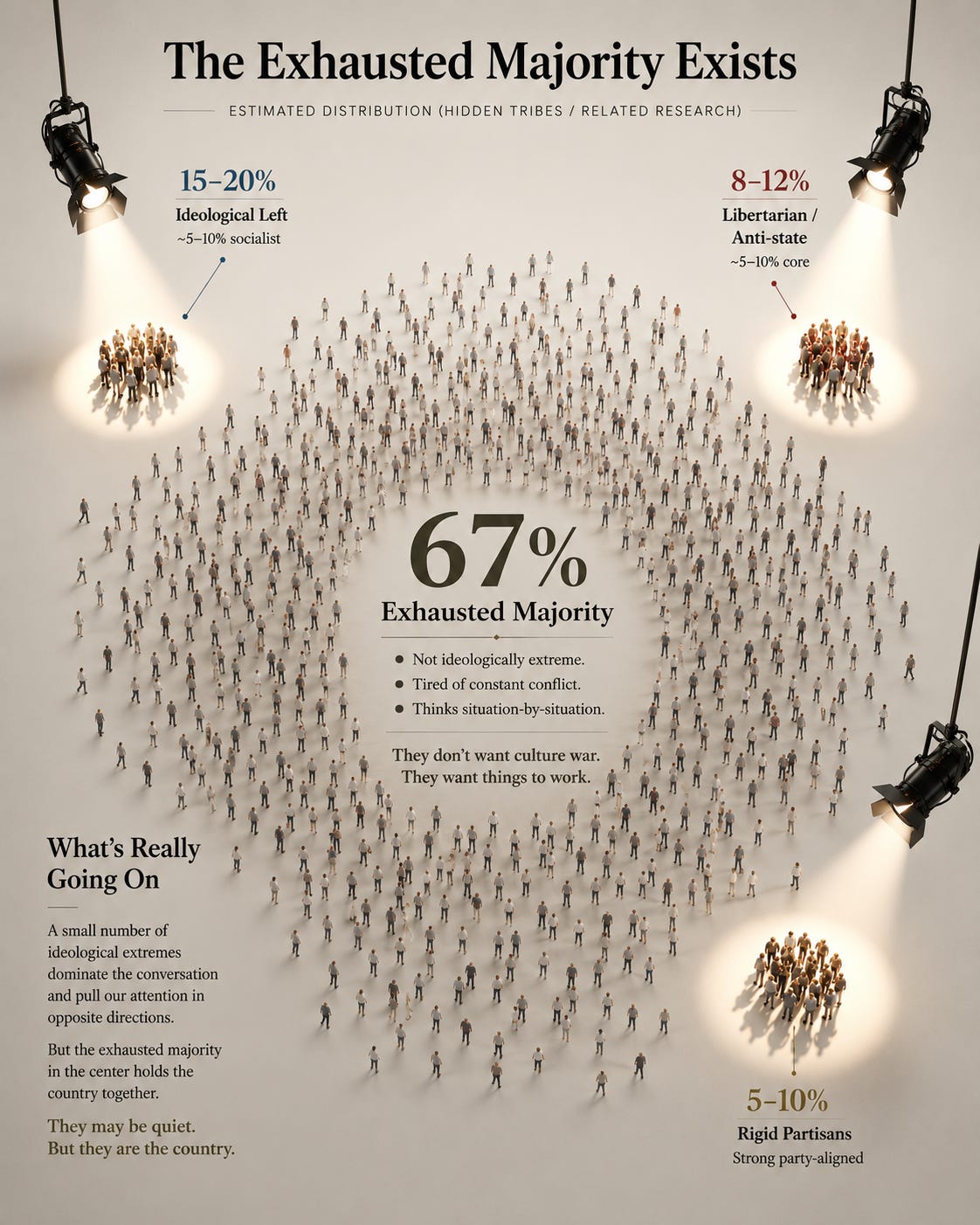
Two thirds of the country agrees on the biggest issues.
The majority already exists. You’ve met them. At the grocery store, at work, at Thanksgiving. The person who doesn’t talk politics because they’re too tired. The one who stopped watching the news. The one who voted because they felt they had to, not because they believed it would change anything.
They’re there.
On affordability. On housing. On healthcare. On corruption. On wanting something — anything — different from this.
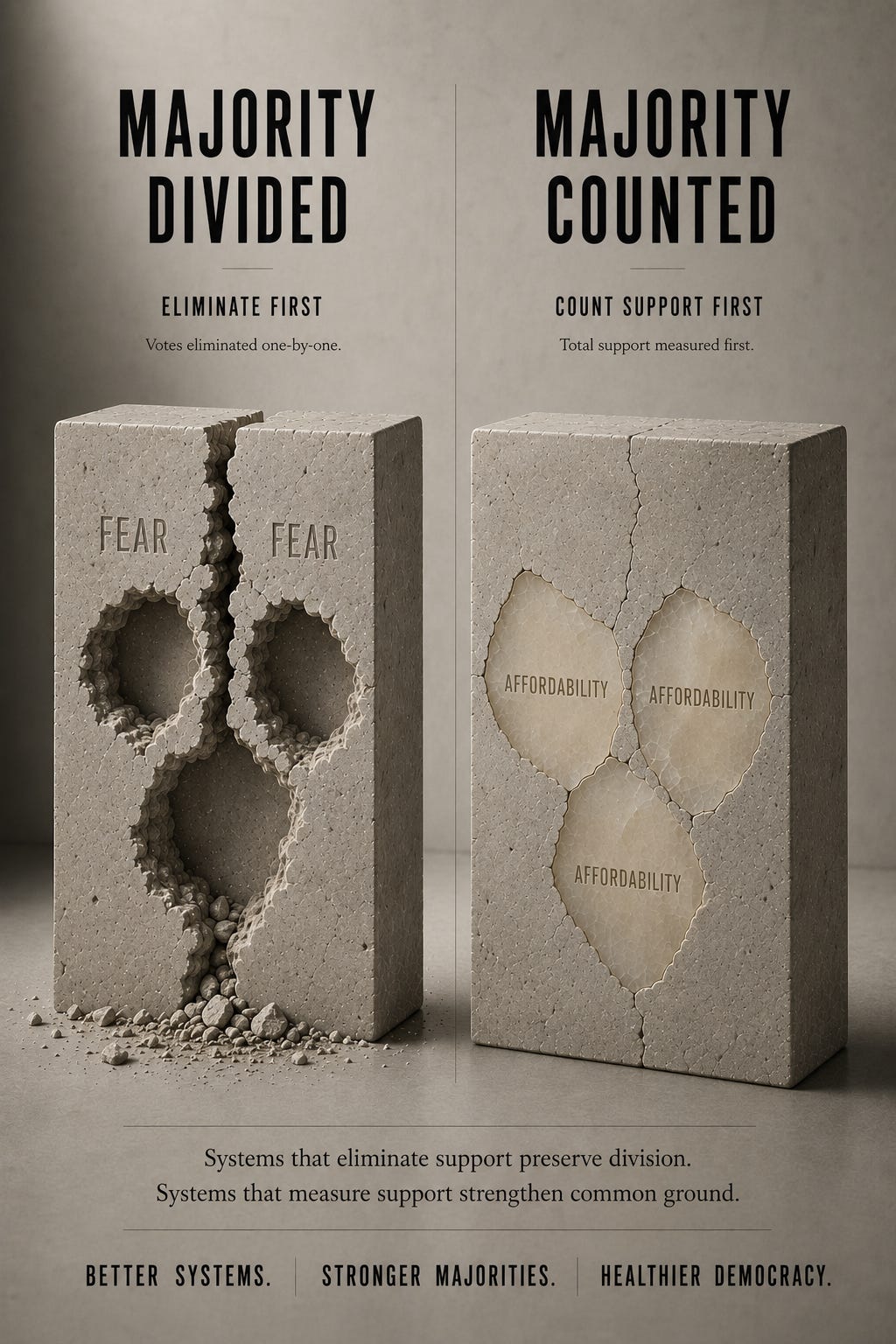
That agreement doesn’t disappear because people are divided. It disappears because the system can’t show it. Support spreads across candidates who represent the same direction, looks fragmented in the count, and loses to a smaller group that happened to stay unified.
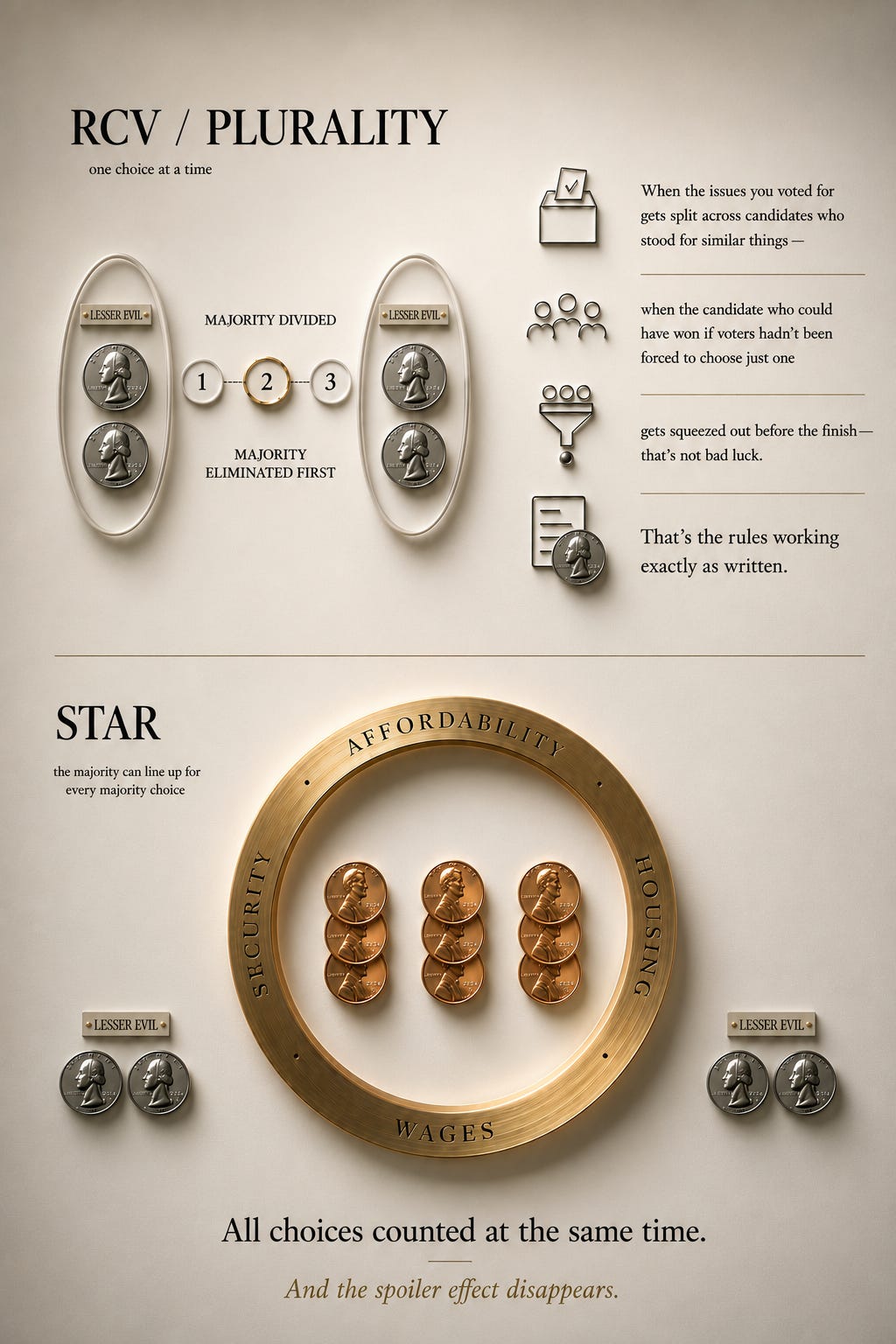
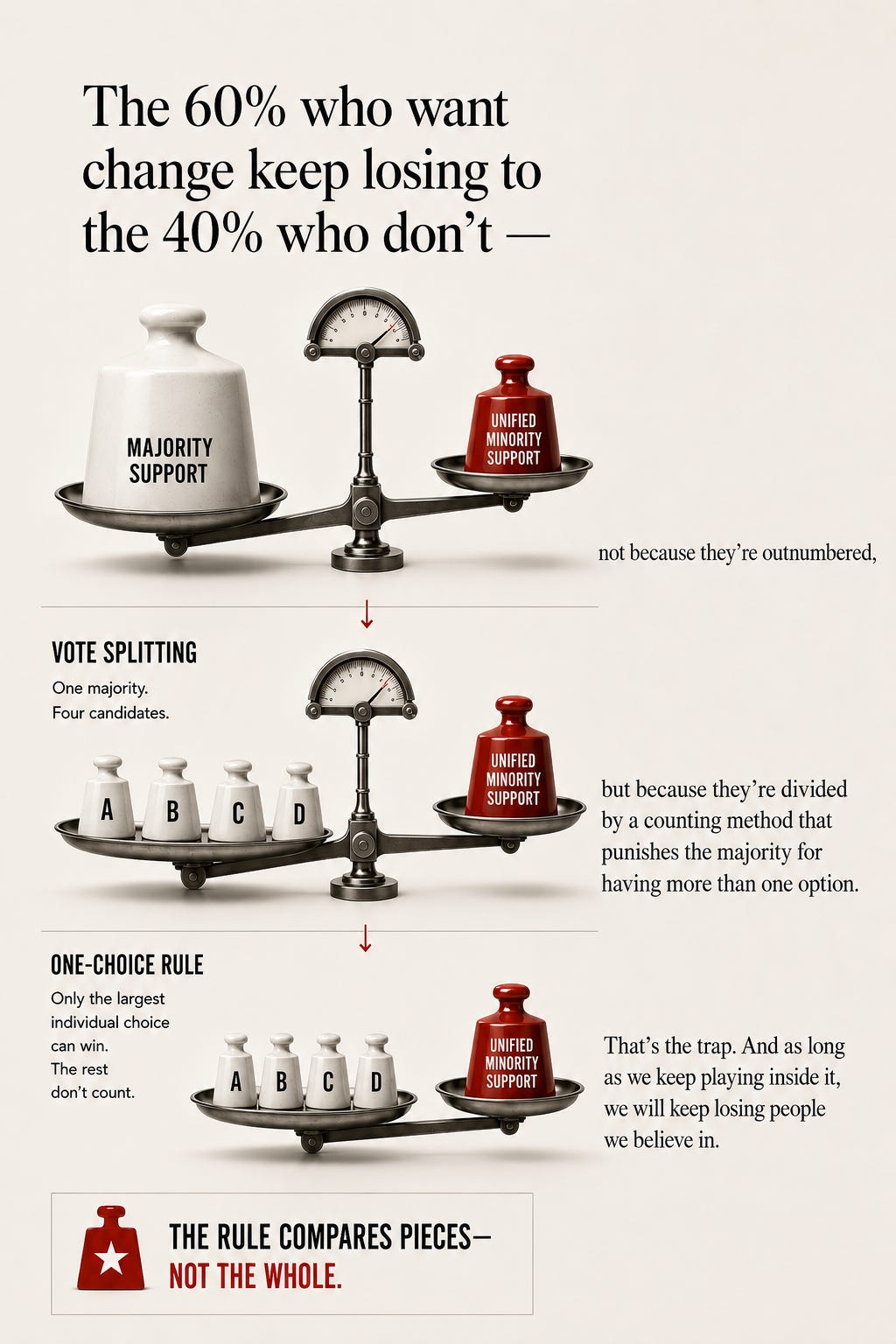
Too Many Good Options Is How the Worst One Wins
The vote splitting causes the spoiler effect. The spoiler effect leads to strategic voting. Strategic voting leads to honestly preferred candidates dropping out. The donors quietly break the tie.
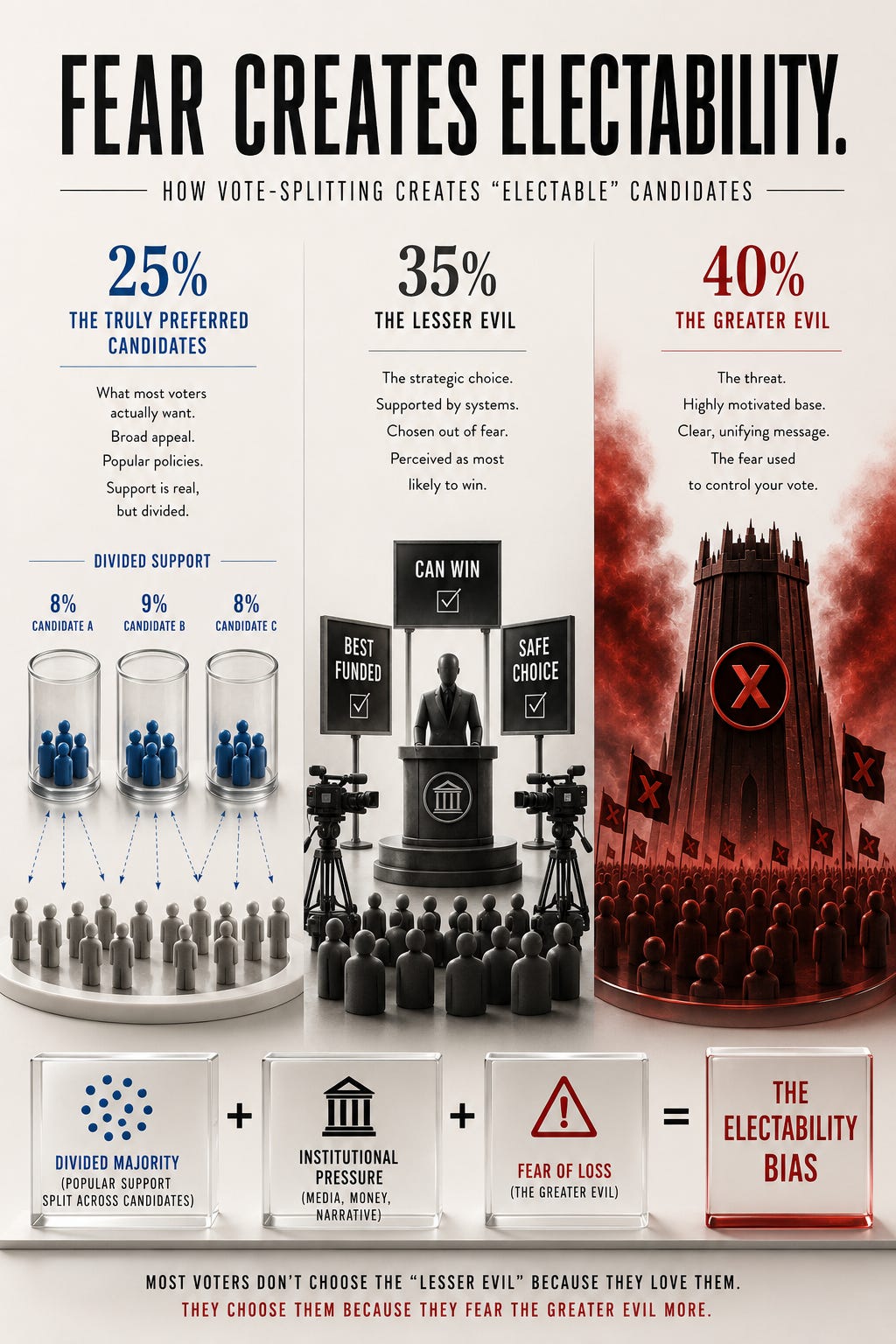


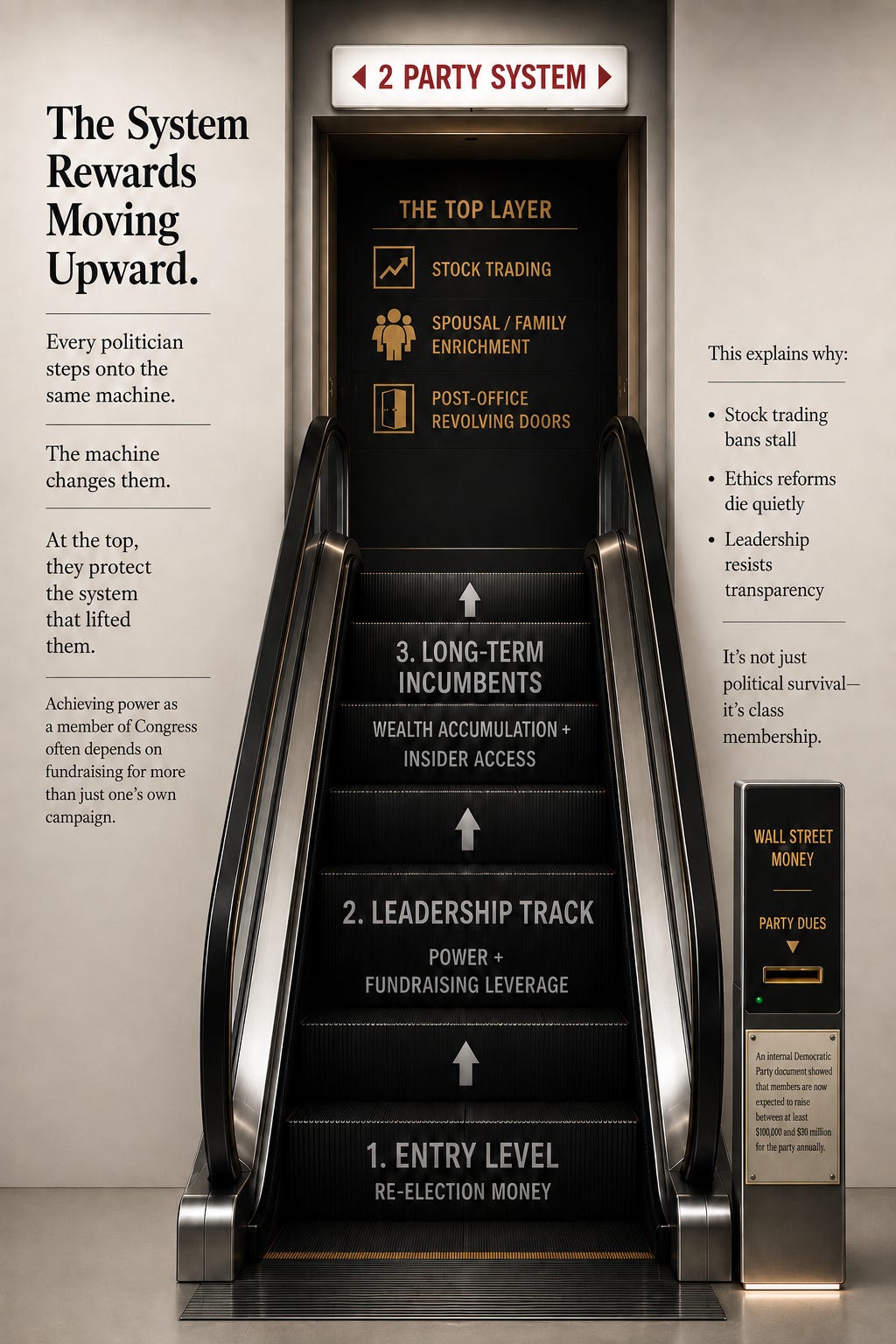
You Can’t Demand More From Leaders The System Was Designed To Protect


The More You Want, The Less You Get.
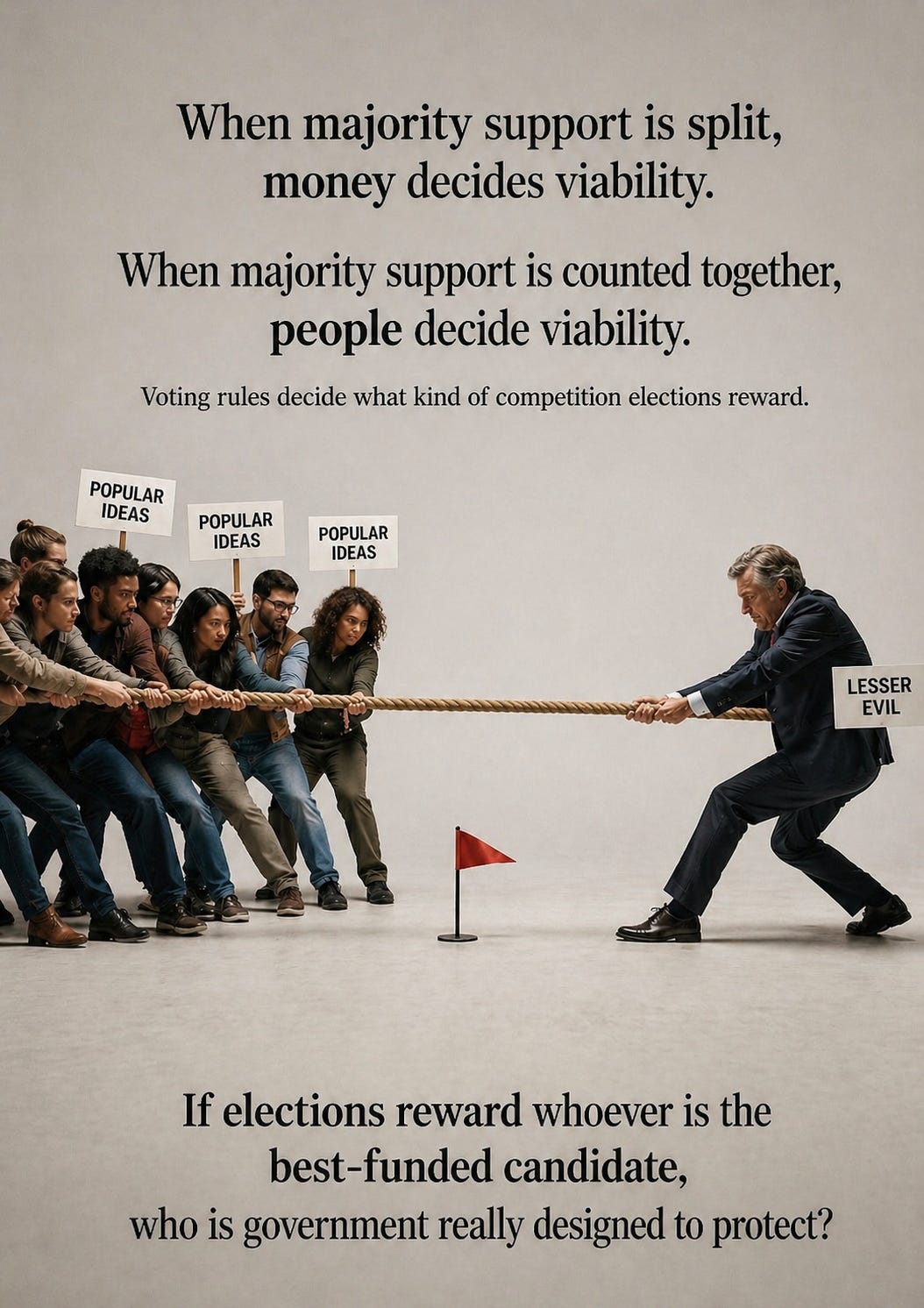
None of that is inevitable. It’s a consequence of the rules.
Same voters. Same preferences. Different outcomes — depending on the system used to count them.
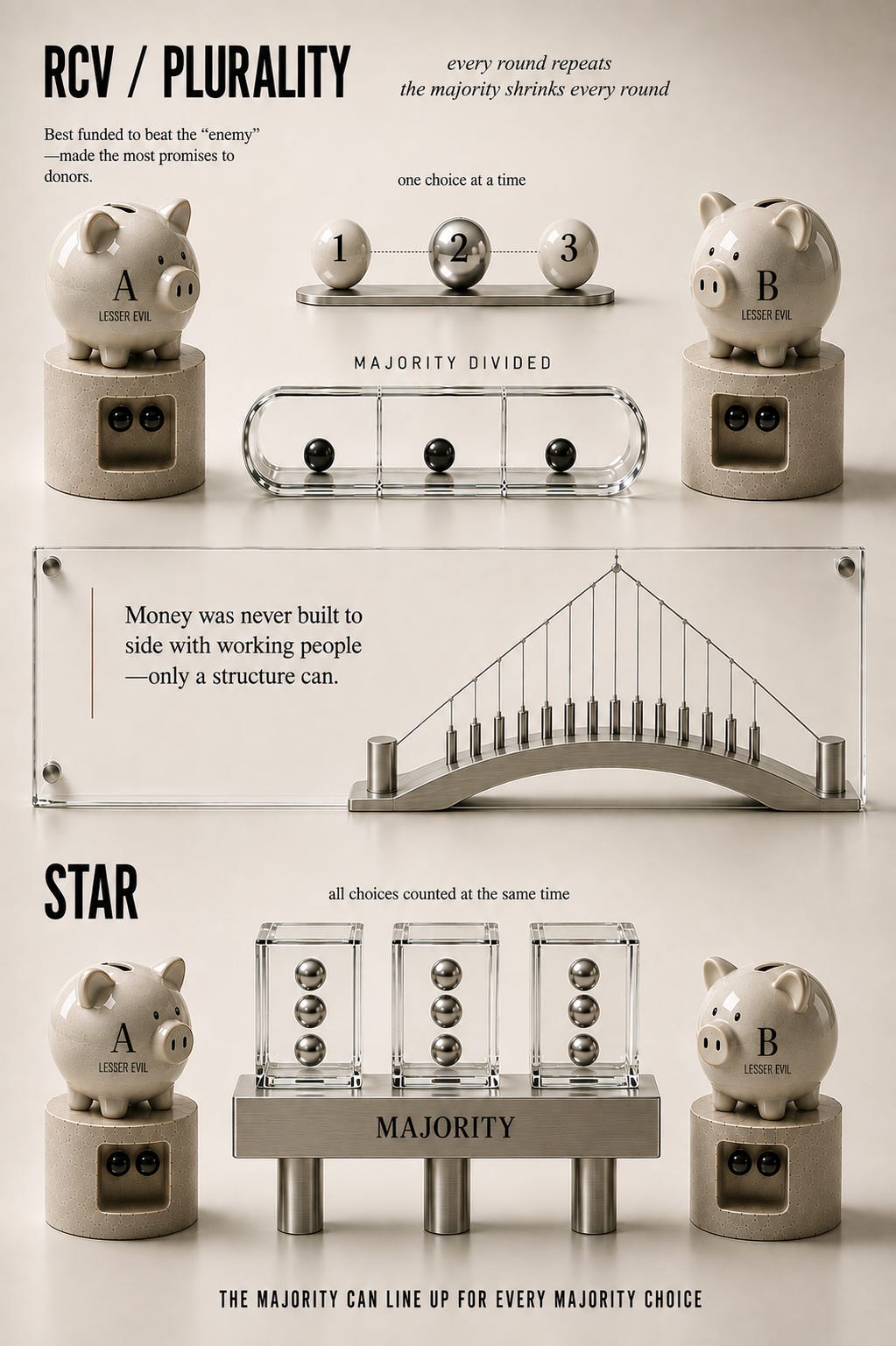
The Goodness Is In Us. The Corruption Is In The Structure.

You’re not seeing a divided country. You’re seeing a filter that makes the majority disappear. That makes the other side look like a monster.
The mirror isn’t showing you reality.
It’s showing you what survives the split.


Build democracy that works for people. Not just the powerful.
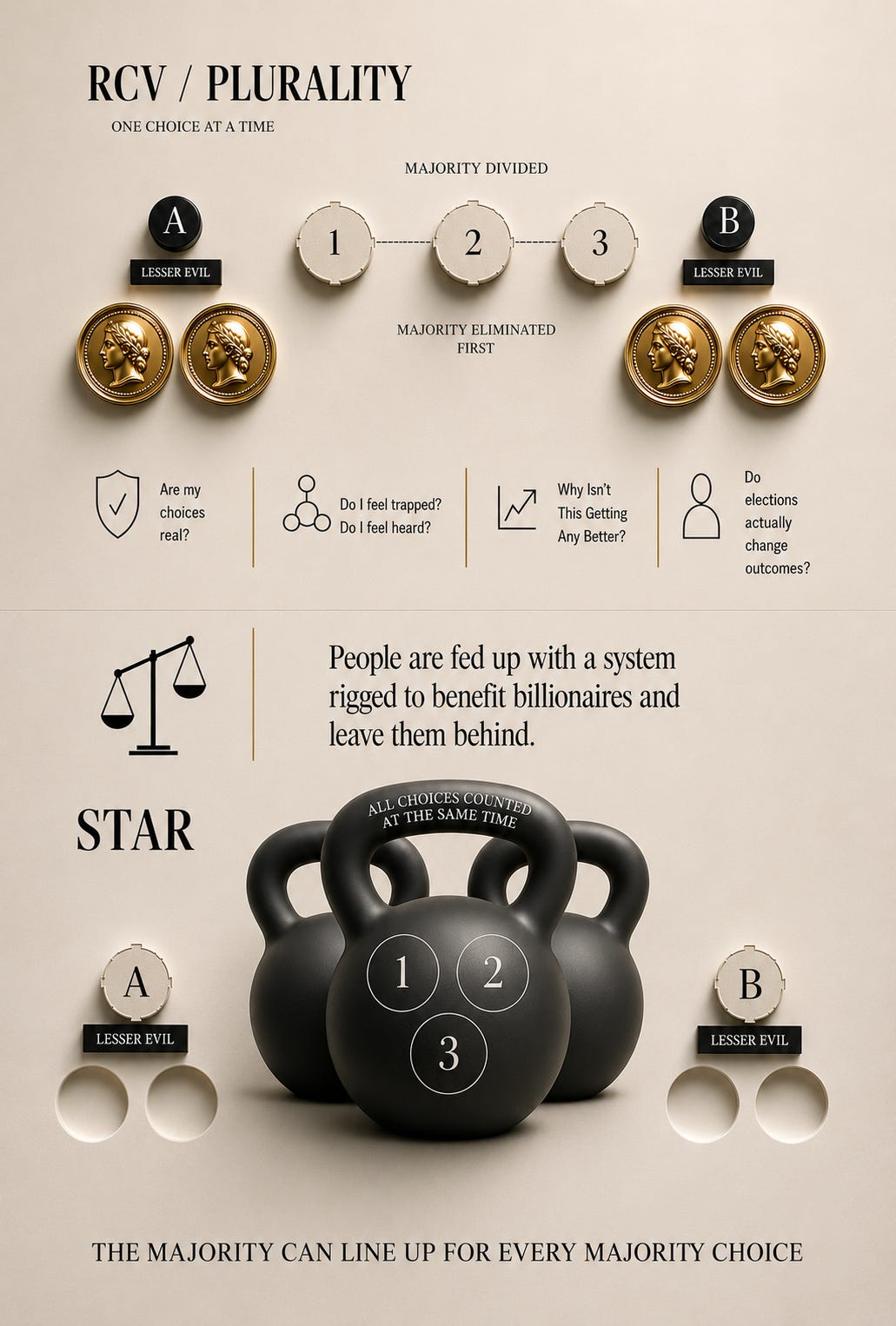


We all agree on more than we’re allowed to act on.
Players argue.
Rules decide.
Change the rules.

The Culture War Was a Distraction. The Real Story Started Years Before 2024.