I Believed The RCV Arguments. Then I Checked The Math.
What the majority deserves to know.


Part 1: A Letter To The Reader
There are people who deliberately try to limit voter choice and concentrate political power. That makes these discussions sensitive — none of us want to unintentionally help the wrong actors.
But honesty has to come first.
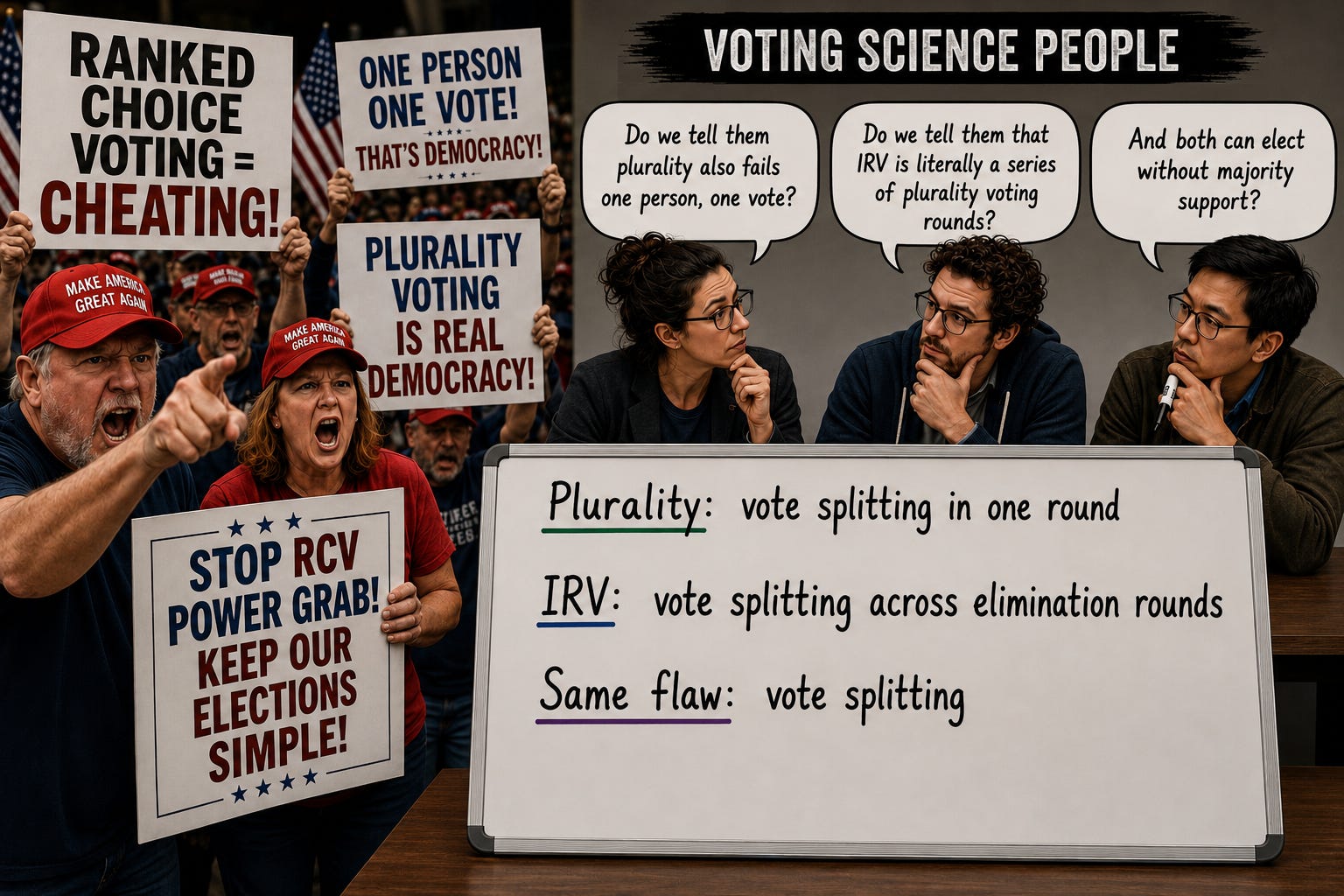

Earlier in my journey, I strongly promoted Instant Runoff Voting. I believed in it. I repeated the arguments — coming from a well-funded organization — with confidence.
Then I discovered something difficult: some of those arguments weren’t mathematically true.
So I studied the science. What I found is something that happens in every field: ideas improve. Instant Runoff Voting was proposed in 1871, when voting science was still early. Its creator wasn’t a mathematician and actually warned against broad adoption. Voting science didn’t stop there.
Honesty requires something simple: follow the evidence. Facts, not factions. Misinformation thrives wherever knowledge is uneven.
My goal was never to change minds that won’t change. It was to close the gap between people who have studied voting systems for years and the millions who were never given the chance. Democracy only works when information isn’t gated — when the majority understands the rules shaping their choices just as well as the small groups who benefit from confusion.
So I tried to meet people where they are. Remove jargon. Make complex ideas intuitive. The goal has never been division. The goal is understanding.
The loudest voices in any discussion are rarely the majority. The real majority reads quietly — curious but hesitant, worried their question might sound naïve next to someone who has spent years on voting theory.
This was always for them.
If you’ve been quietly trying to understand how the system works — I see you. This was always for you.
Part 2: The Corporate Myths
Most widely circulated explanations of IRV describe what advocates wish were true.

1. RCV Fixes Vote-Splitting.

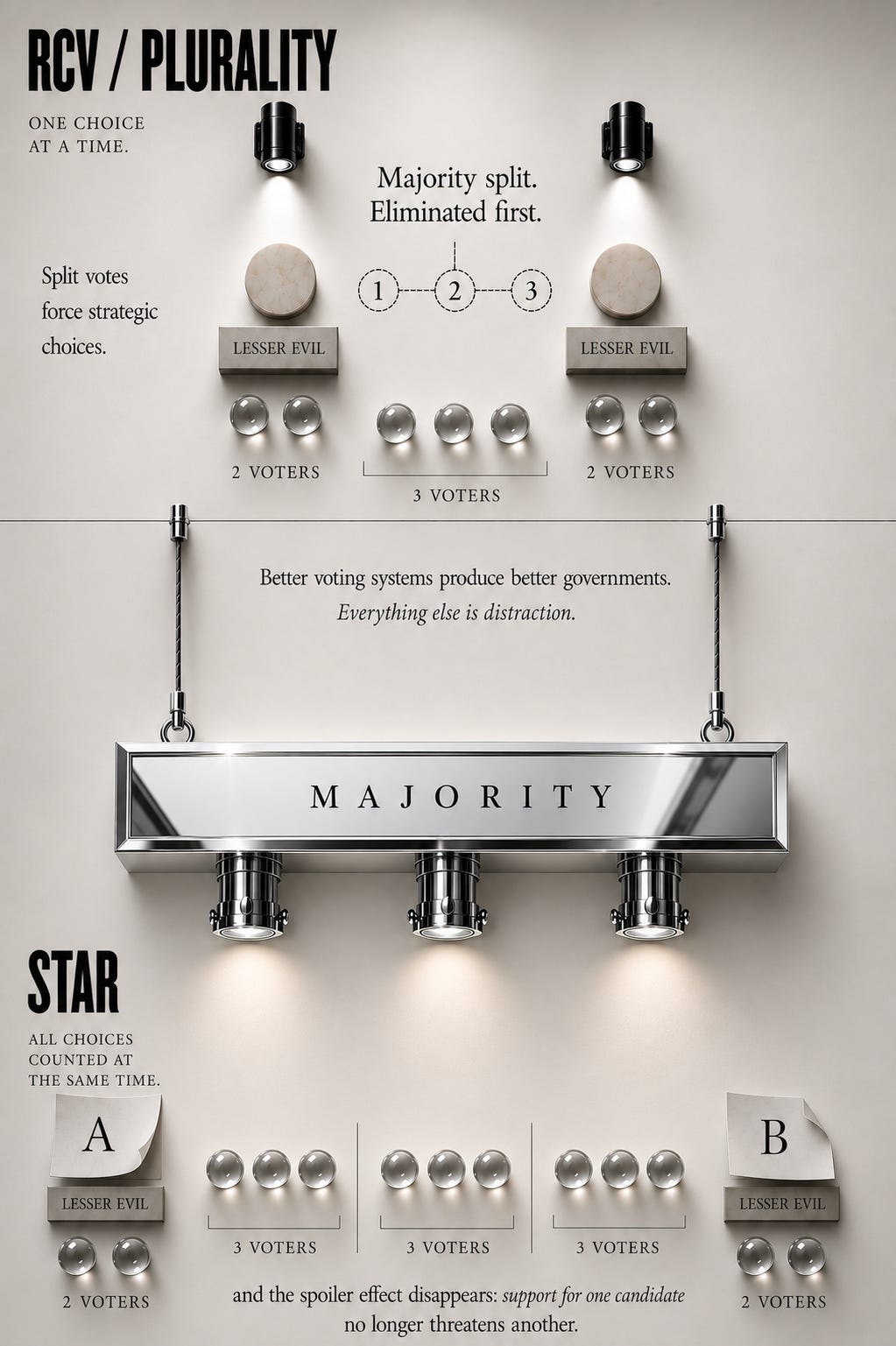
Every round is still plurality voting (first past the post)— the thing you were trying to fix.
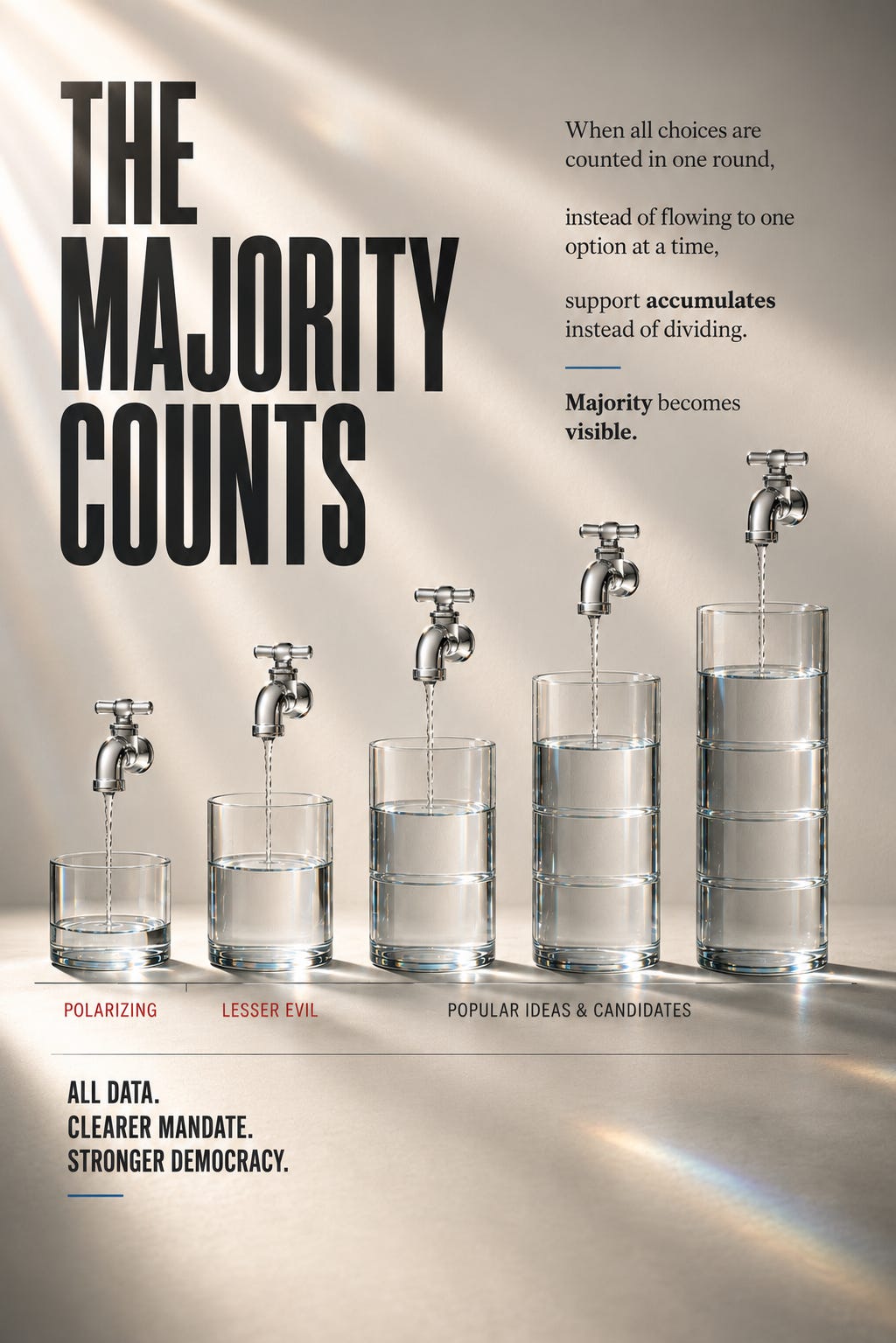
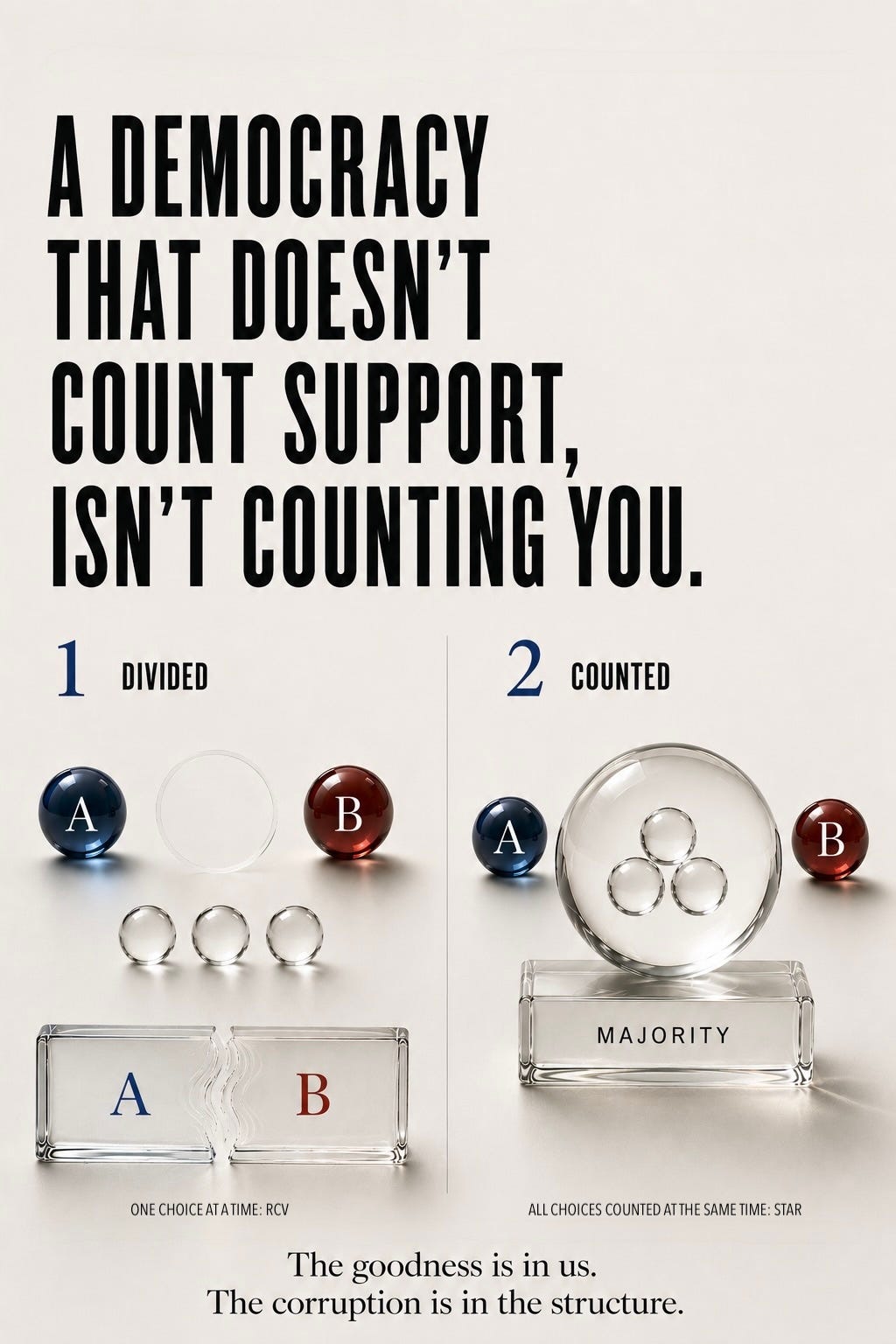
The most common claim is that IRV fixes vote splitting — the problem where similar candidates divide the same pool of voters and hand the win to someone most people didn’t want. But IRV doesn’t fix this. It just moves it.
In the first round, every candidate competes at once and votes scatter across the field exactly as they would in any normal election. The problem is baked into step one.
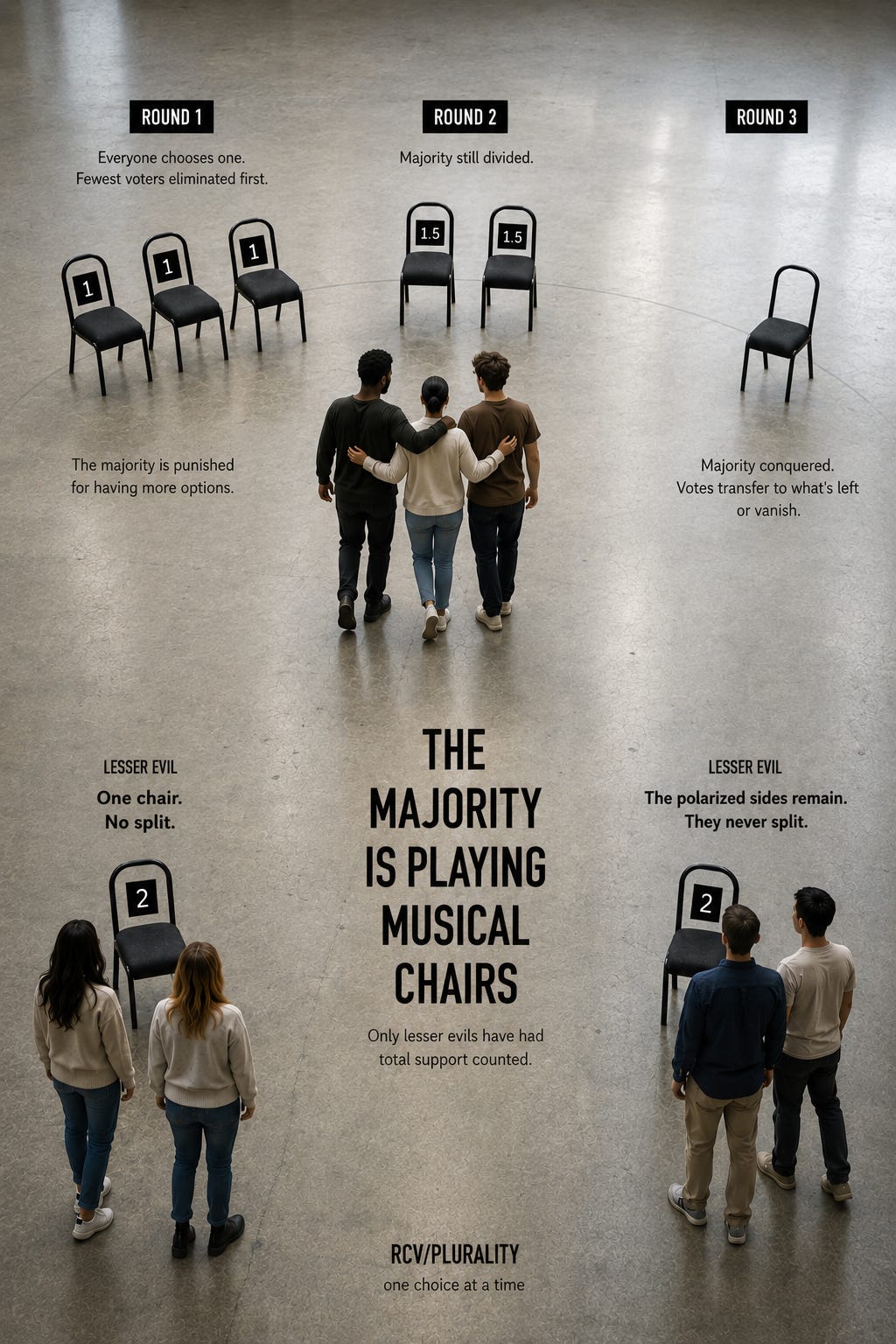
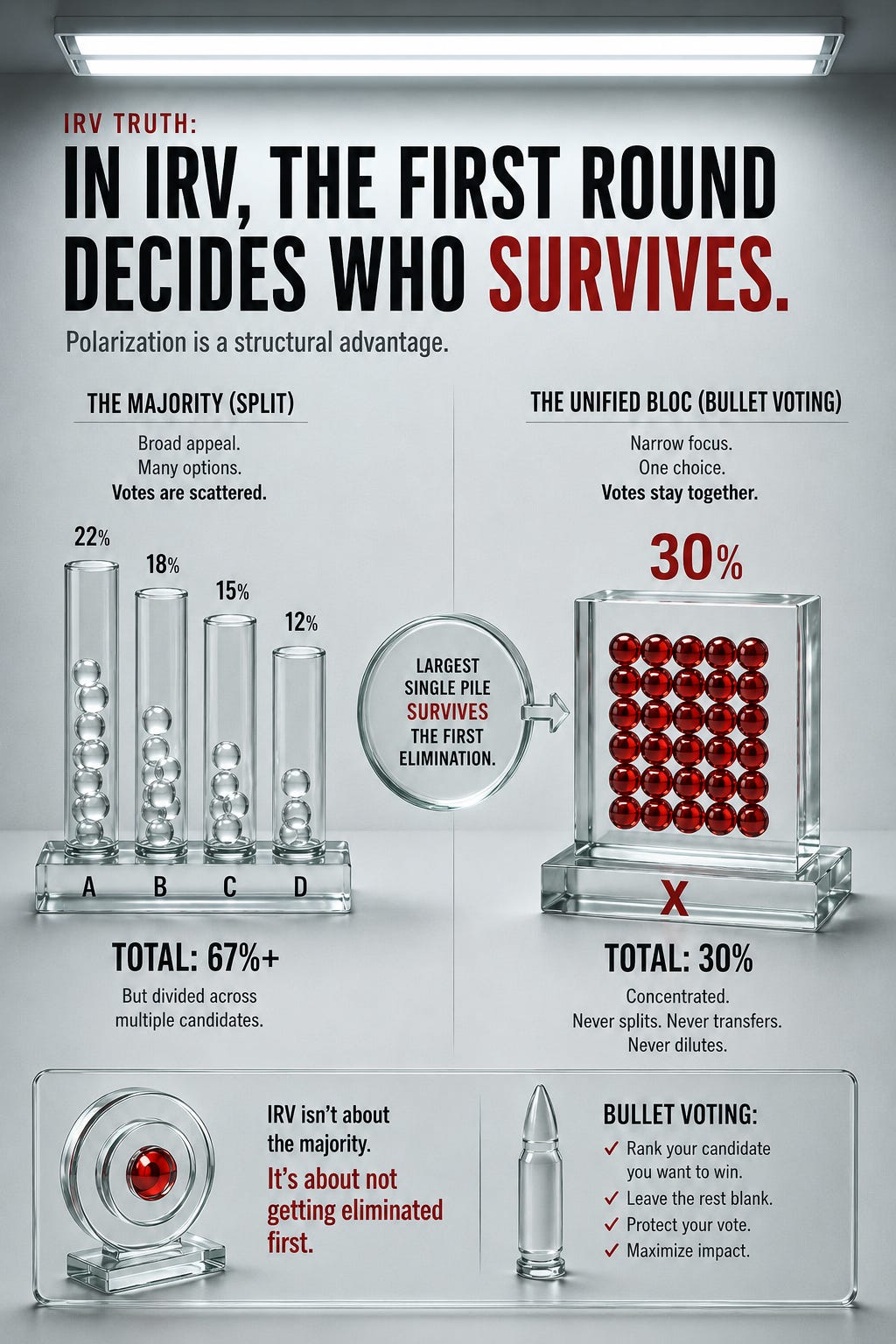
What happens in that first round matters enormously, because it decides who stays in the race at all. Once a candidate is knocked out, they’re gone — and their voters’ preferences can only flow to whoever is still standing. If the candidate with the broadest appeal across the whole electorate is eliminated early because they weren’t anyone’s polarizing first choice, no amount of vote-shuffling in later rounds can correct for it. The damage is permanent.
This is why the claim that IRV “breaks away” from normal election dynamics doesn’t hold up. Each round of IRV works the same way as a regular election: whoever has the fewest votes is eliminated. IRV runs that process several times in sequence.
It’s the same engine, just with more laps.

2. RCV Gets Rid Of The Spoiler Effect / Duopoly
The spoiler claim is where the gap between advocacy and mechanics is widest. IRV does reduce one small specific type of spoiler — an unpopular minor candidate pulling votes in a low-competition first round. This is why its spoiler effect can remain hidden for so long — most elections aren’t competitive.
But in competitive elections the spoiler effect comes for anyone, and it happens when it hurts the most — crowded high stakes elections.
A popular candidate can be knocked out mid-count even when the majority of voters would have preferred them over everyone else. This isn’t a theoretical concern.
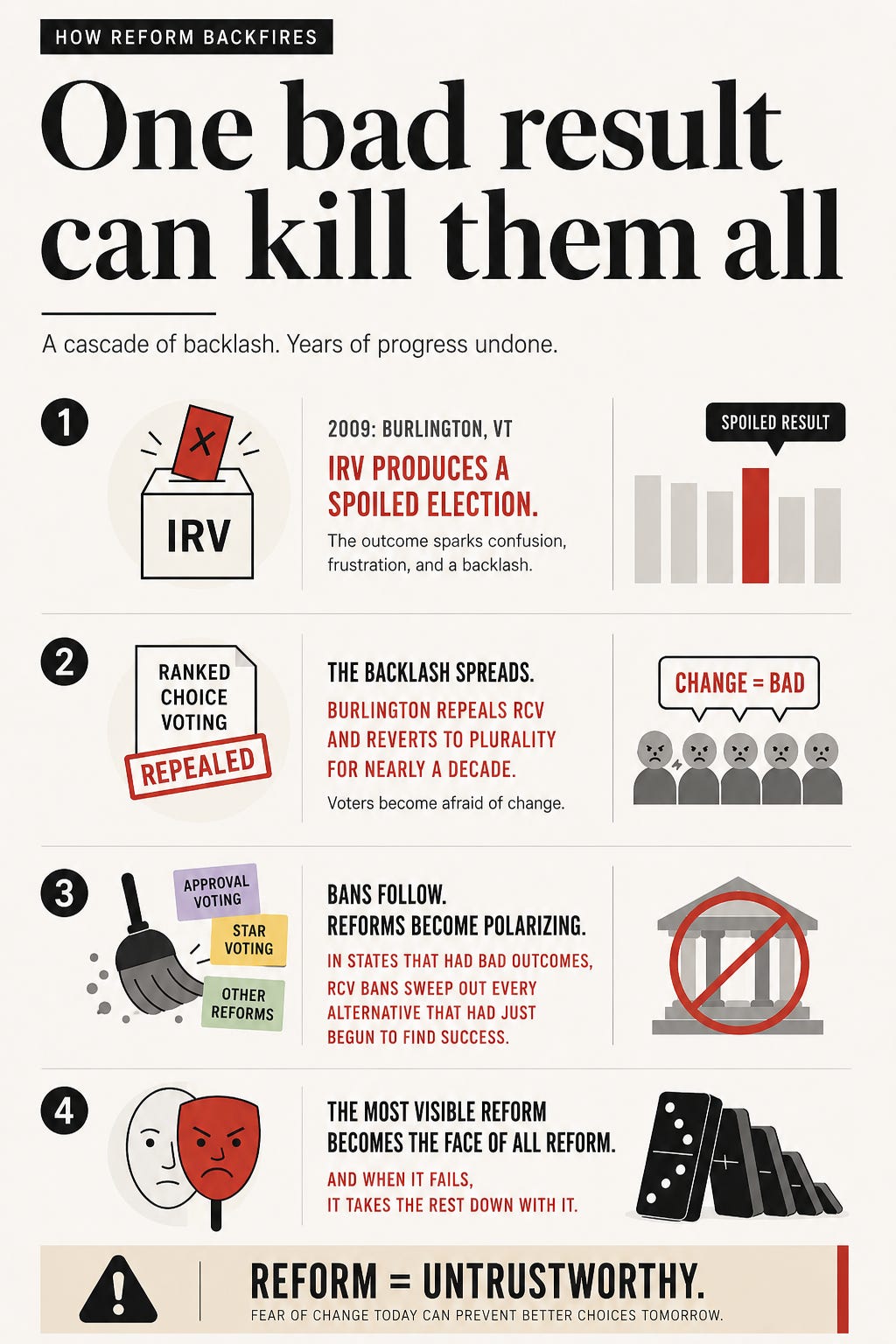
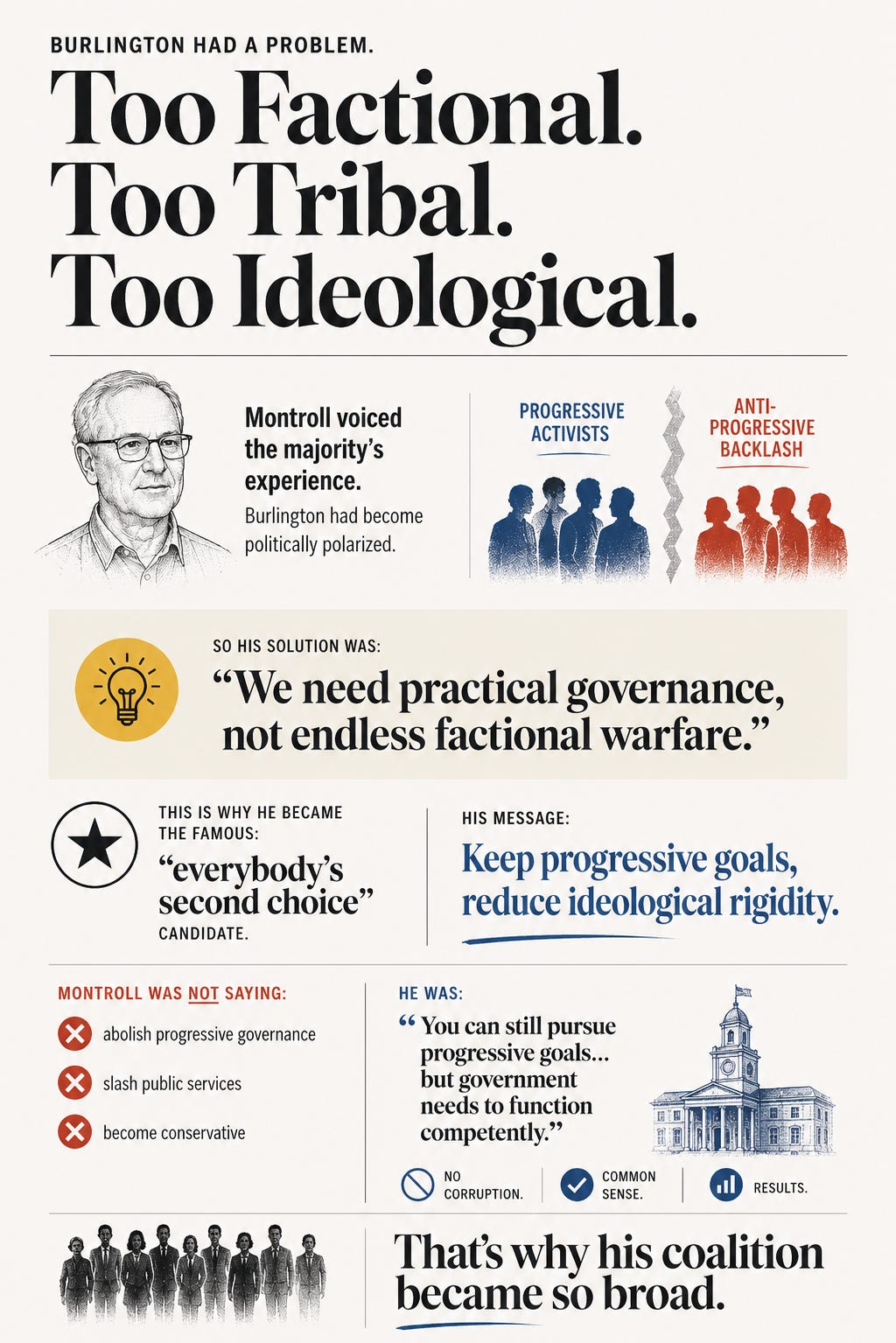
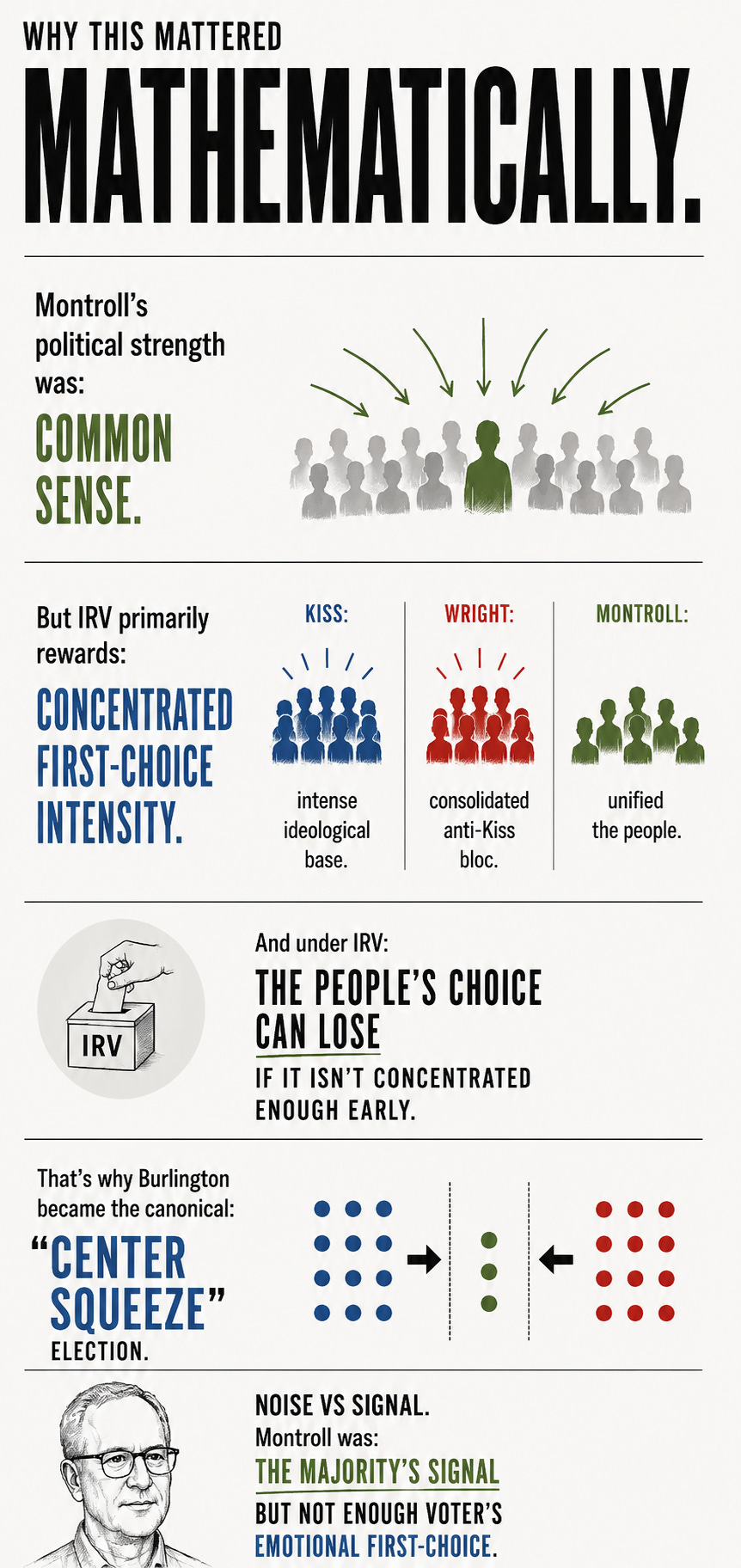
It happened in Burlington, Vermont in 2009, where the candidate most voters preferred, Andy Montroll, was eliminated before the final round. He came in third.
Bob Kiss, the corrupt incumbent, won.
The election result was widely criticized and Burlington repealed Ranked Choice Voting in 2010.
The Story Behind Burlington, Vermont's 2009 Election


How the Spoiler Effect Happened

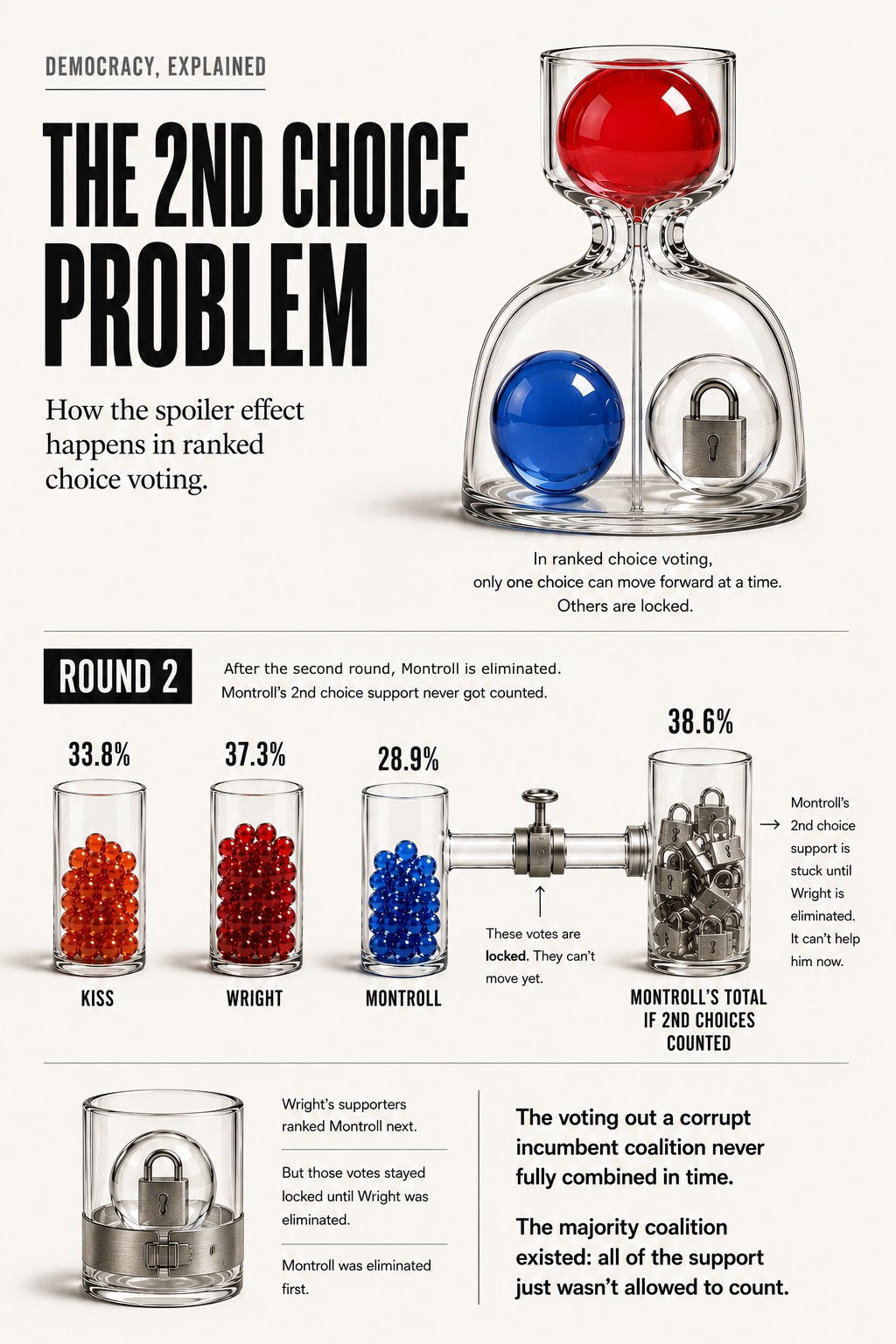
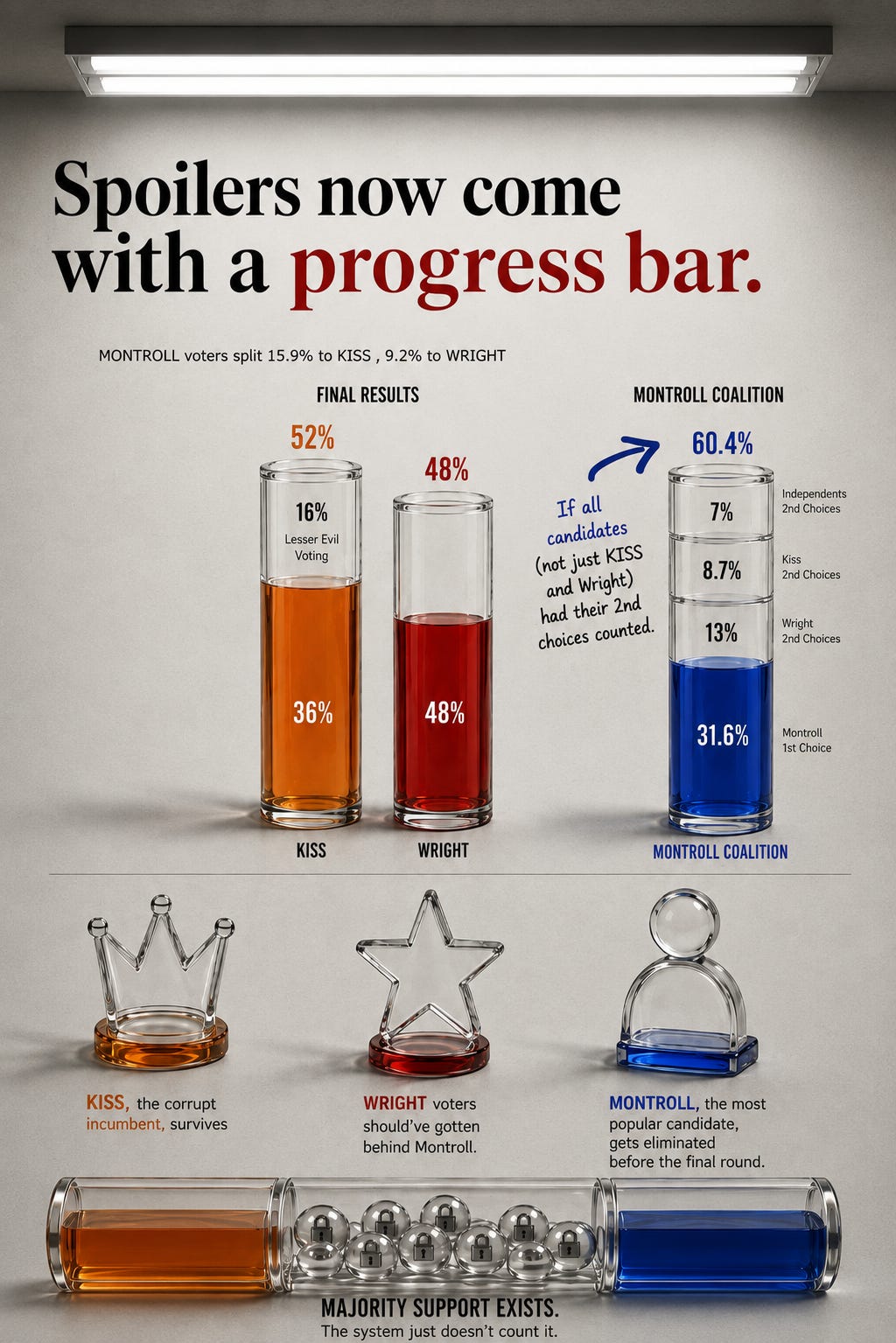
Wright cost Montroll the lead. Montroll’s eliminated voters then cost Wright the election. One split, two casualties.
Burlington 2009 is the case study RCV advocates don't love to discuss. Wright entered, split the majority vote, and Montroll — the candidate who would have beaten Kiss head-to-head — was eliminated before he got the chance. His voters didn't go home to Wright. They went to Kiss. The plurality candidate won a ranked choice election. The city repealed RCV two years later. The method failed not because voters did something wrong, but because elimination order is fragile — and RCV's results depend on it entirely. STAR doesn't. The scoring phase surfaces broad support before anyone is eliminated. Montroll's preference to nearly everyone would have shown up in the scores. He would have made the runoff. He would have won.

What makes RCV’s spoiler effect harder to predict is that voter preferences don’t sort neatly into left and right. Most people are ideologically mixed. A second-choice ranking might reflect a local issue, a personality preference, a protest, or simple name recognition as much as ideology. Or just plain old “lesser evil” voting. The transfers after each elimination go wherever individual ballots point — which means who spoils whom, and who benefits, can be genuinely arbitrary.
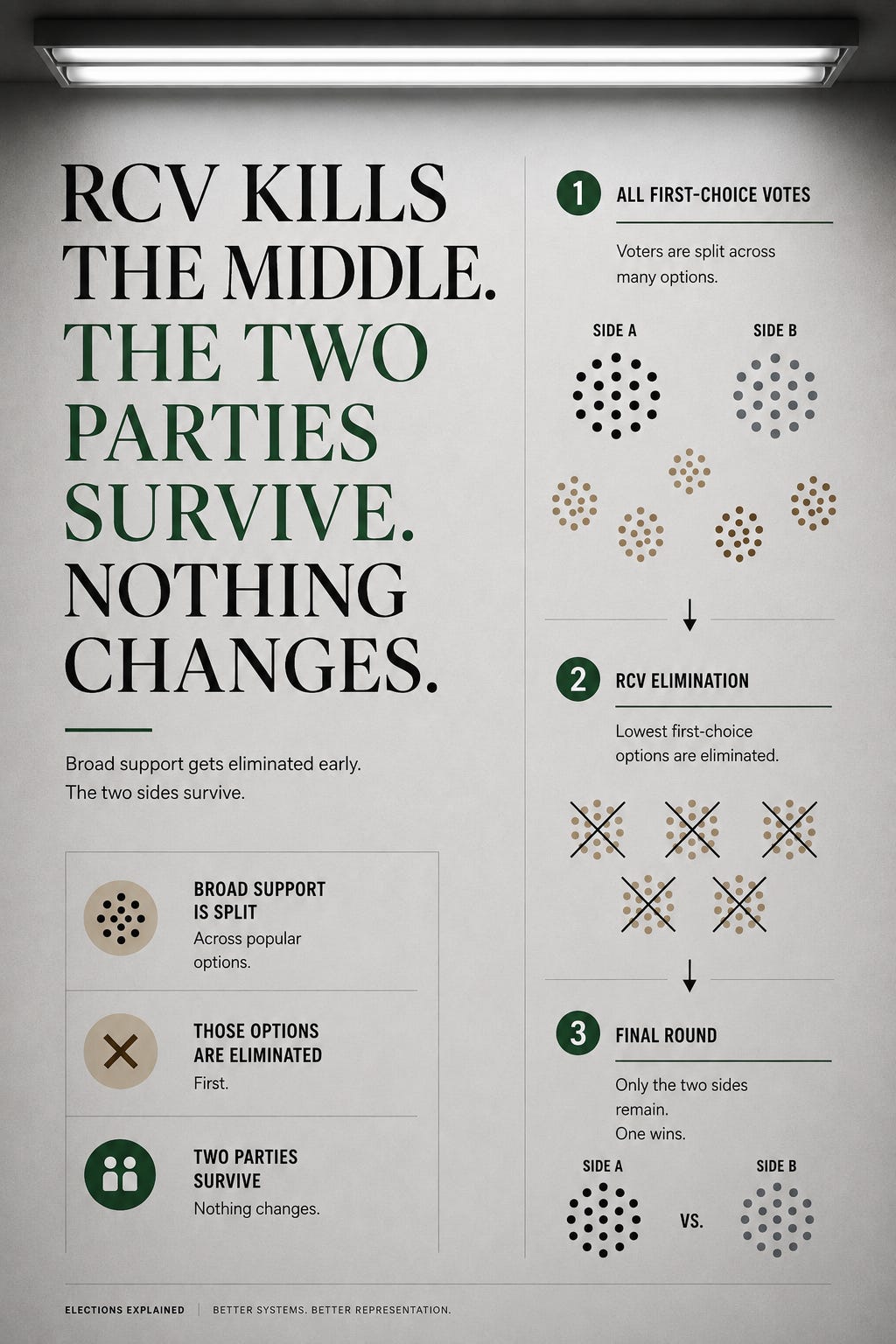
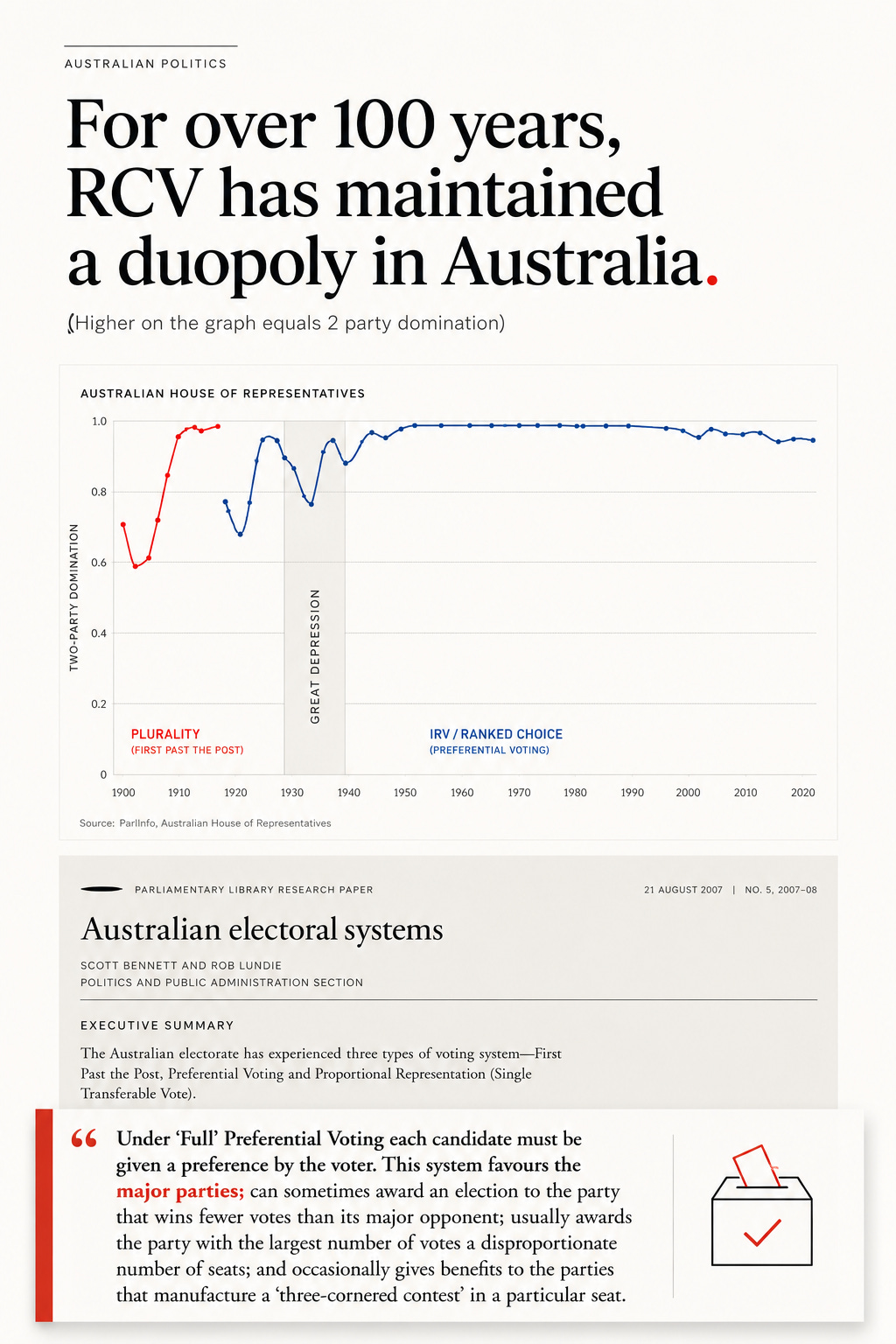
But here’s the deeper problem: these aren’t just individual election failures. They’re the mechanism that maintains the existing two-party system and prevents anything from breaking through it. Spoilers and center squeeze don’t just produce bad outcomes in specific races — they make it mathematically near-impossible for a third option to survive in a competitive field.
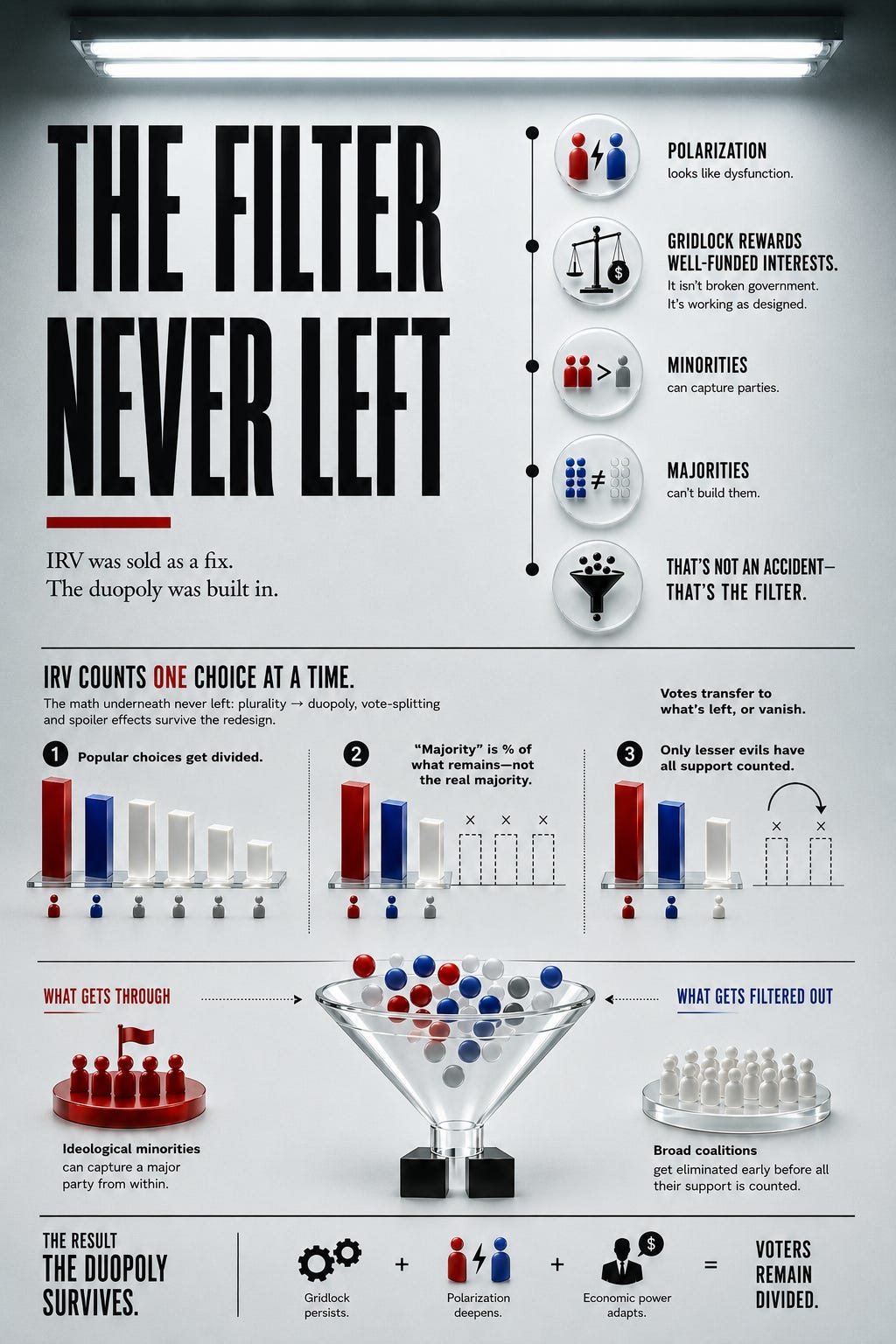
A race looks divided because the system makes the majority disappear. The two dominant parties don’t just survive — they’re actively protected by the mechanics.
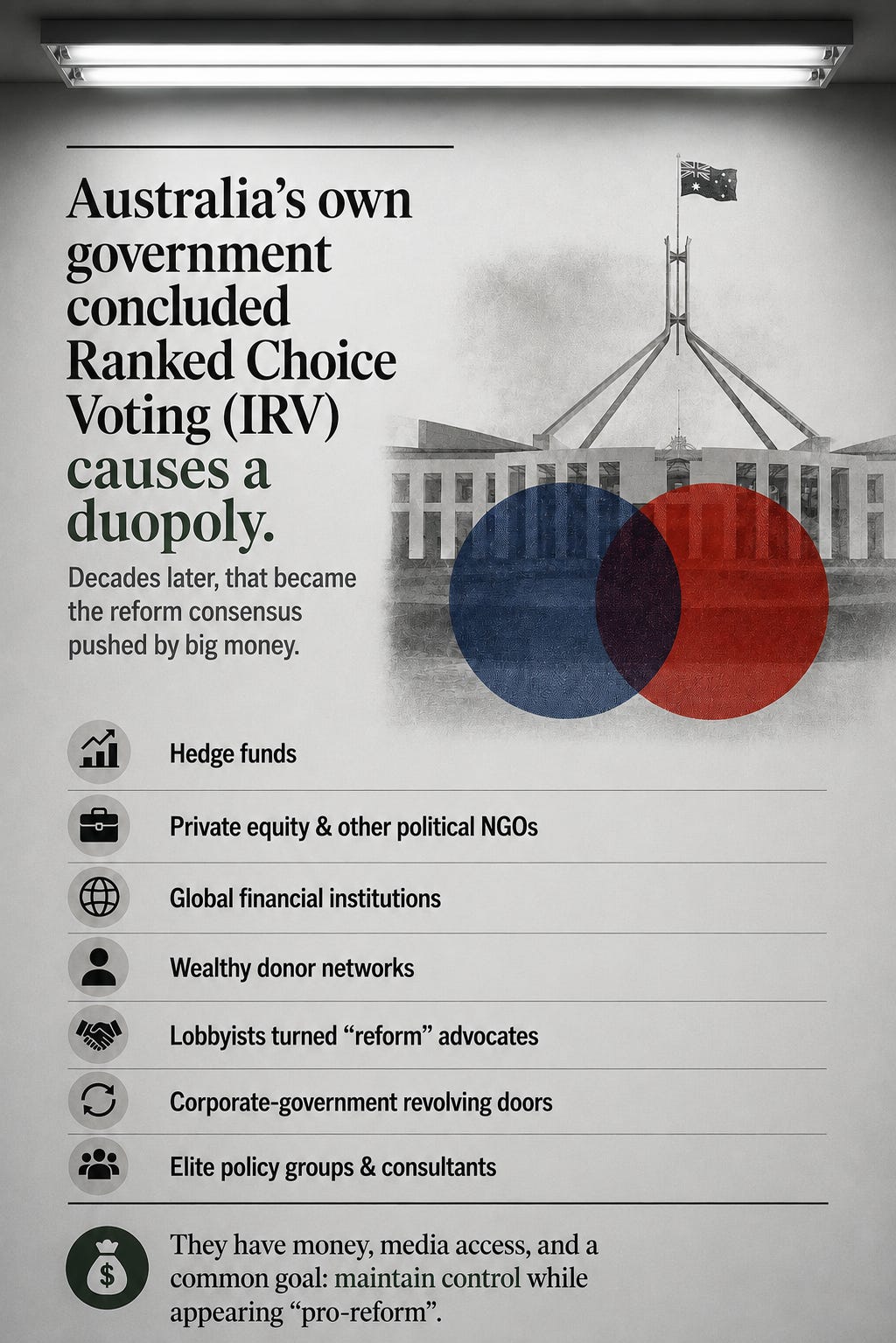
IRV doesn’t break the duopoly. It launders it.
Any new candidate or movement that gains traction immediately threatens to split the side it’s closest to, triggering exactly the dynamic that gets them eliminated. The lesson is learned fast. Voters hedge toward whoever looks safest. Parties gate-keep to prevent their side from splitting.
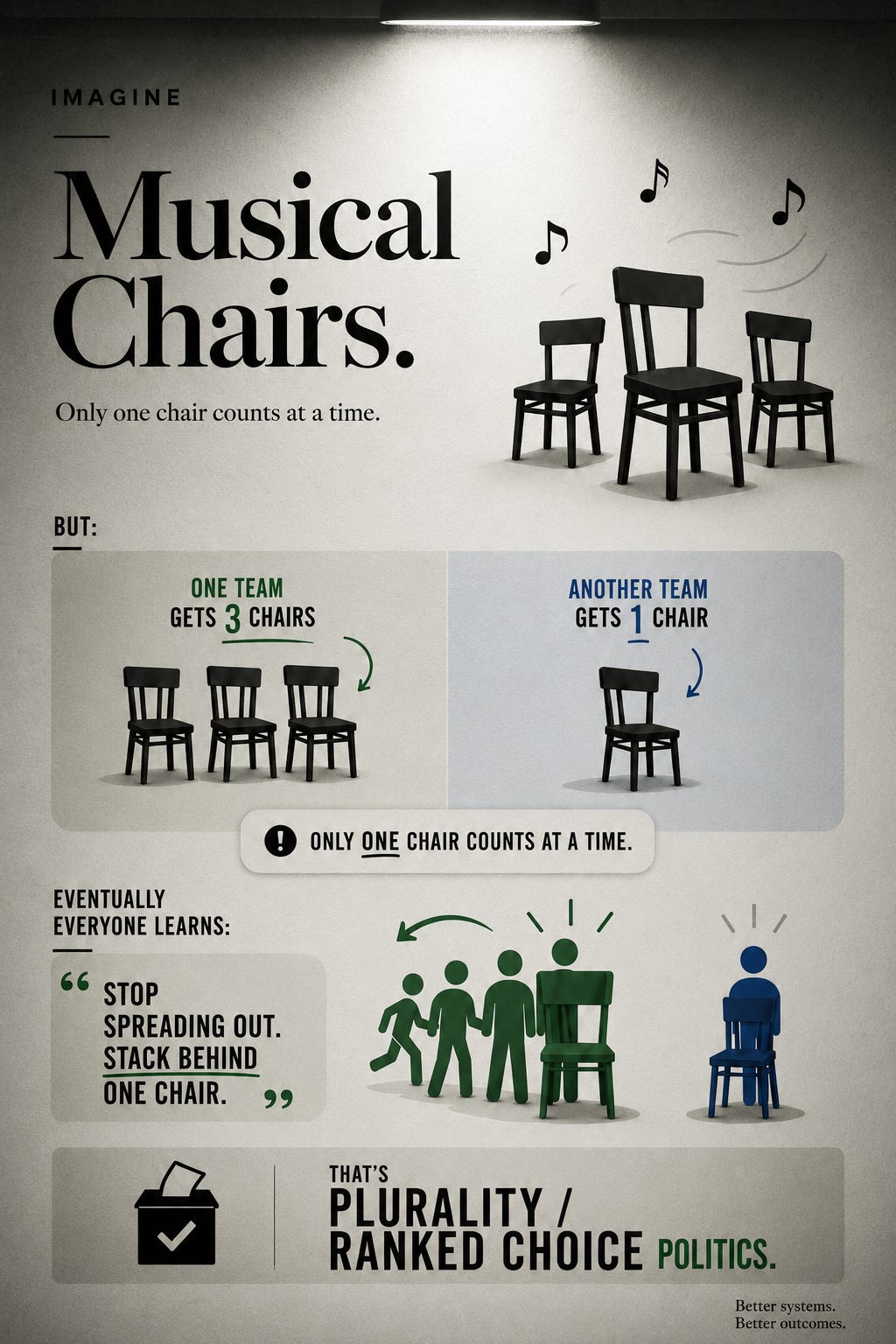
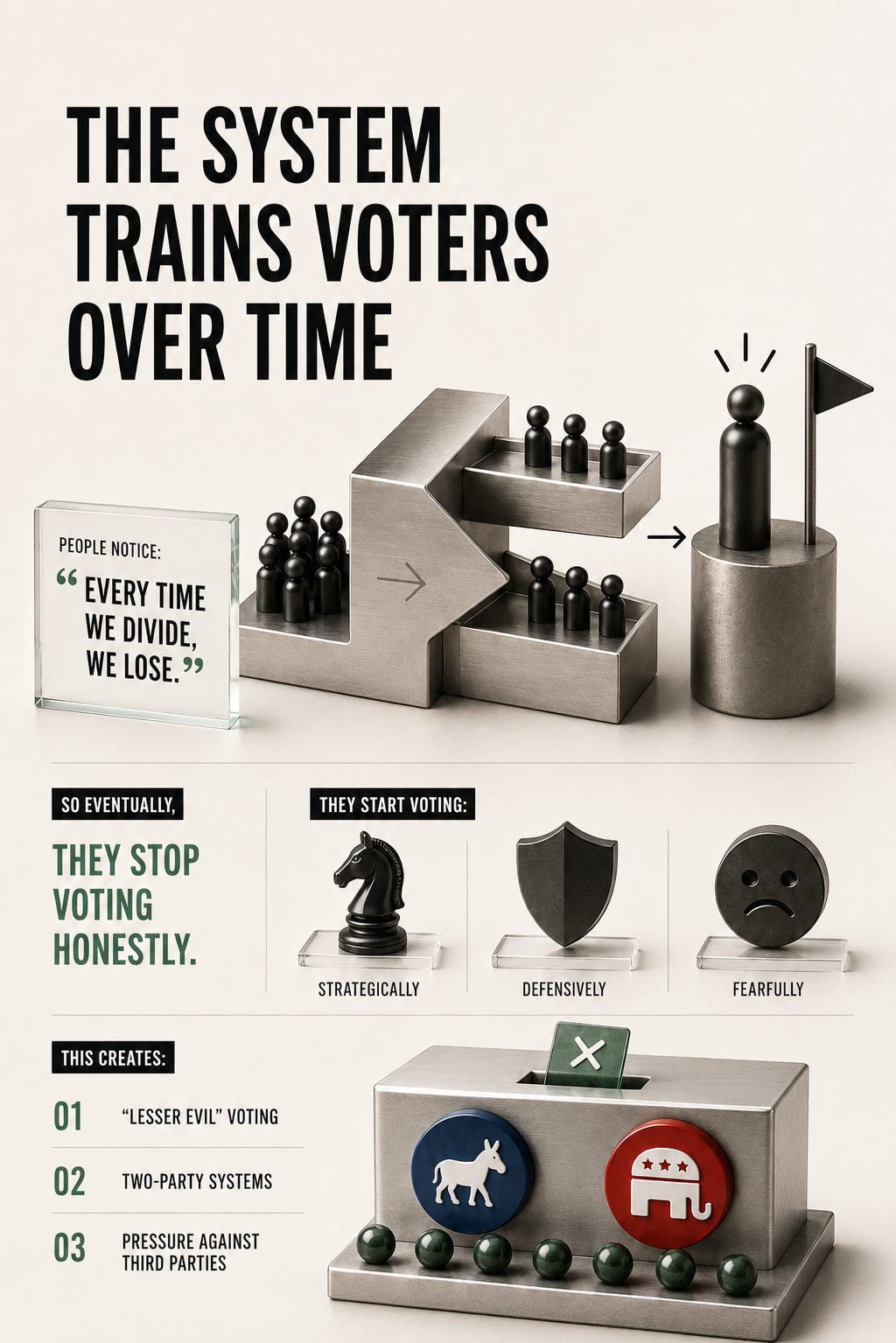
Multi-candidate races feel chaotic because the system makes them that way. Count the votes right, and the madness disappears. When the math works properly, everything else falls into place.
Choose a better method, and elections stop feeling like a crisis.


The rules can change. And when they do, the majority that has been disappearing into the count every election cycle becomes visible again.
That’s not optimism. That’s math.

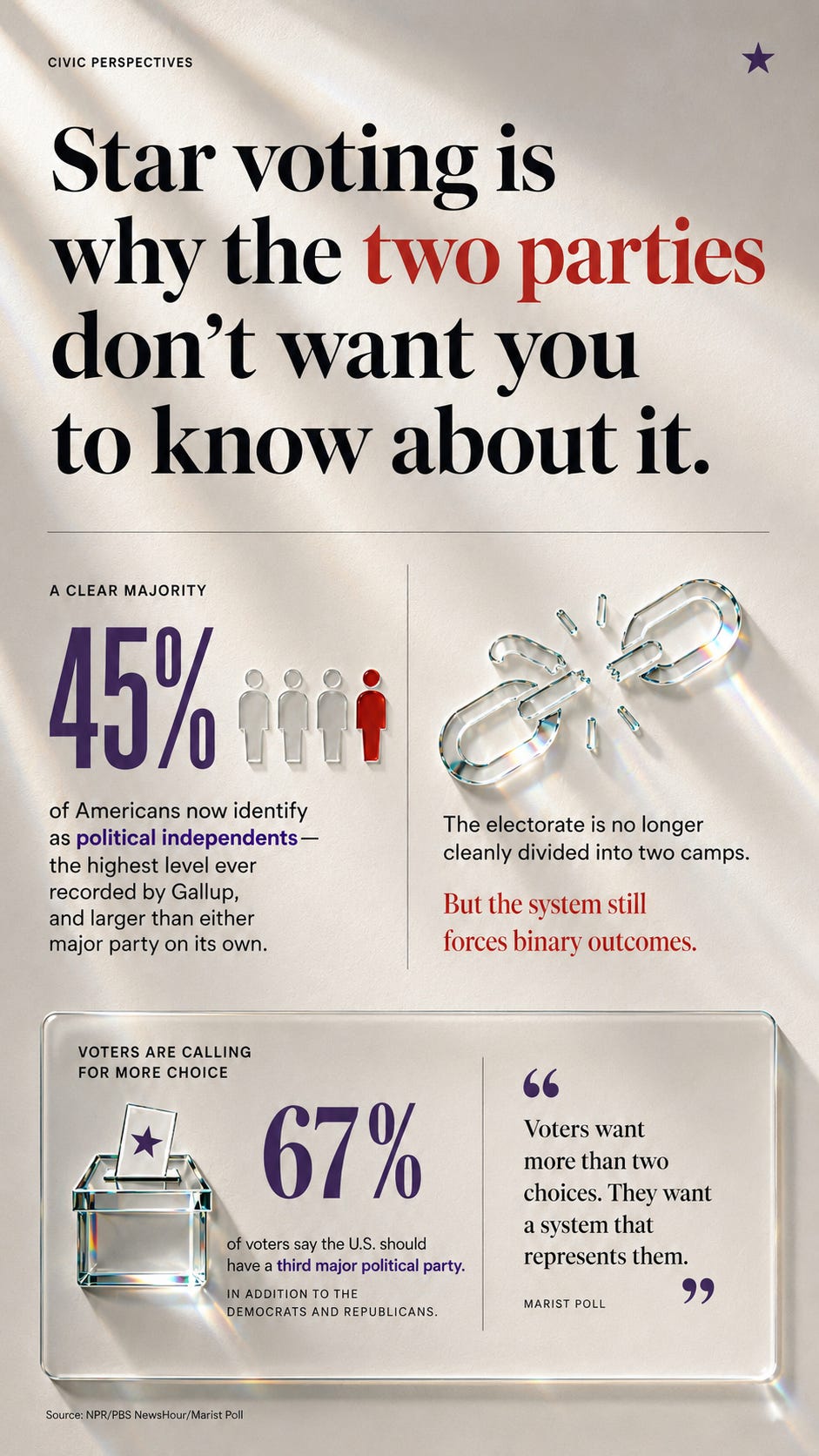
For those frustrated with the two-party duopoly — let's fight to make STAR Voting a reality. Independents outnumber Democrats. Independents outnumber Republicans. The only thing they don't have is a voting method that counts them. STAR fixes that. STAR would make our politics more dynamic, more responsive, more honest.
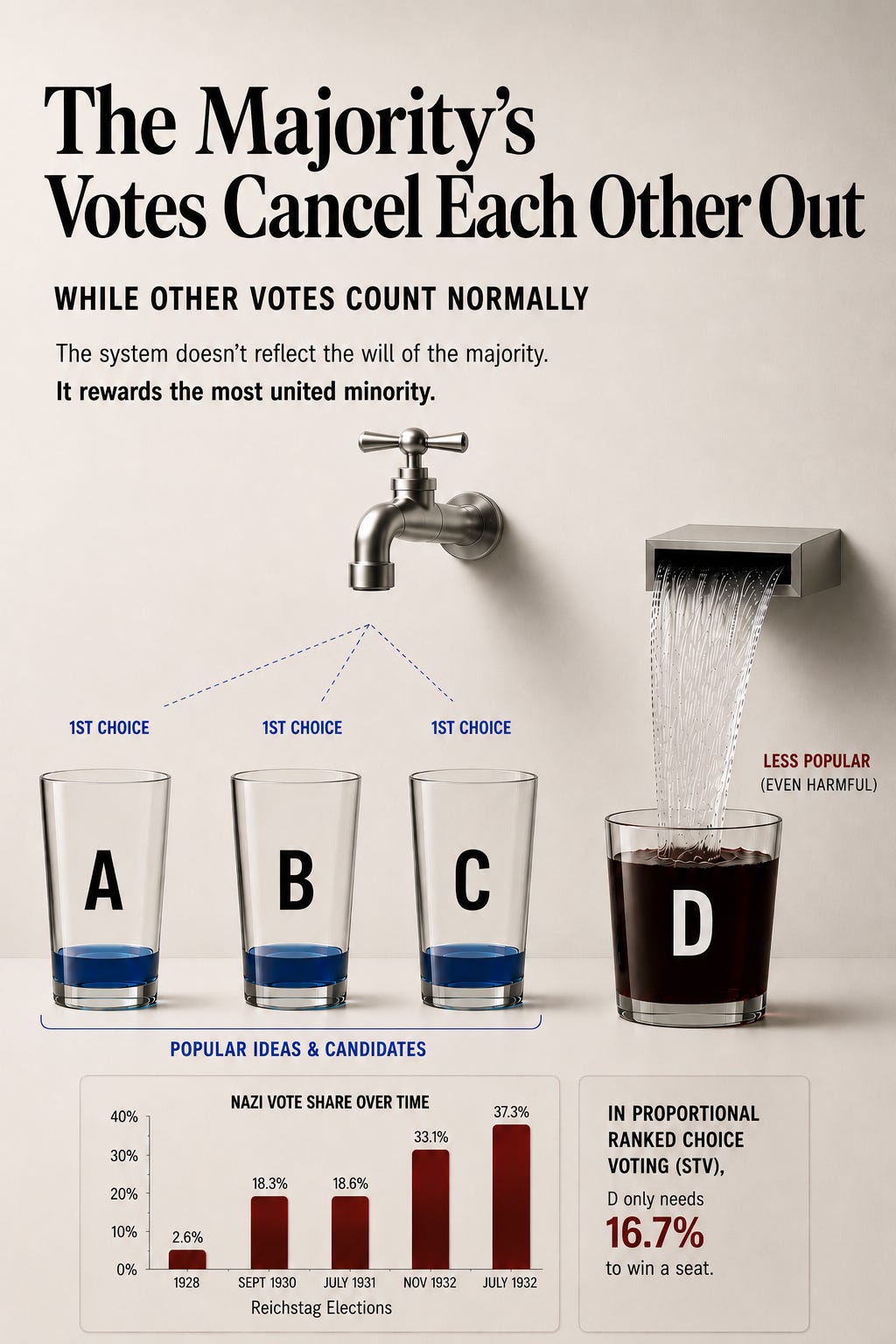
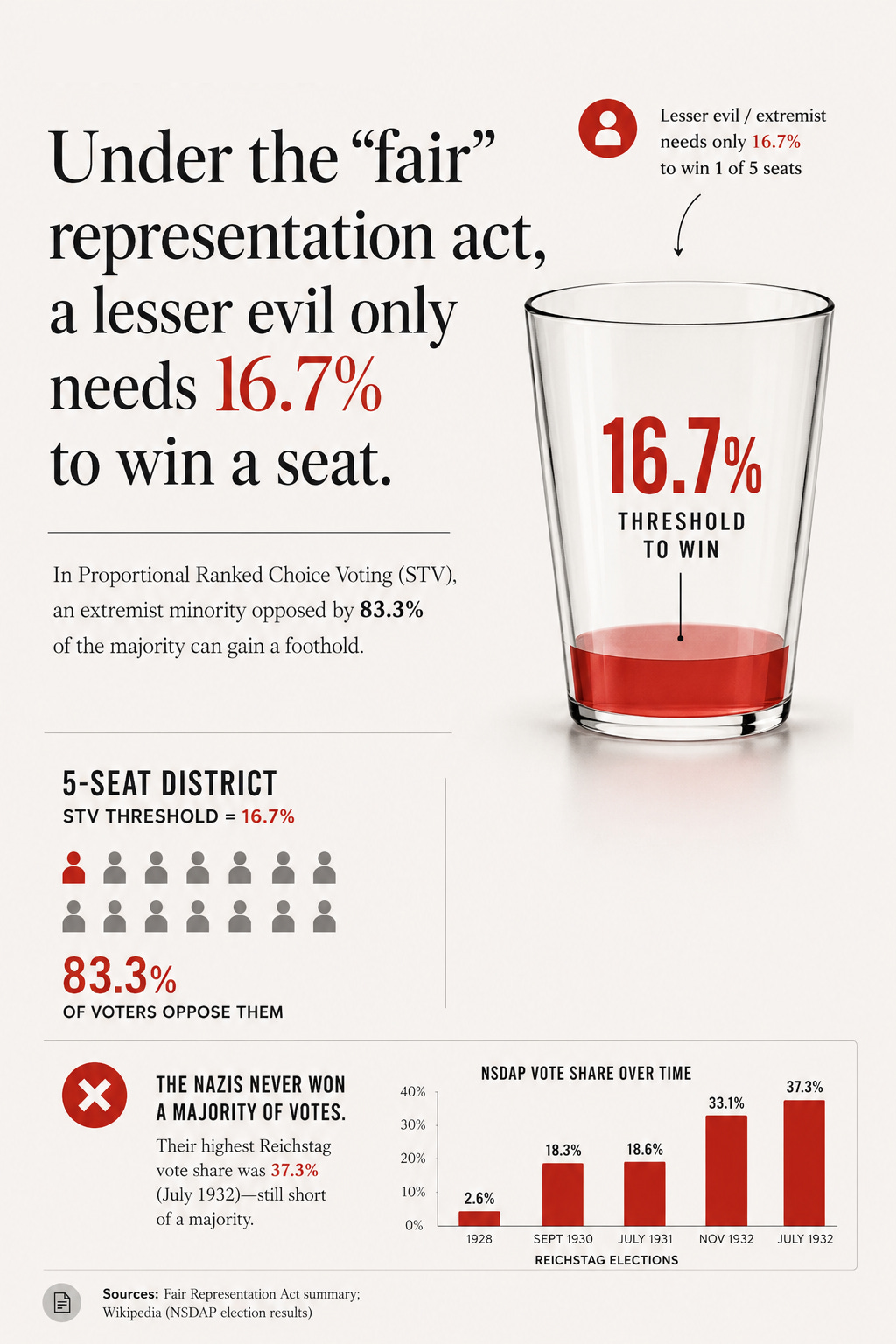
Bring up ranked choice voting’s duopoly problem and proportional ranked choice voting will almost always be the answer you get. But a system designed to broaden representation can also broaden it in the wrong direction — giving a foothold to harmful parties even when most voters, up to 83%, are united against them.
World Peace Isn't That Polarizing, Actually.

Chapter 1: We Exported Plurality Voting To Palestinian Elections. It Elected Hamas. We Still Use It Here. Connect The Dots.
3. RCV Ensures A Majority Wins
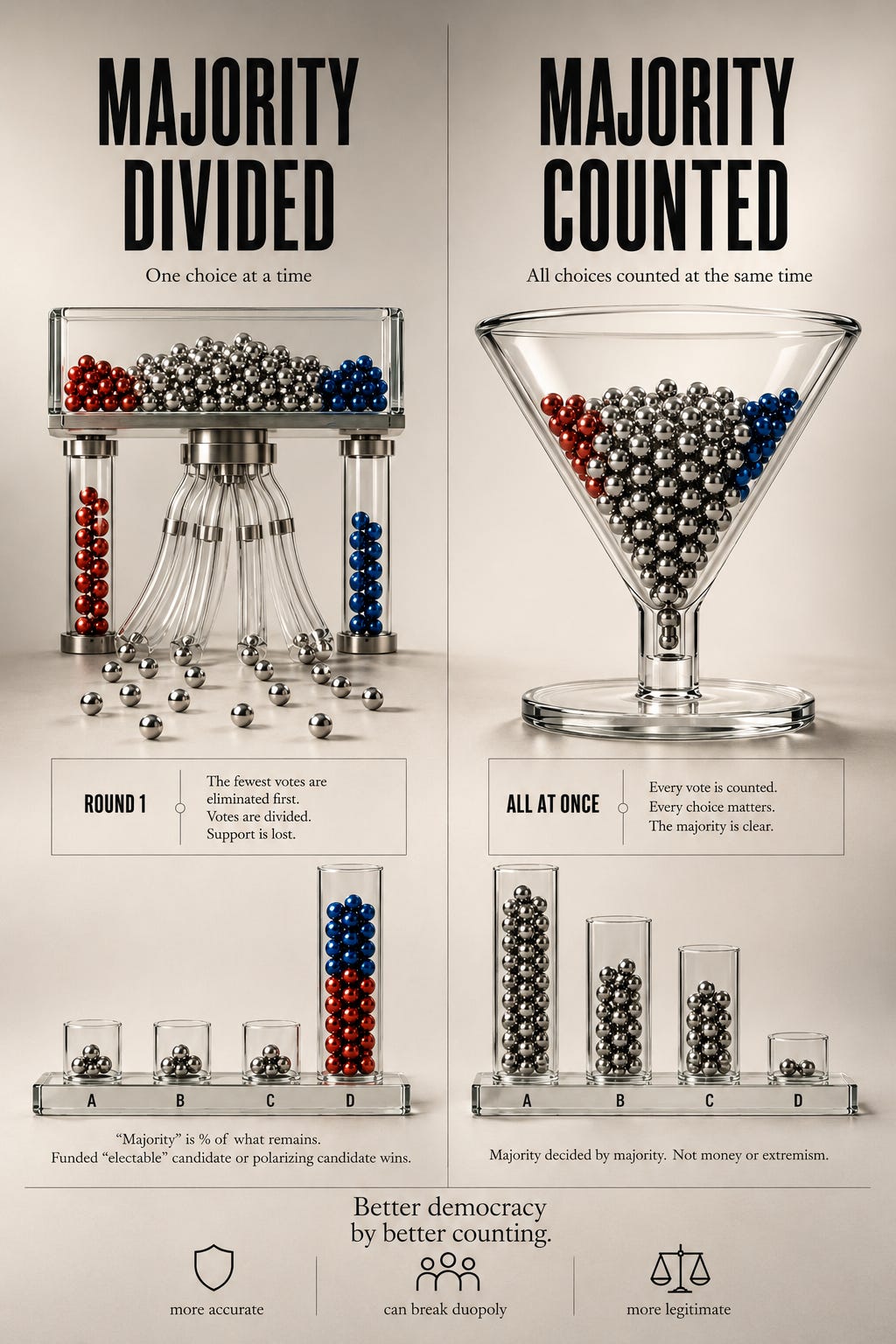
The “majority rule” claim has a similar problem. The majority IRV produces is built from whoever is left standing. By the final round, many voters’ original choices are already gone, and the winner needs only a majority of the remaining ballots — not a majority of what the full electorate actually wanted. True totals are wildly distorted.

Vote redistribution — the mechanism IRV depends on to fix all this — is more limited than it sounds. Votes only move to surviving candidates. Lose your second choice early, and your ballot slides to your third, then your fourth — the earlier the elimination, the less your original preferences matter. Your two favorite candidates can knock each other out splitting your 1st and 2nd choice votes, leaving you with a weaker third — and, ultimately, the lesser evil.
4. You Can Support Multiple Candidates
Then there's the ranking question. IRV's supporters like to describe ranking as a way to support multiple candidates. But ranking is a pecking order, not a coalition — one support at a time. You're forced to order your preferences from first to last; your second-choice vote only activates once your first is eliminated.
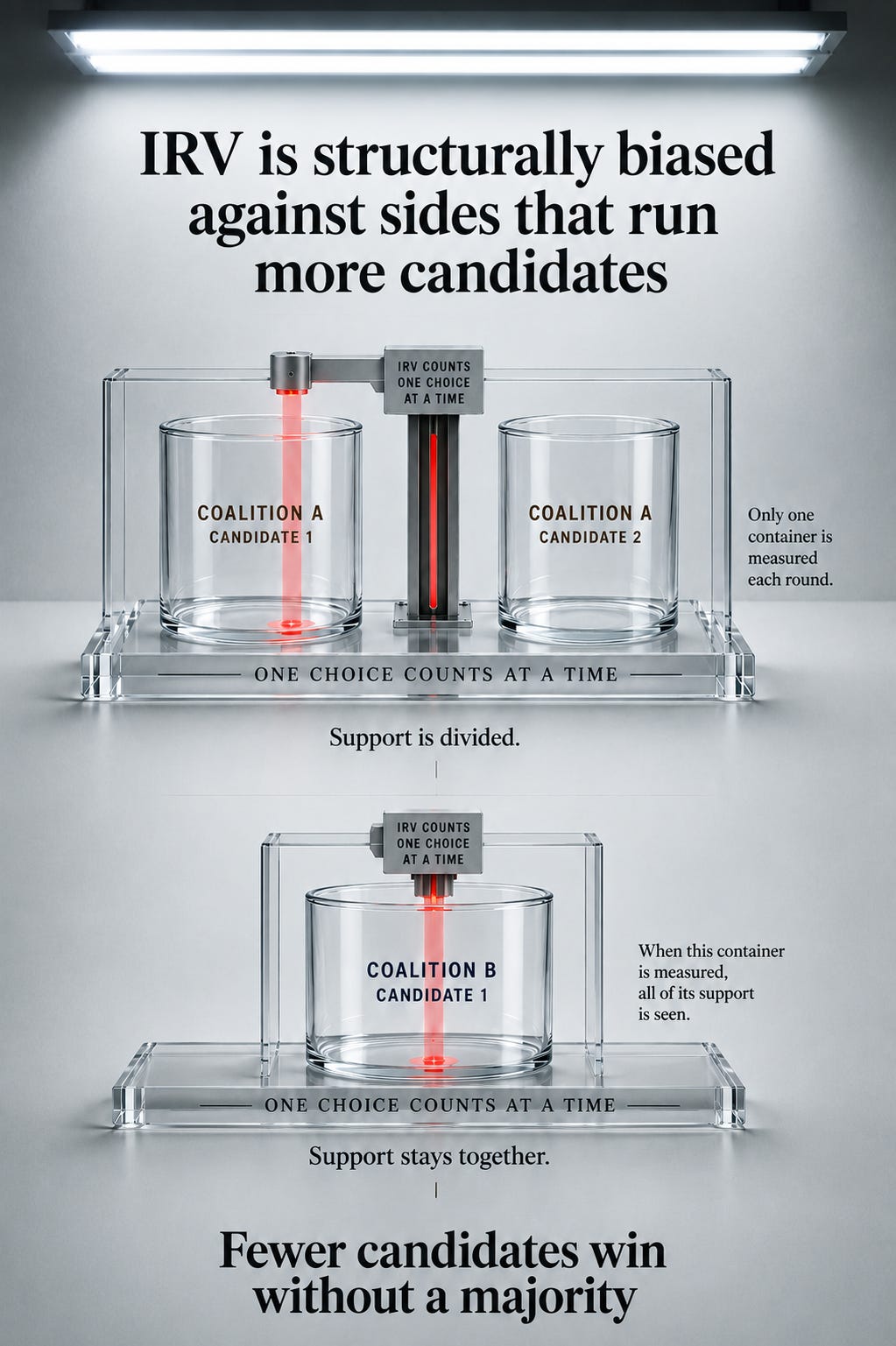
There is no way under IRV to say 'I support both of these candidates equally,' 'my coalition is bigger than five candidates' (or whatever arbitrary number the horizontal width of a ranked ballot design decides it can fit), or 'I want all my support counted for every candidate' — the format doesn't allow it.

5. RCV Reduces Polarization
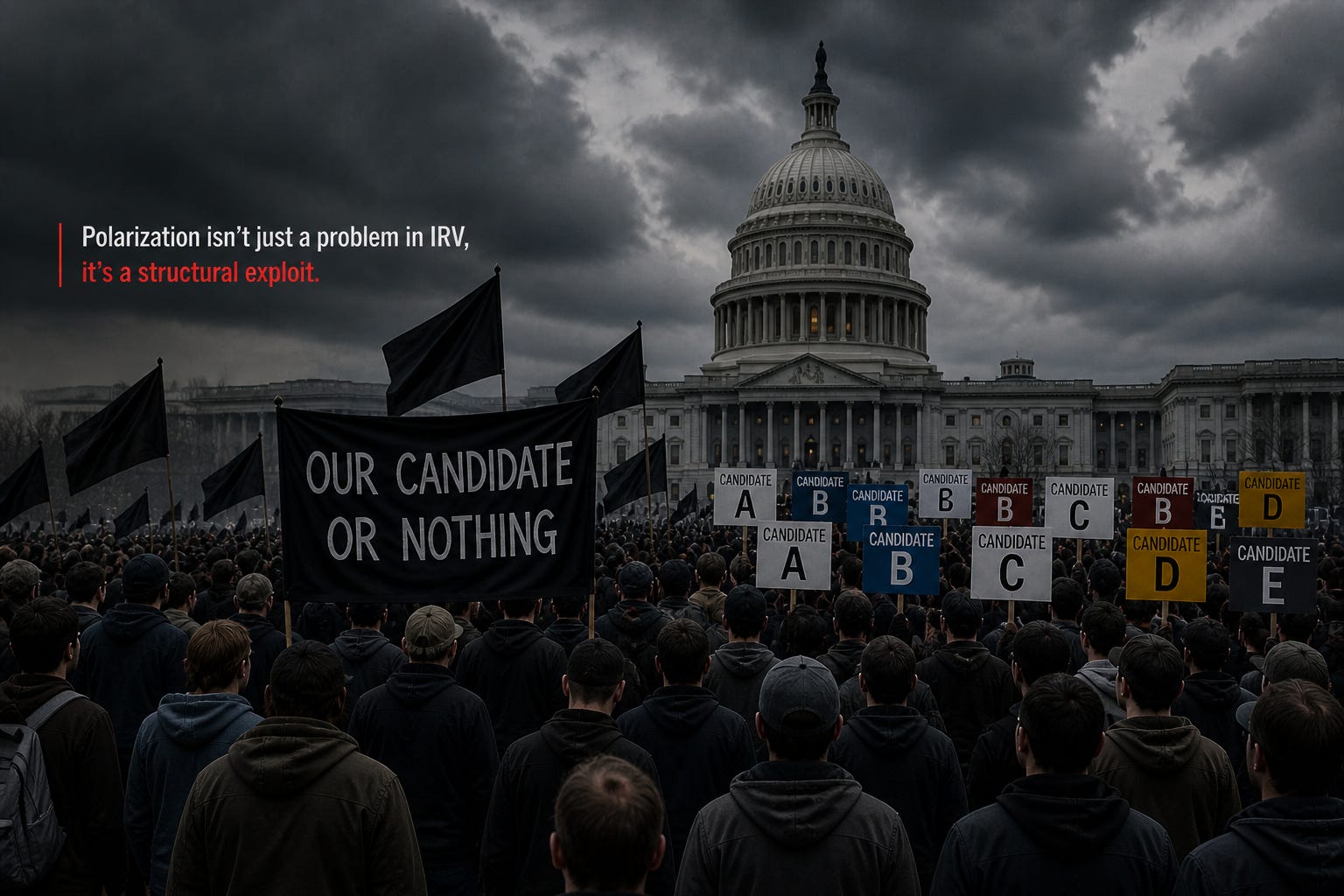
Finally, the claim that IRV reduces polarization and helps unifying candidates win is contradicted by the mechanics themselves.

A candidate who is nearly everyone's second choice — the classic unifier, the consensus builder — can be knocked out early simply because they weren't anyone's polarizing first choice. It doesn't even take that; a crowded field of genuine first choices can divide and conquer each other just as easily.



IRV rewards unpopularity over popularity — the bigger and more popular a coalition is, the more candidates it has, and the more ways IRV finds to divide and conquer it, one 'choice at a time.' What survives isn't the most support. It's whatever's left after the split — the leftovers, the lesser evils.

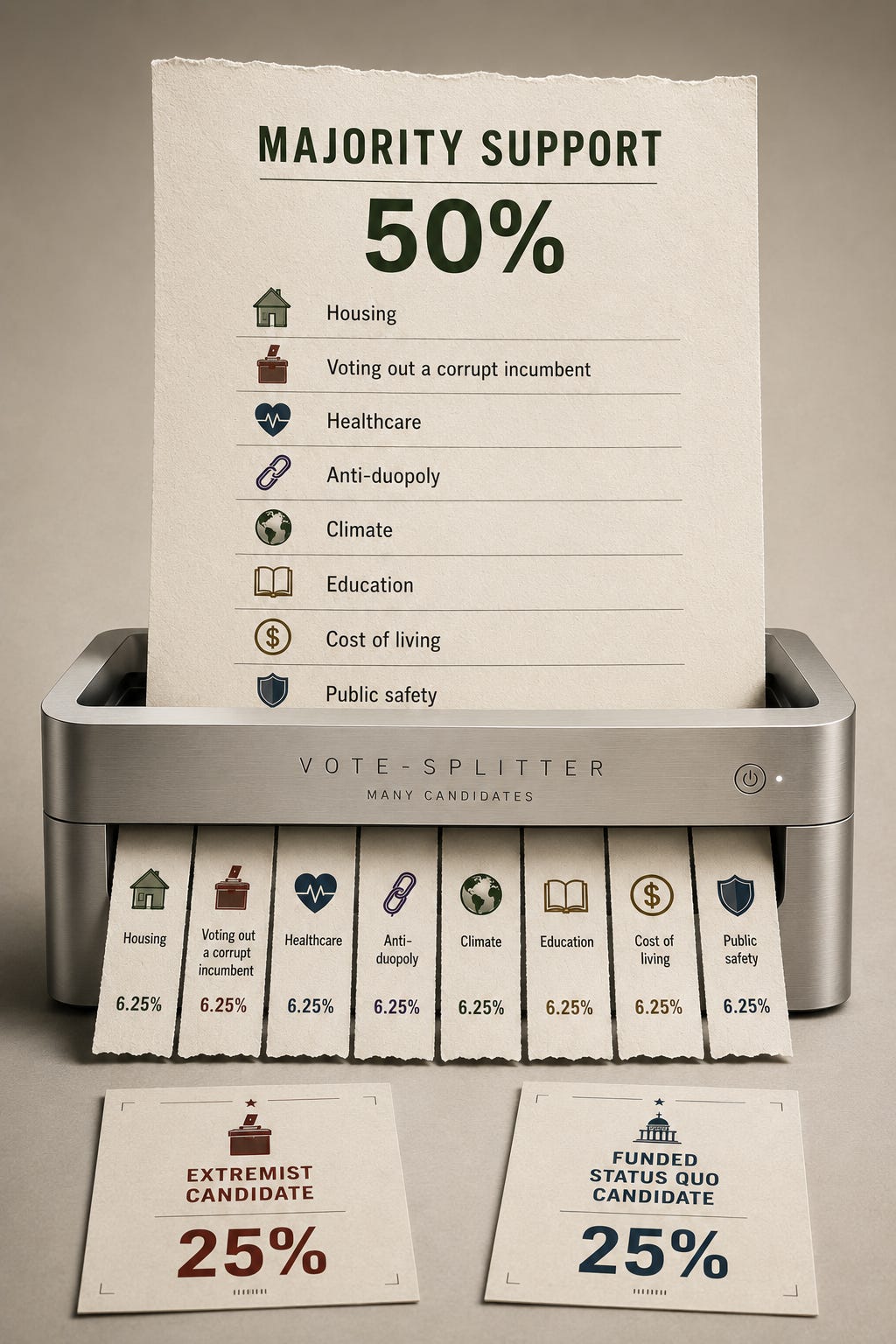

And with bullet voting in play, polarization can actually increase.
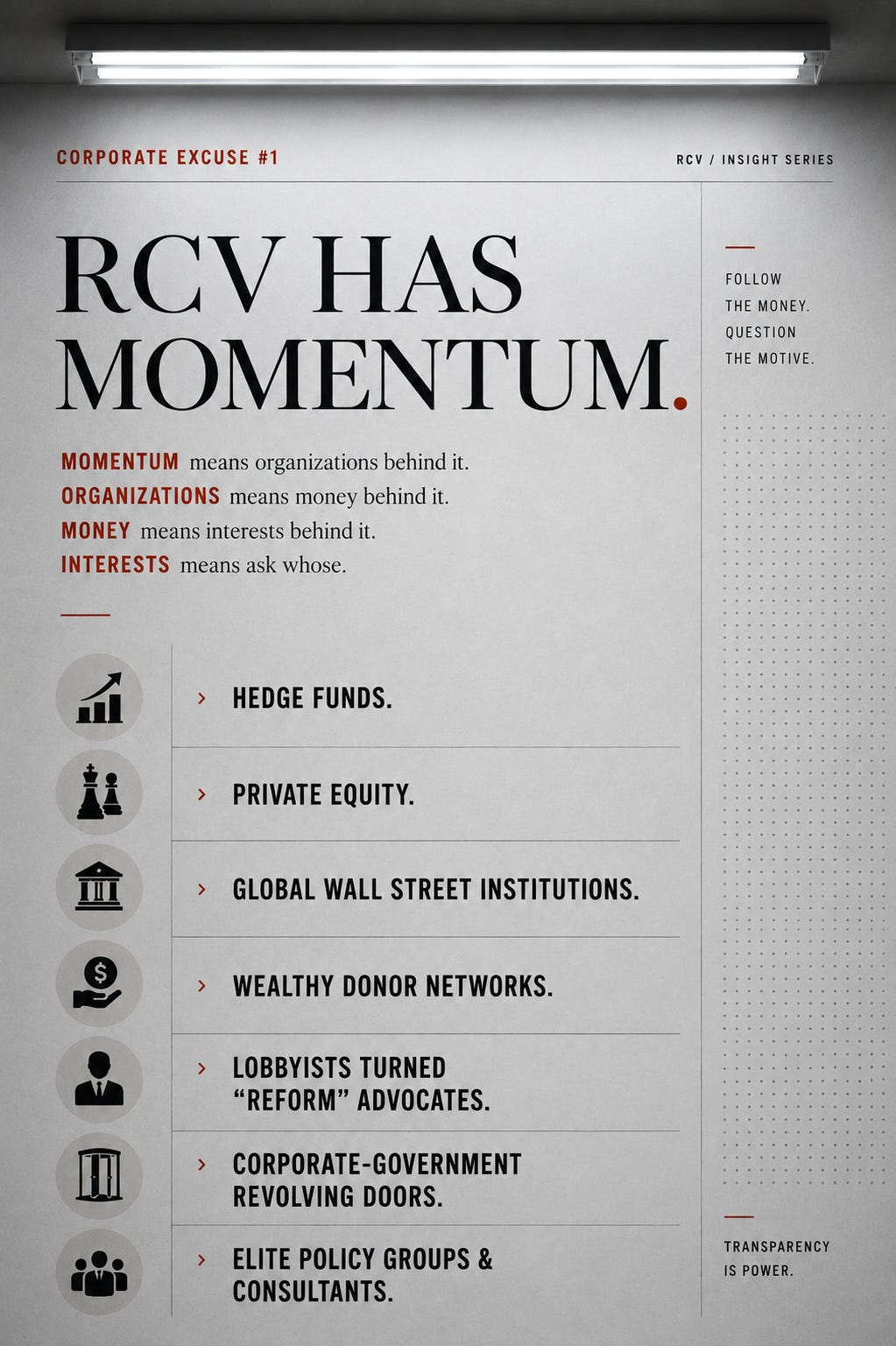
Part 3: Corporate Excuse #1 — “RCV Has Momentum” (Big Donor Money)


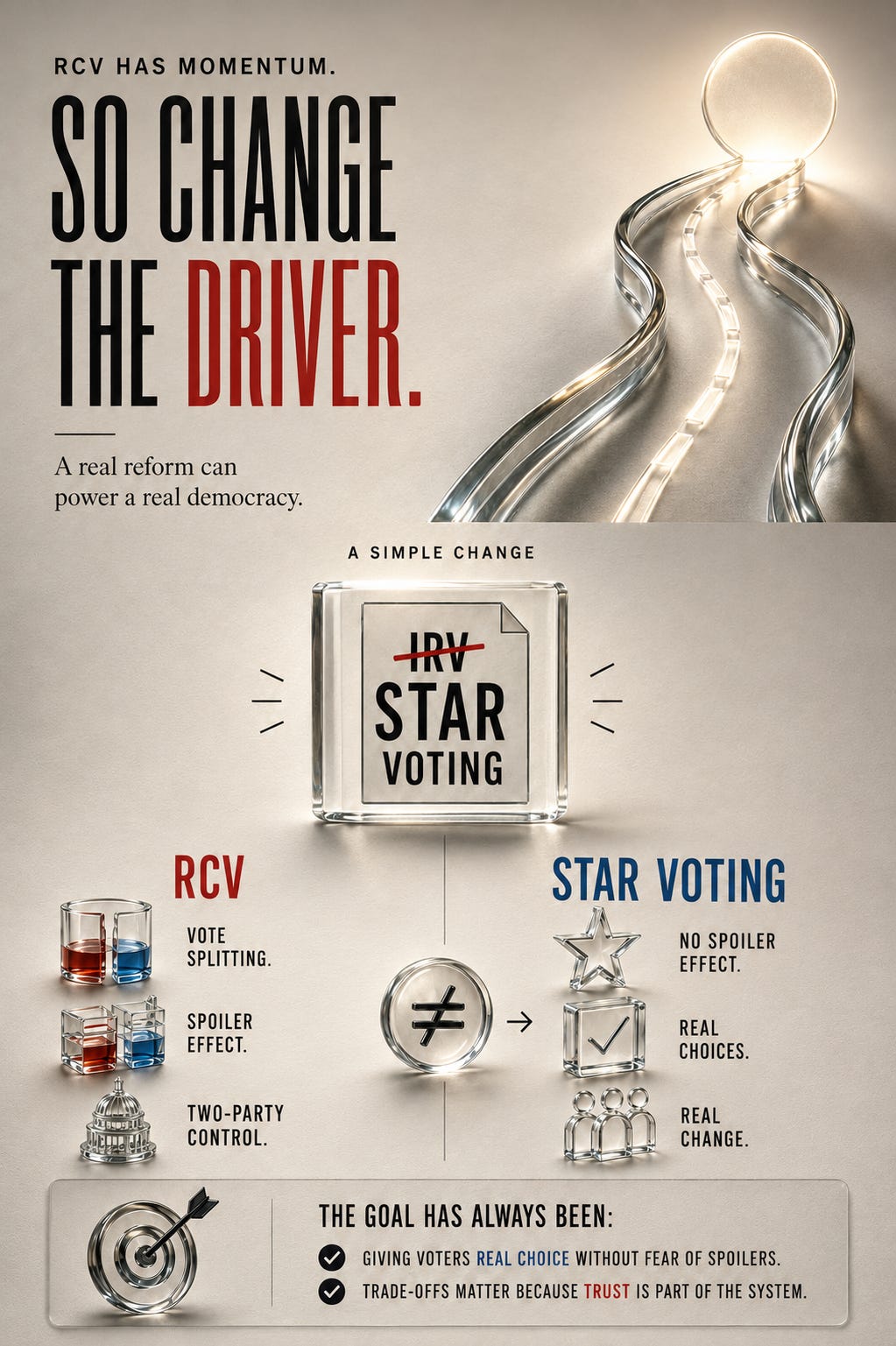
Wherever ballot language already says ‘Ranked Choice Voting,’ those three words can be replaced with a system that delivers what RCV promised. RCV did the organizing work. Now finish it with a method worthy of what that work was for.
Voting Methods Finally Explained in Plain English

This Isn’t A Culture War. It’s A Cost of Living War.