Why “FairVote” Means Different Things To Different People


Chapter 1: Three definitions of “fairness” are colliding—and no one’s saying it out loud.
There are three sections on this ship:
• A high-income group that prefers predictable, stable outcomes
• A large, exhausted majority
• And smaller groups that feel drowned out
They don’t define “fairness” the same way. Because they’re not playing the same game.
Some groups feel drowned out by the majority. So to them, fairness means stronger representation, even if it comes through a system that fragments the majority.


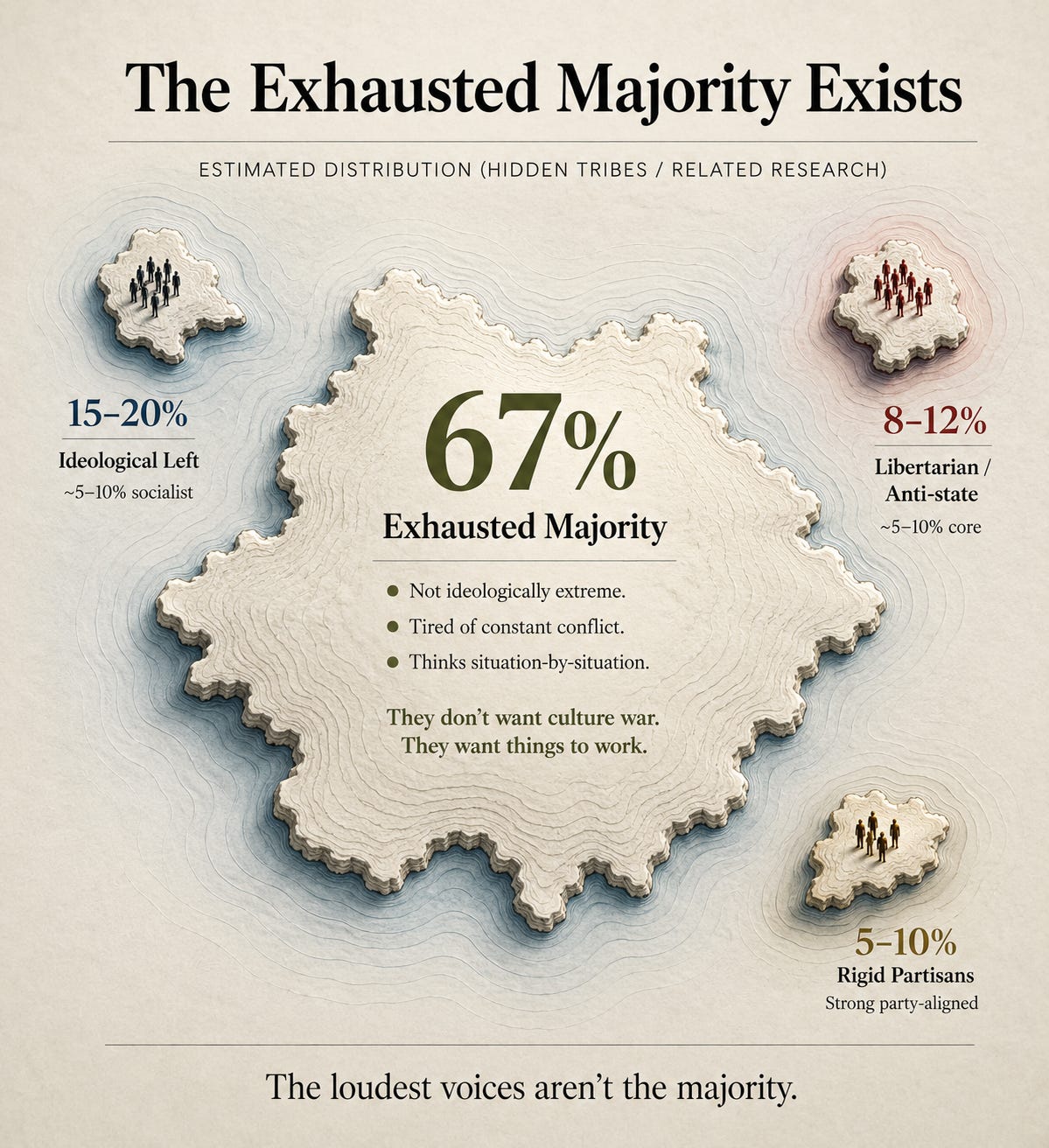
Then there’s the majority. Not the loud online version—the quiet one. Research like Hidden Tribes / “The Exhausted Majority” finds that roughly: ~67% of Americans are not ideologically extreme.
They’re:
less politically engaged
more open to compromise
tired of constant conflict
They don’t want culture war. They want things to work.
But they’re fragmented.
And fragmentation = weakness.


And then there’s a third group people don’t talk about much. The financially secure / asset holders. If you’re doing well in the current system, your incentives change.


Some groups may prefer systems that keep two sides locked in place. Not because it’s “fair” in the broad sense, but “fair” because they get to keep what’s theirs.
If you’re doing well in the current system—financially, professionally, whatever—your priorities shift a bit. It’s less about big change and more about not breaking what’s already working.

A multi-party system sounds good in theory, but it also means:
more volatility
policy swings
tax changes
uncertainty
A two-party system with a lot of gridlock? It kind of freezes things in place. That’s not great for everyone. But for people with assets, businesses, or long-term financial exposure: stability is rational.
So you end up with this weird alignment:
some people pushing harder partisan energy
a big middle that’s fragmented
and a layer of people who benefit from things not changing too fast
Chapter 2: Loud Partisan Conflict. A Fragmented Middle. Quiet People Who Benefit From Nothing Changing Too Fast.
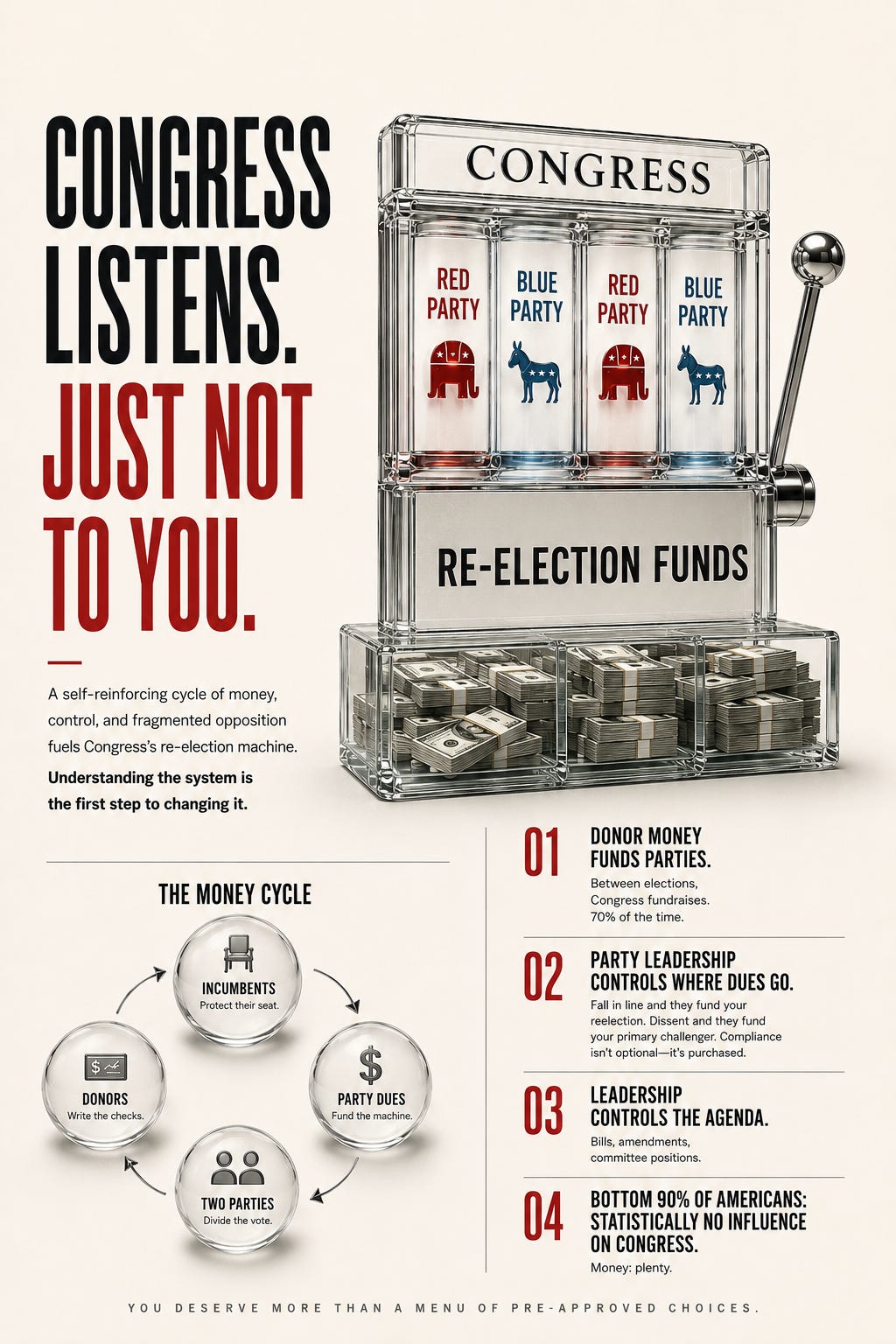
And the result is… nothing really changes.
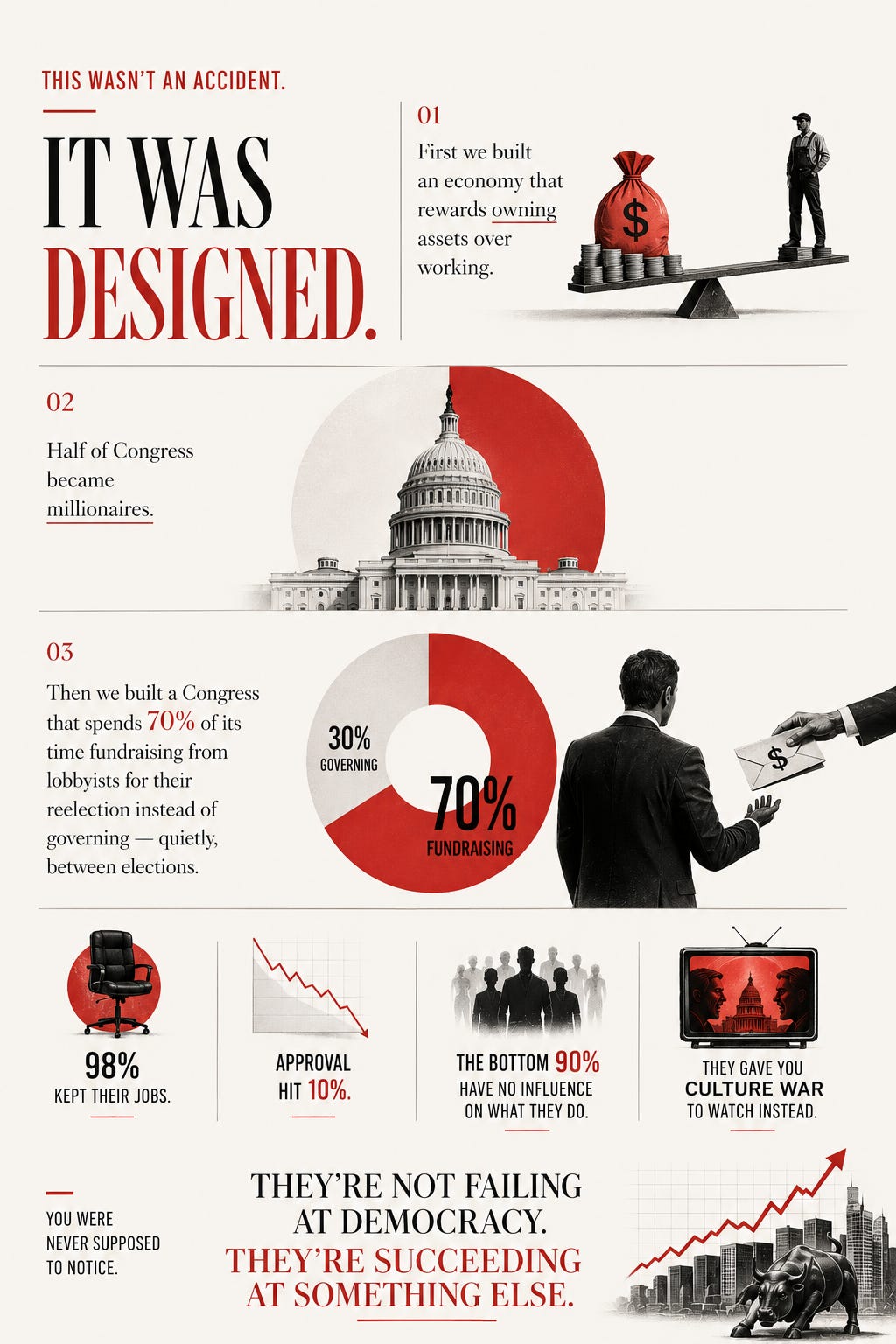
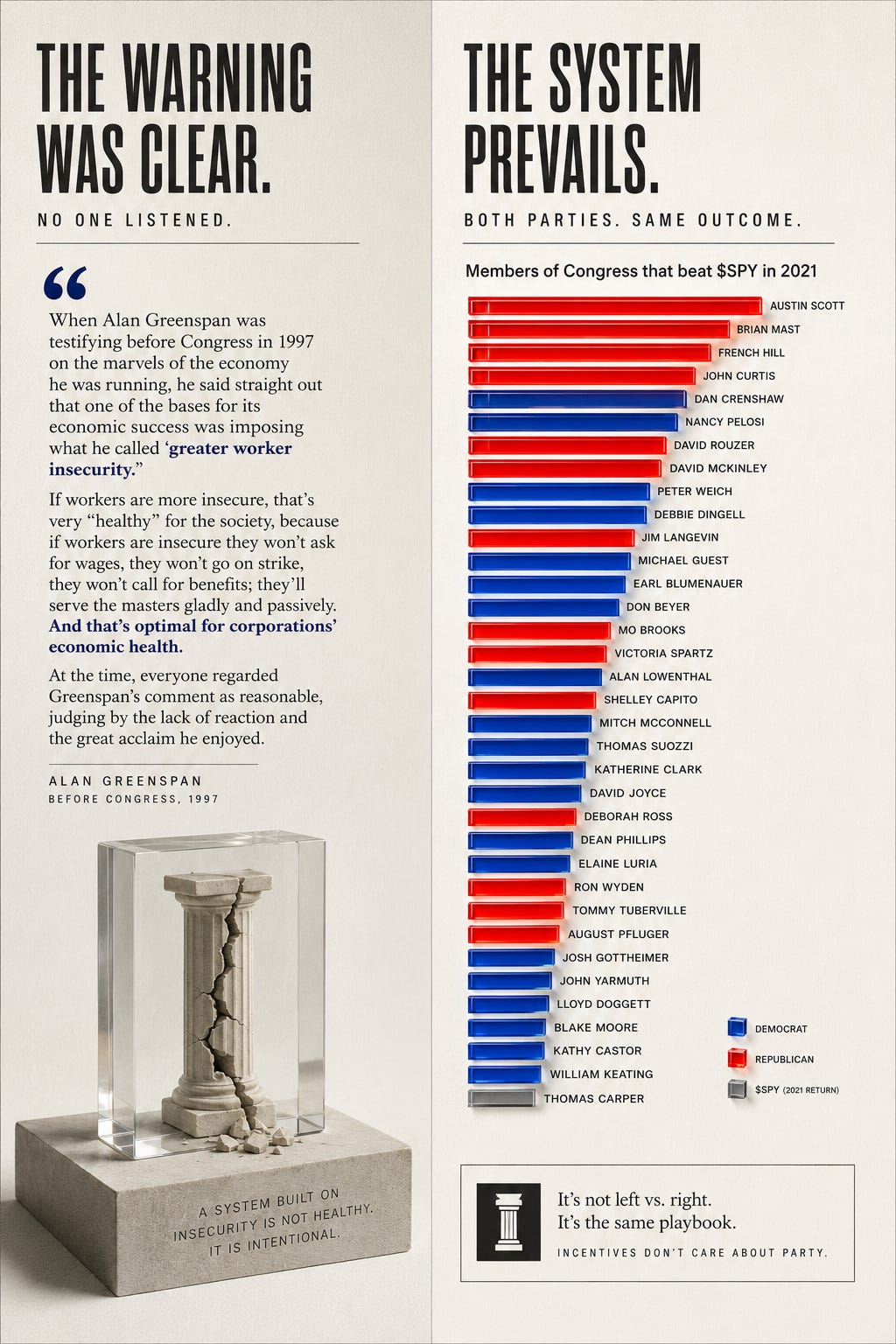
98% of incumbents get reelected. Congress has 10% approval. That gap alone should tell you something’s off.
That’s a system where: conflict is loud, change is rare, outcomes stay stable. And while we’re focused on: culture war, partisan fights, outrage cycles…
the stuff that actually moves money tends to happen quietly:
tax details
regulatory carve-outs
financial rules
Usually bipartisan. Usually low visibility.
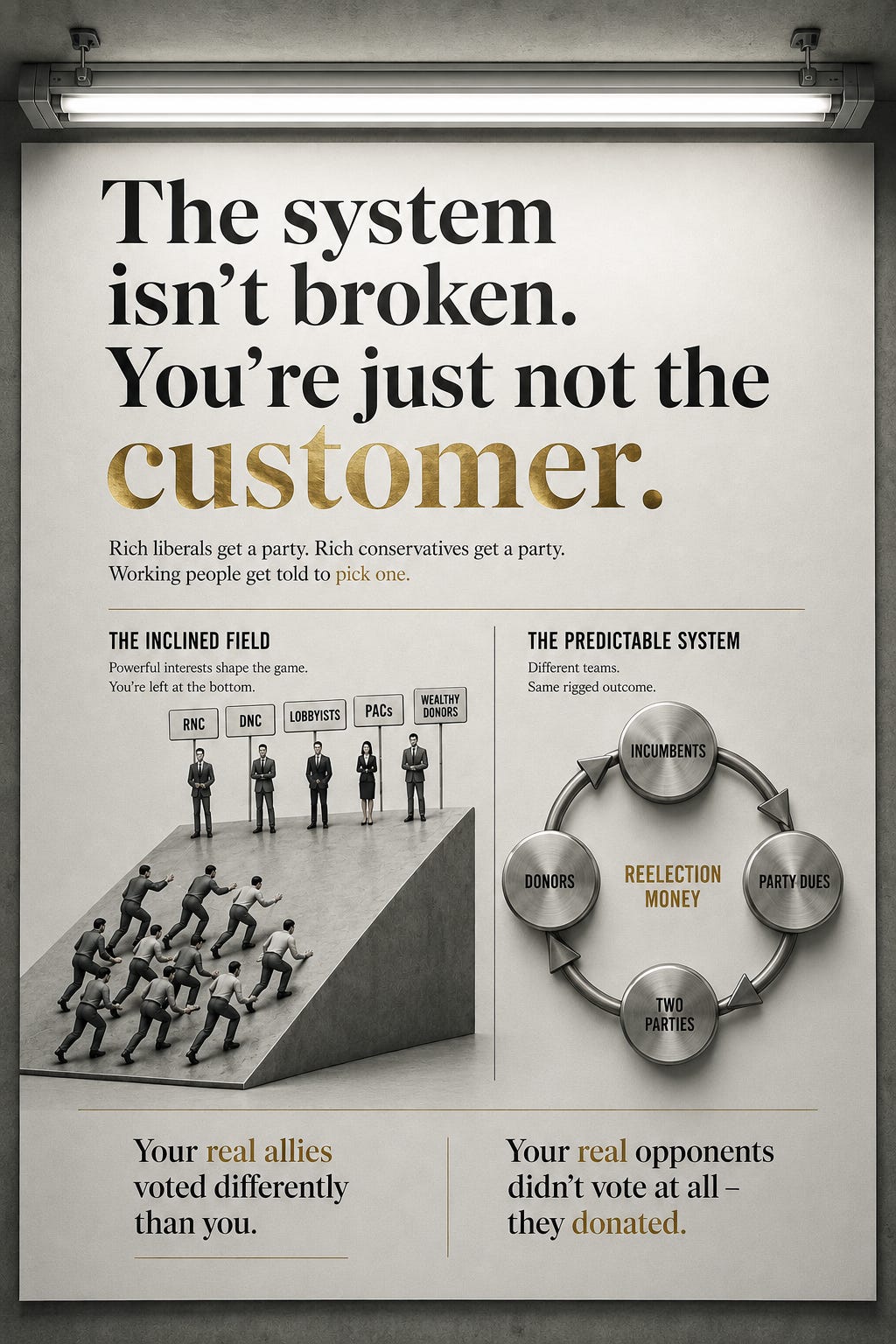
Power is easier to manage in a duopoly. Fewer players. Clearer lobbying paths. You know who matters and where to go. You can build relationships on both sides and maintain them over time.
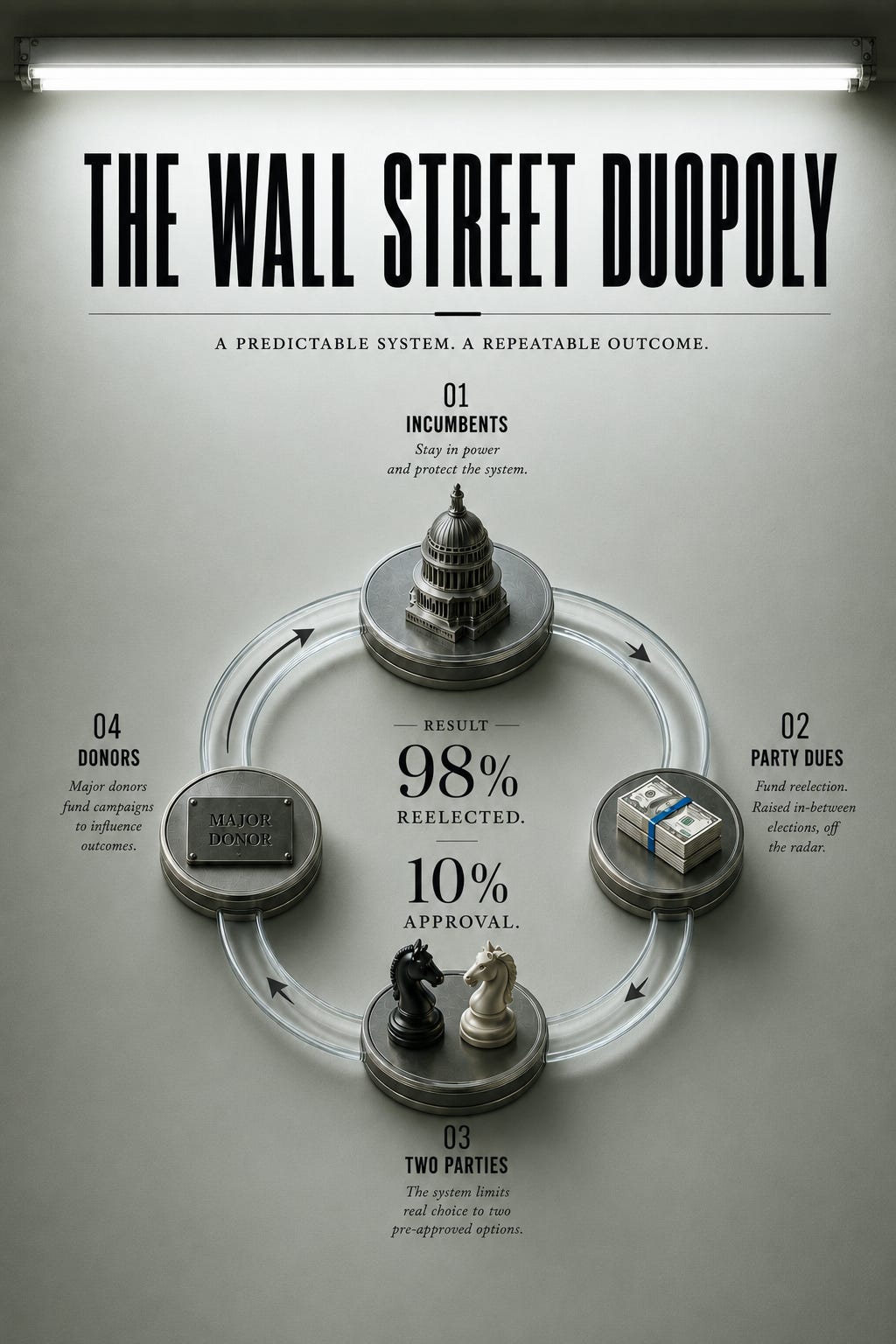
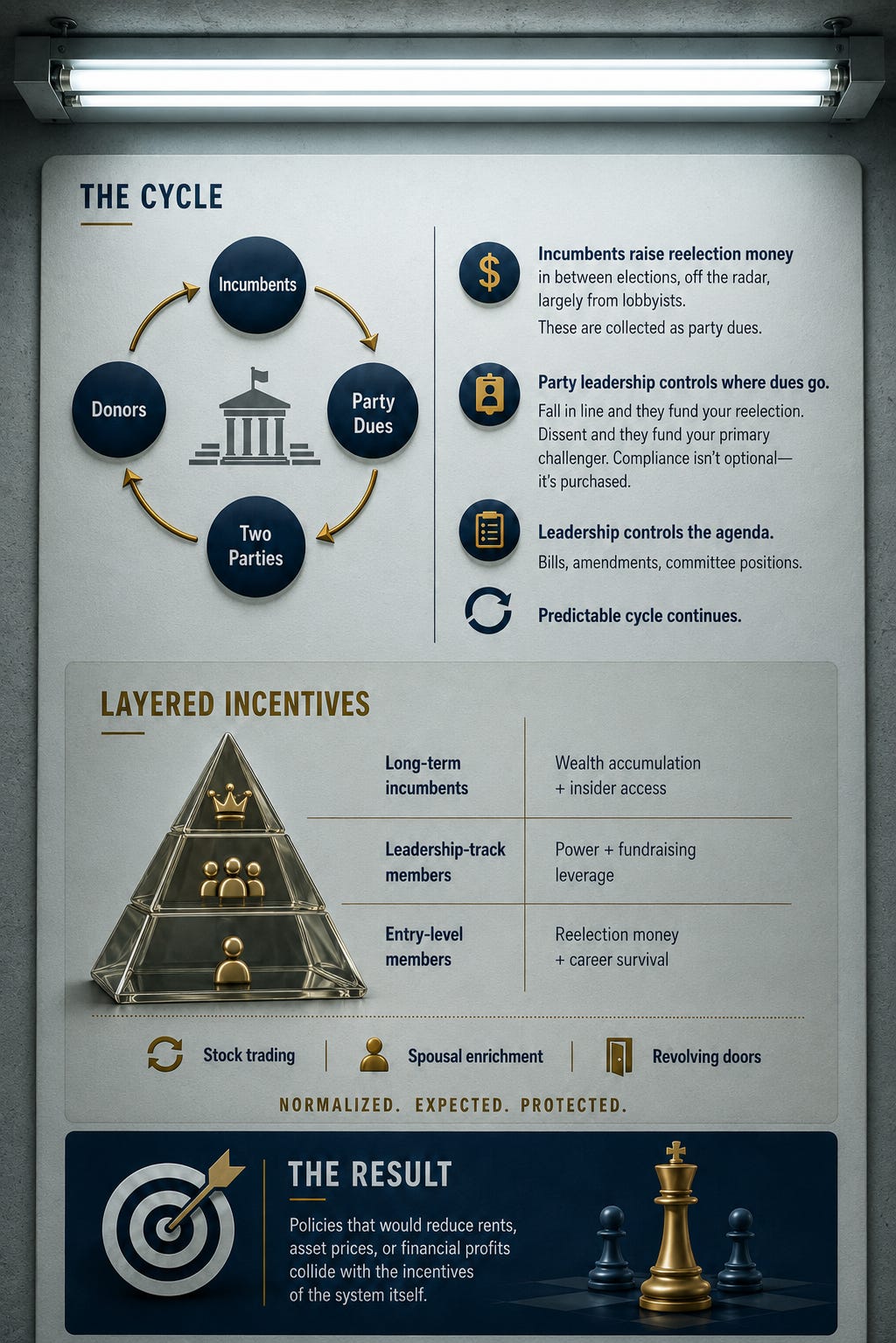

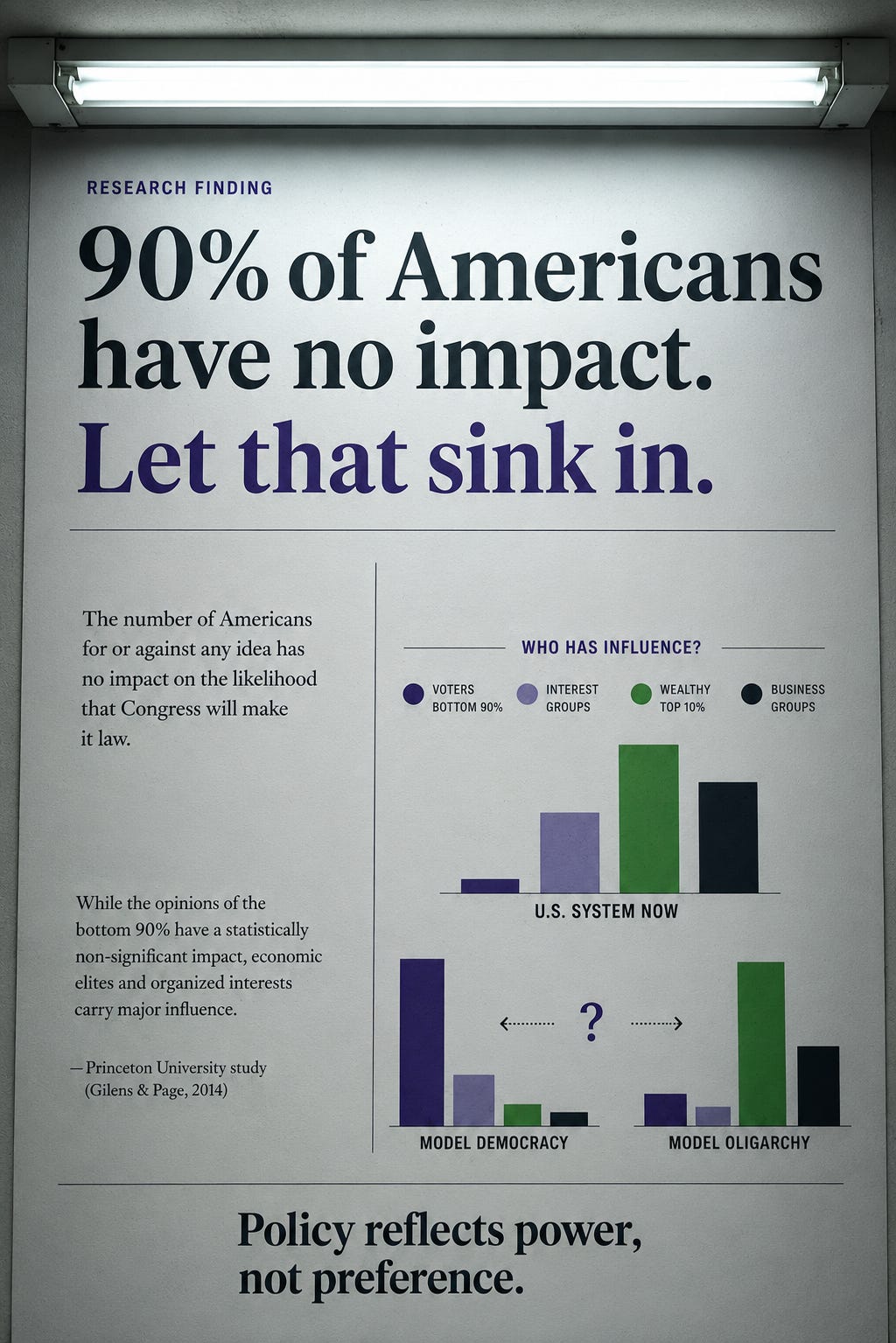
And we already have evidence for what that adds up to. Gilens and Page found that the bottom 90% have little to no measurable influence on policy outcomes, while economic elites and organized interests do.
When the bottom 90% have 0% influence, that’s not democracy.
That’s oligarchy with elections.
Now imagine: multi-party system. More candidates. More coalitions. More turnover. No same incumbents piling up millions of reelection money over their seats until the day they literally die. Influence is scattered and control is difficult.

So what’s holding it all together? Here’s the part that gets lost:
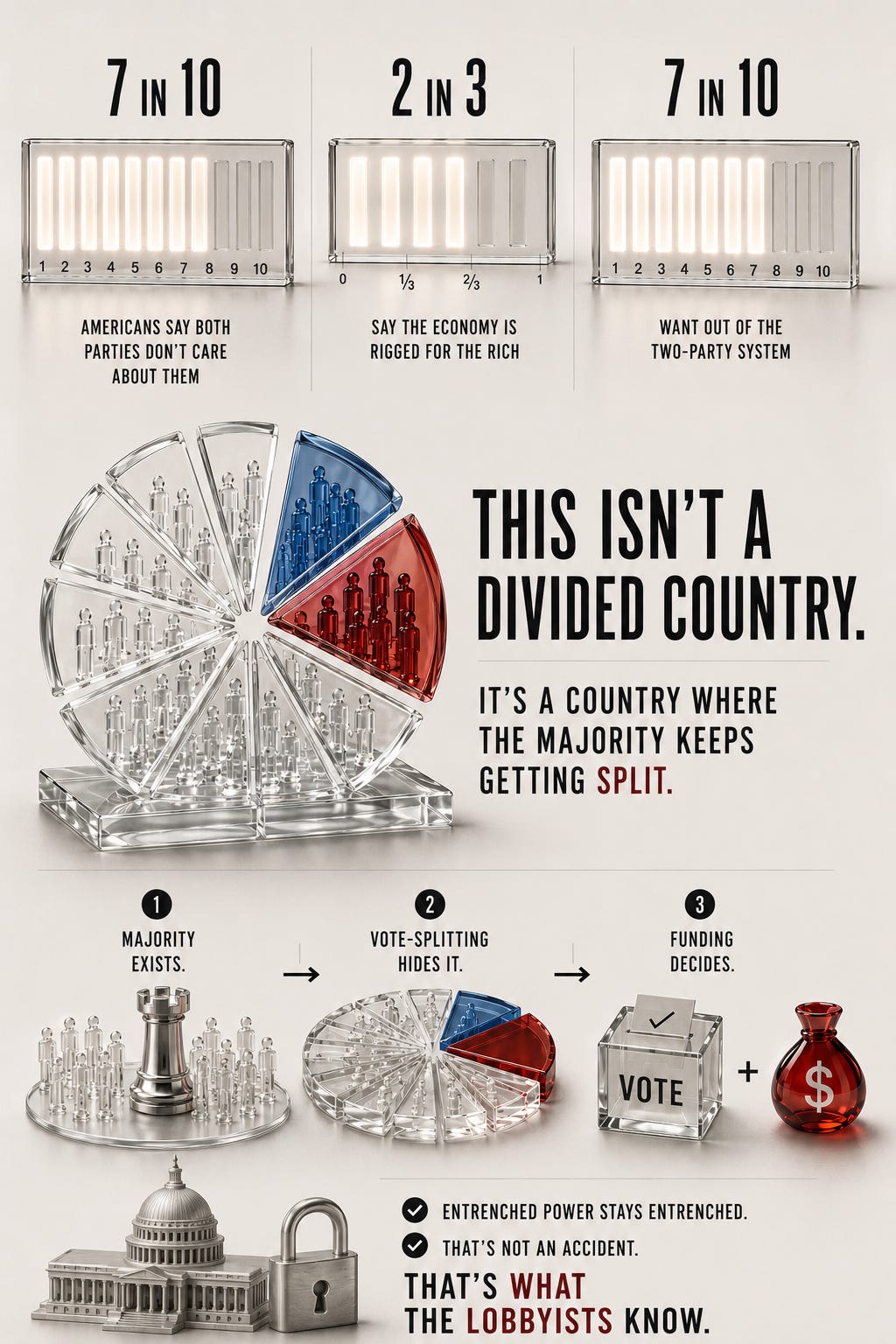
So this is not a country with no shared frustration.
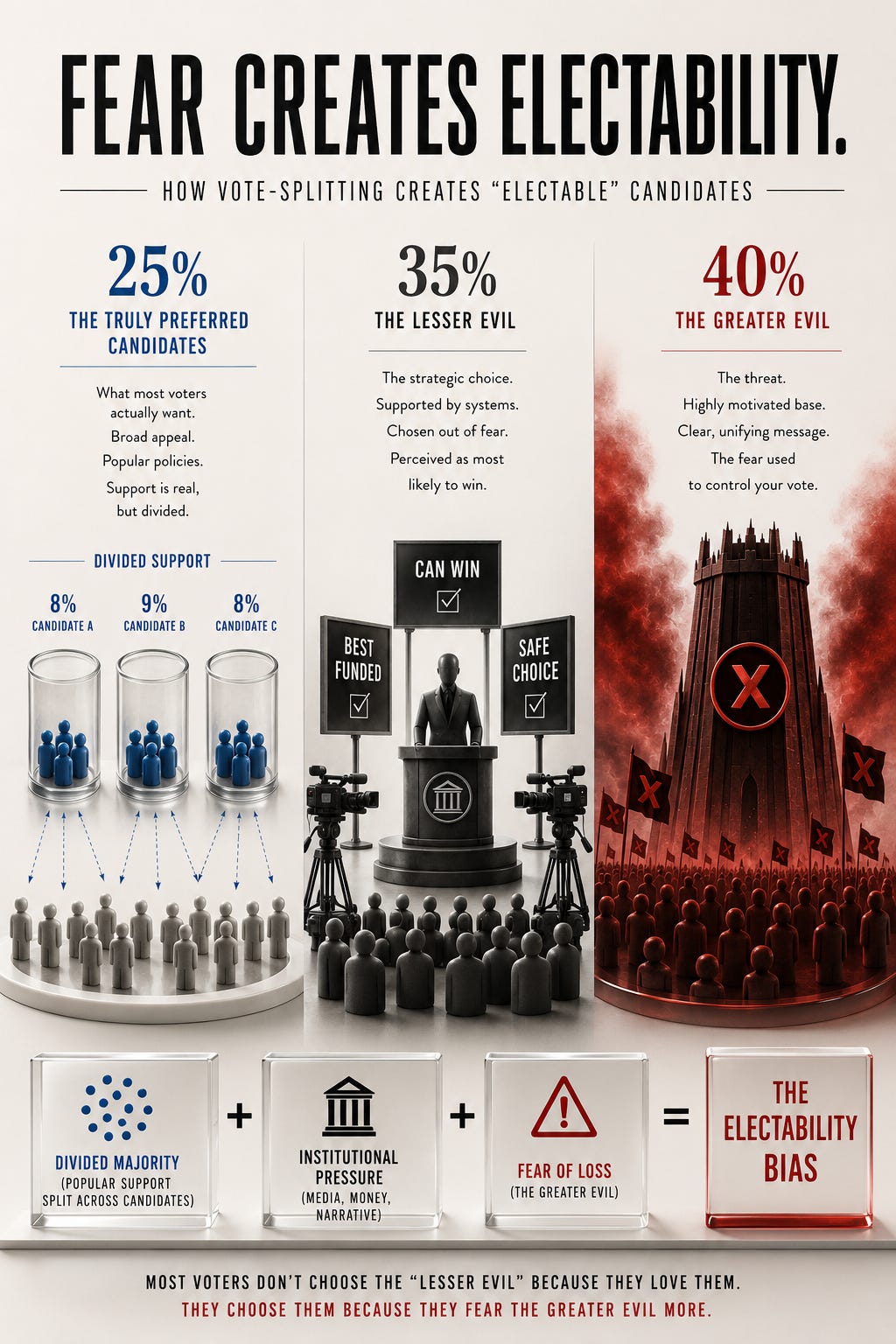
If 70% of people want change, why does nothing change? It’s a country where the majority has a lot in common, but gets split. That’s the mechanic that holds it all together: vote-splitting.
People with similar interests divide across options and weaken themselves. The outcome stops reflecting what most people actually want.



Chapter 3: Some Aren’t Trying To Break The Duopoly. They’re Trying To Gain Leverage Within It.
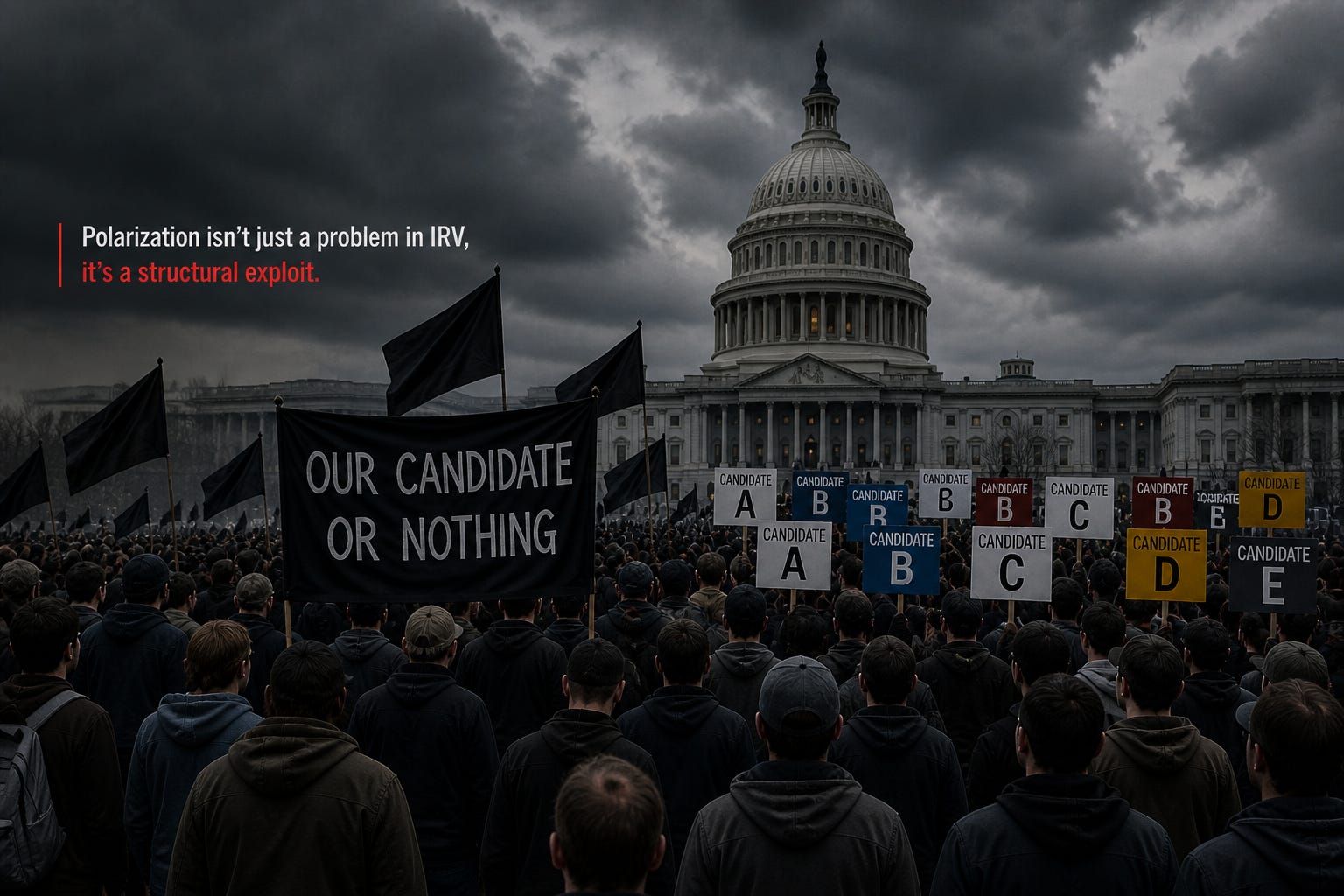

If you don’t see yourself as the majority,
then a system that blends everyone together isn’t rational. You need something that protects your lane.
That’s why some groups are focused on steering their major party. RCV already has momentum for that. Breaking the duopoly comes later — maybe.
And if it ever does happen,
they don’t want it replaced by one broad majority coalition.
They want strong, distinct blocs that can hold power. So their incentives point in a different direction. Instead of merging support, the goal becomes preserving cohesion.

That’s where voting methods start to matter:
• STAR → rewards broad popular consensus
• RCV (IRV) → allows cohesive blocs to survive rounds and consolidate influence


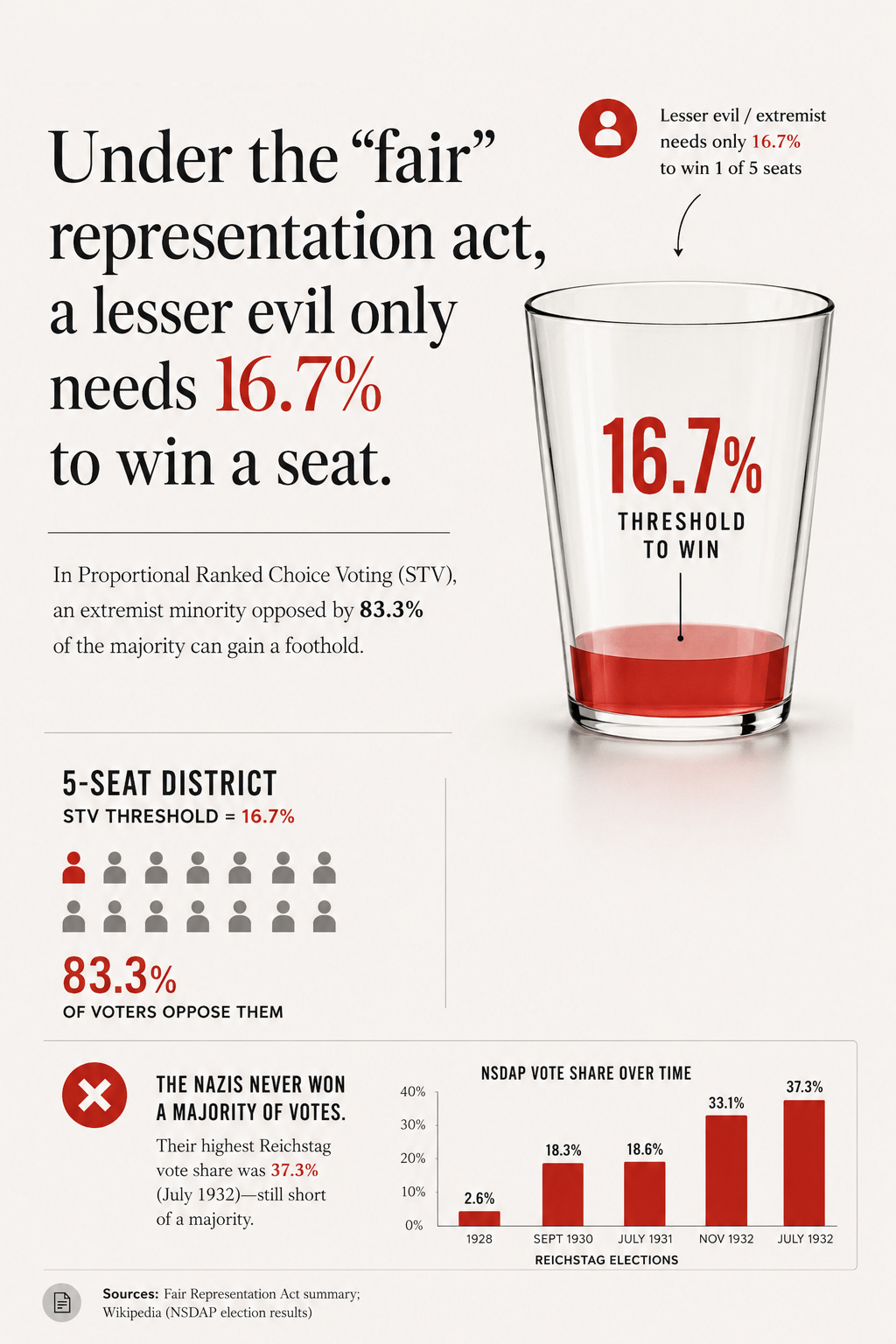
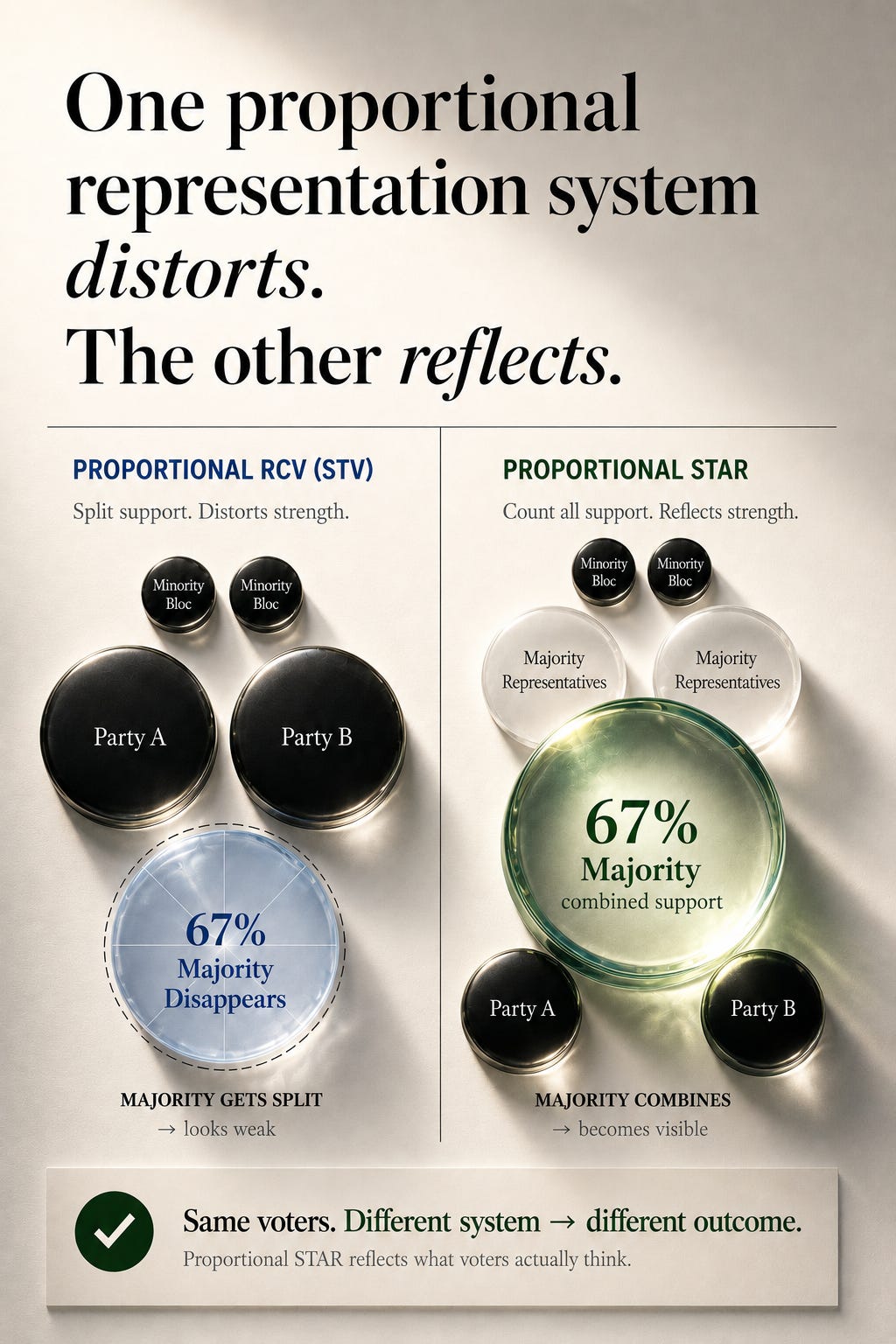
So when people argue about “fairness,” they’re often talking past each other.
Some mean:
combine support into a true majority
Others mean:
maintain a strong, distinct voice without needing majority support
And underneath all of this:
Even when you change who wins inside a two-party system,
the rules — and the incentives tied to capital and stability — tend to keep outcomes constrained.
The house doesn’t need to pick the winner. It just needs to preserve the system.
Because at its core:
This is a financialized system first.
An ideological system second.
Which means:
You can swap the winners…and still keep the same incentives.
And once that happens, funding decides outcomes and entrenched power stays entrenched.
That’s what the lobbyists know.
As for the 3 groups:
I don’t even think this requires bad intent. Each group is acting rationally on its own.
It just adds up to something that doesn’t look like representation.
Chapter 4: 10% Approval. 98% Reelected. Every cycle you vote for the person. Every cycle the incentives win.
Preview:
Count all support, not just one choice. When majority support can combine, Congress can replace corrupt or ineffective leadership more easily.
Make leadership votes anonymous so representatives can vote honestly without retaliation from party leadership.
Guarantee a quota of clean, single-issue bills so important reforms can’t be quietly sabotaged.
No more committee gatekeeping — let bills reach the floor.
Make Congress busy representing the people instead of fundraising — standardized windows, mandatory voting, and better voting process for bills and amendments. Change how electability is determined (voters or money) when citizens vote.
Most people think political gridlock happens because the country is deeply divided.
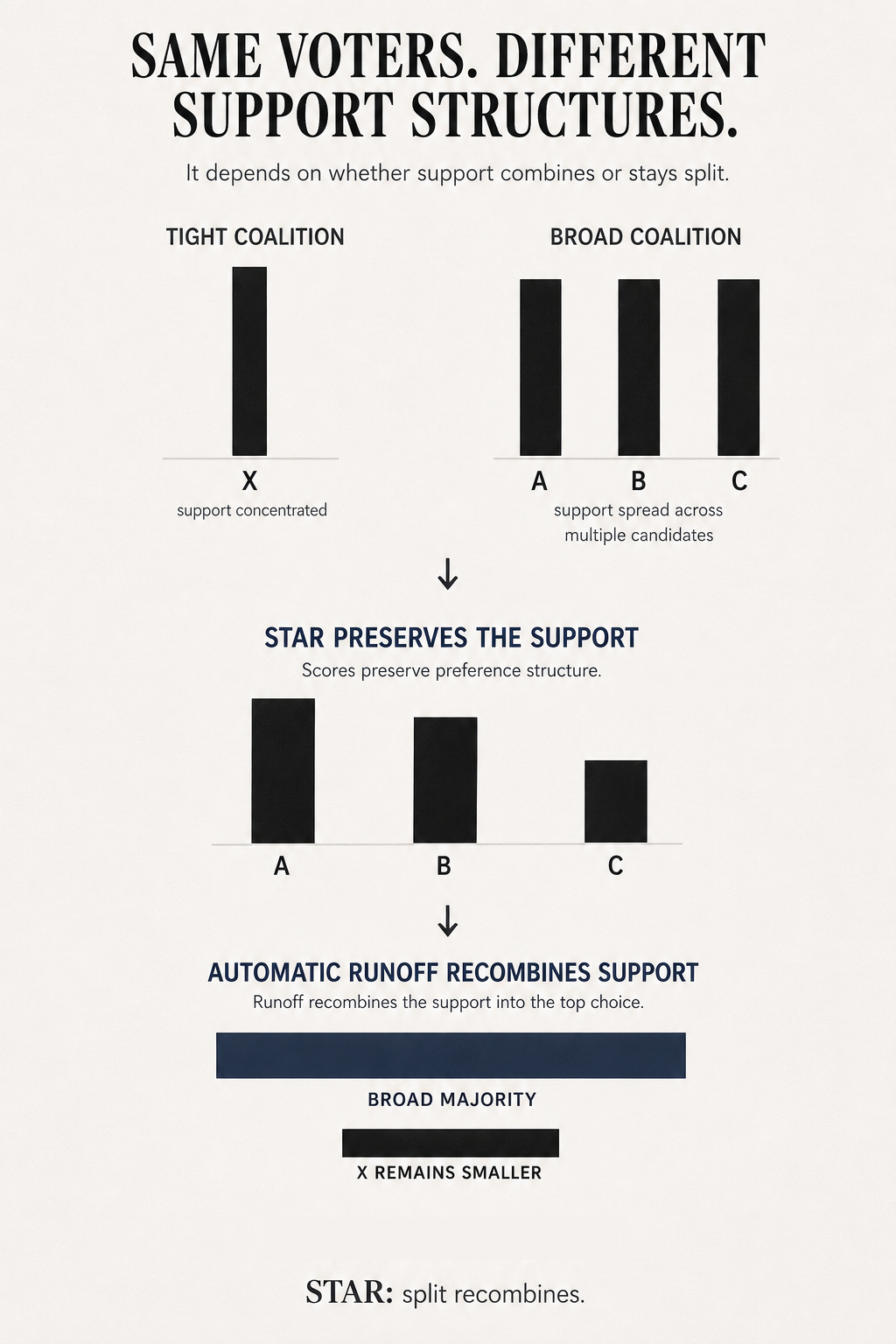
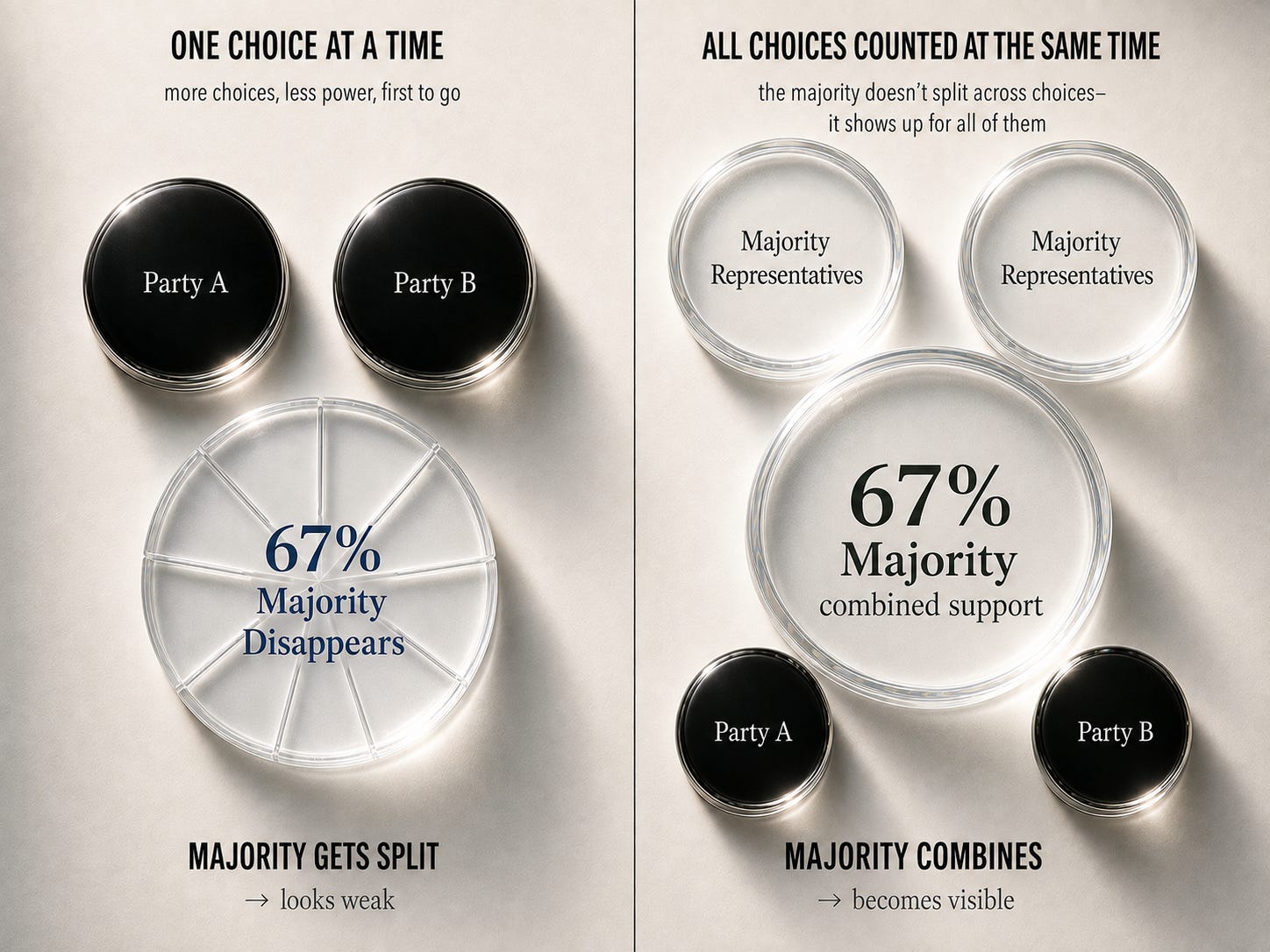
But often something simpler is happening. The majority is being split.
Majorities frequently agree on goals while disagreeing about details.
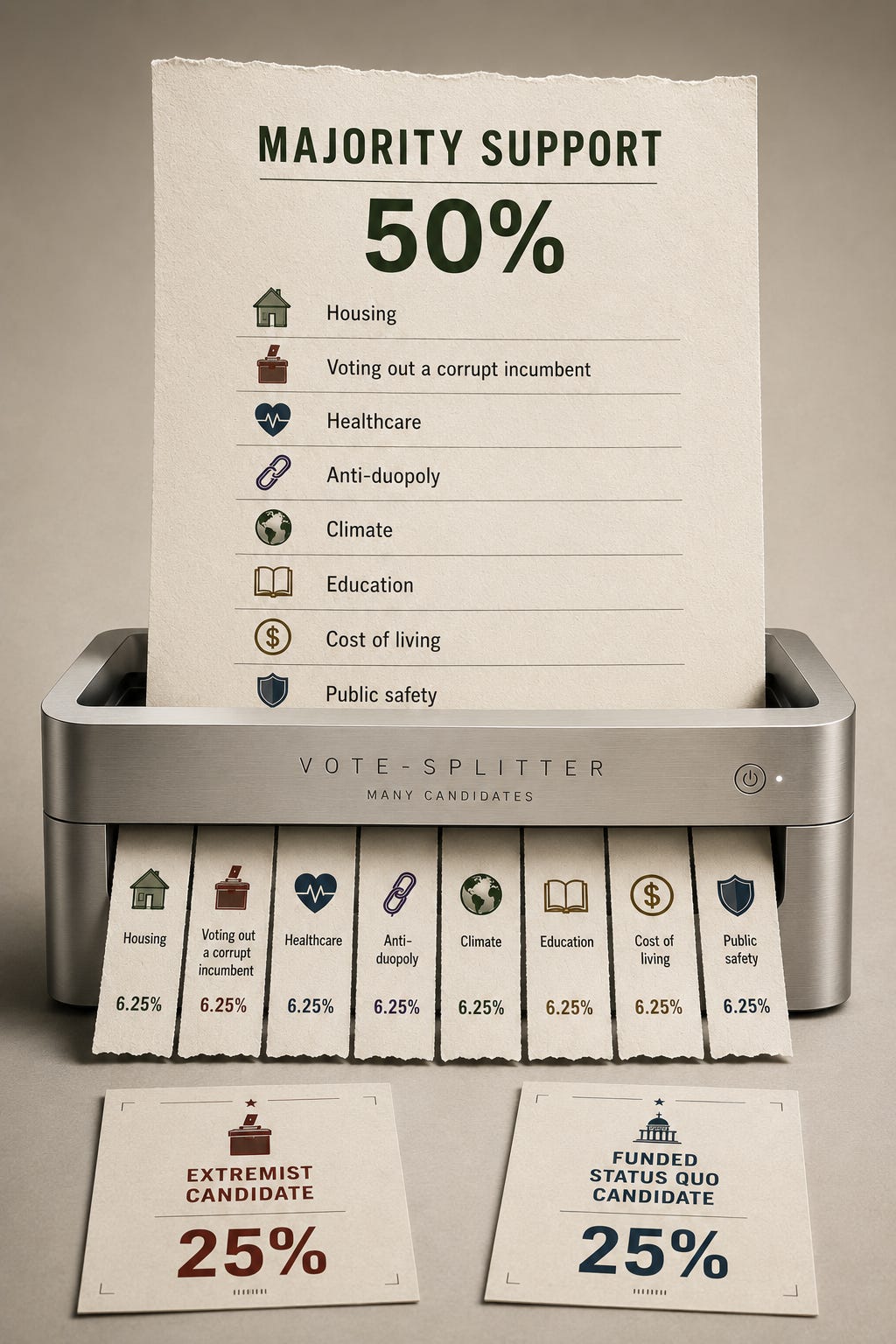
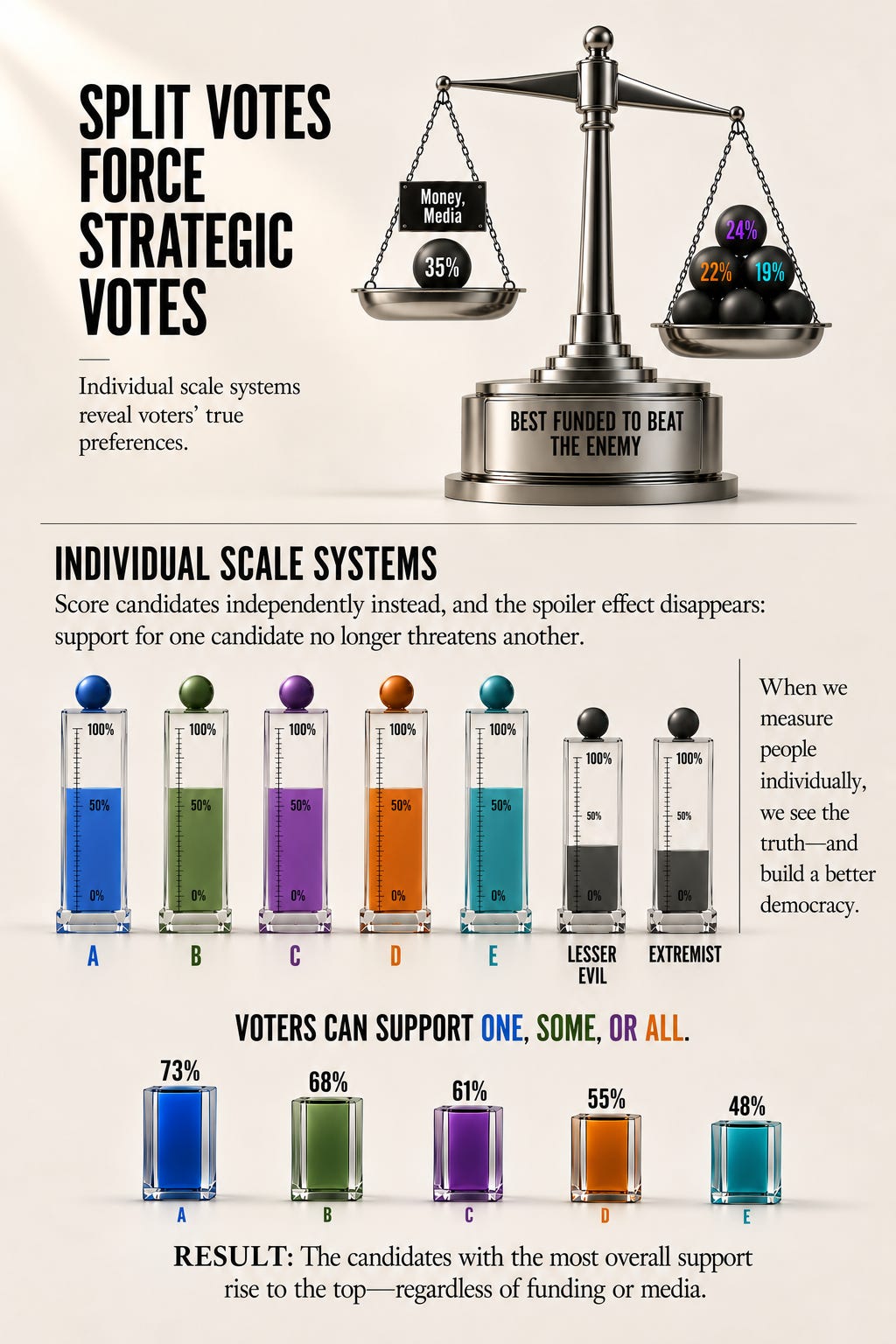
When systems force people to choose only one option, support that actually belongs to the same broad coalition gets divided across multiple choices.
A smaller, unified faction can then win — not because it has majority support, but because the majority was forced to fragment.
Minorities win when majorities are forced to split.
When support can combine instead of split, the majority becomes visible.
Or put more simply:
When majority support divides, power concentrates.
When majority support combines, democracy works.
This pattern explains many frustrations people feel about American politics.
The Duopoly Runs On Split Majorities
In a two-party system, most political coalitions are forced into only two options.
But large majorities often agree on broad goals while disagreeing about the best way to achieve them.
When the system forces everyone to choose only one candidate, those differences stop being differences — and become divisions. The majority fragments across competing approaches while smaller unified factions maintain leverage.

The Majority Exists

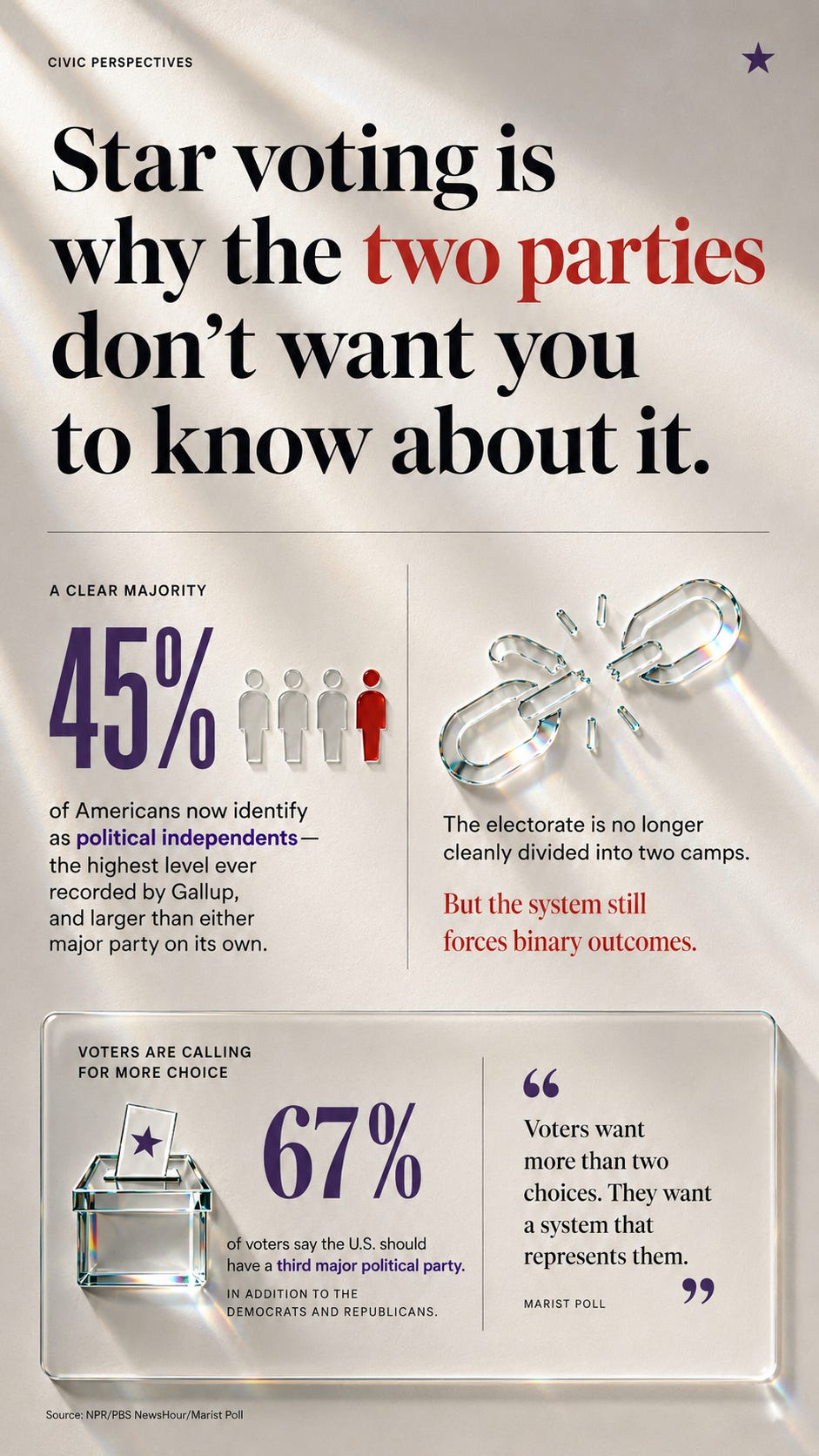
But the rules quietly hide it.
And when a majority cannot appear, the system that divides it becomes extremely difficult to change.
But this dynamic doesn’t stop at elections. It also shapes how Congress governs itself.
Power lives in the people. The system just learned to steal it.

Where the Majority Gets Split Inside Congress
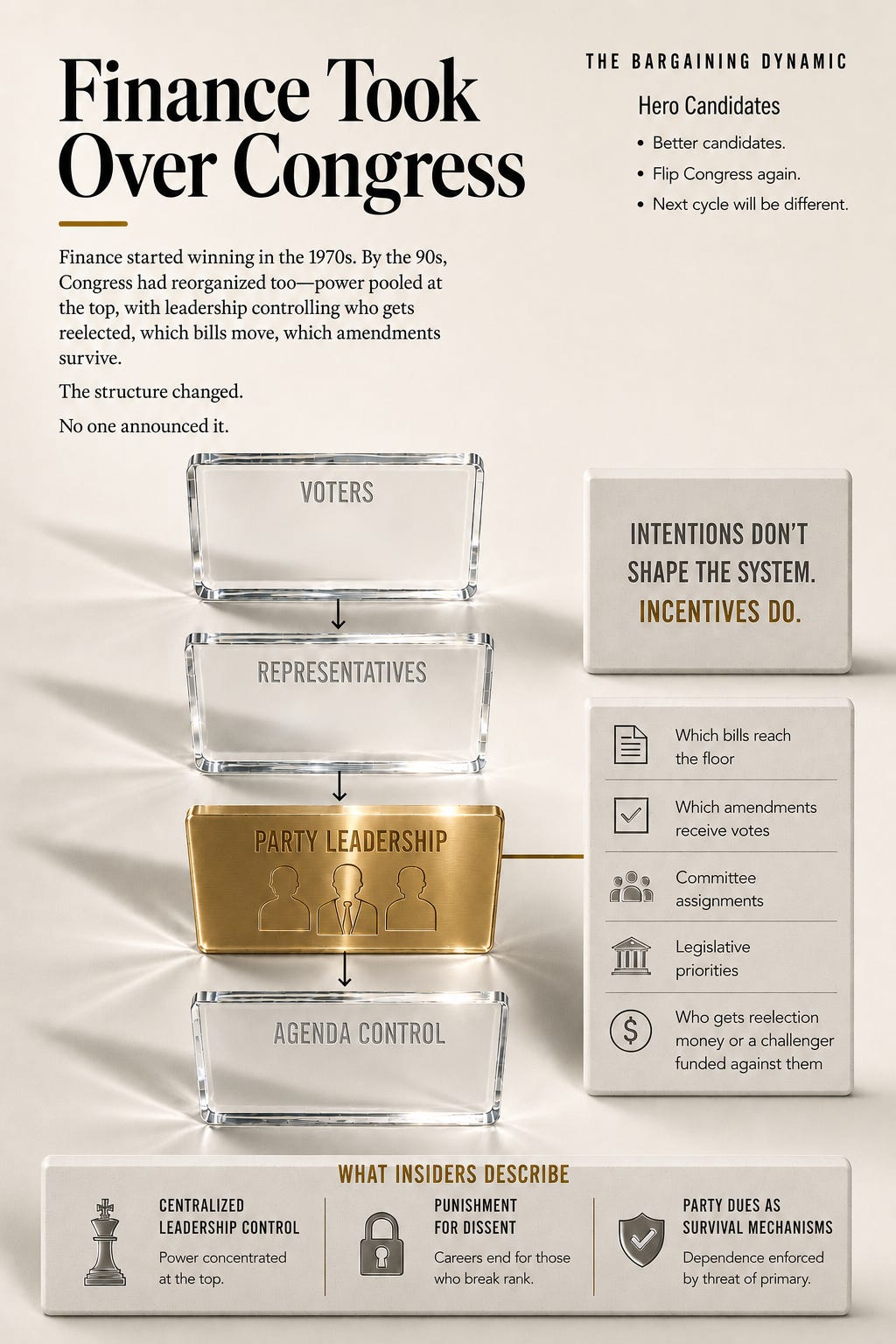
The Speaker is formally elected by the full House, but in practice the majority party decides the outcome before the public vote ever happens and it pushes Congress toward polarization.
Leadership ends up reflecting the money and internal power dynamics of one party rather than the will of the full chamber.
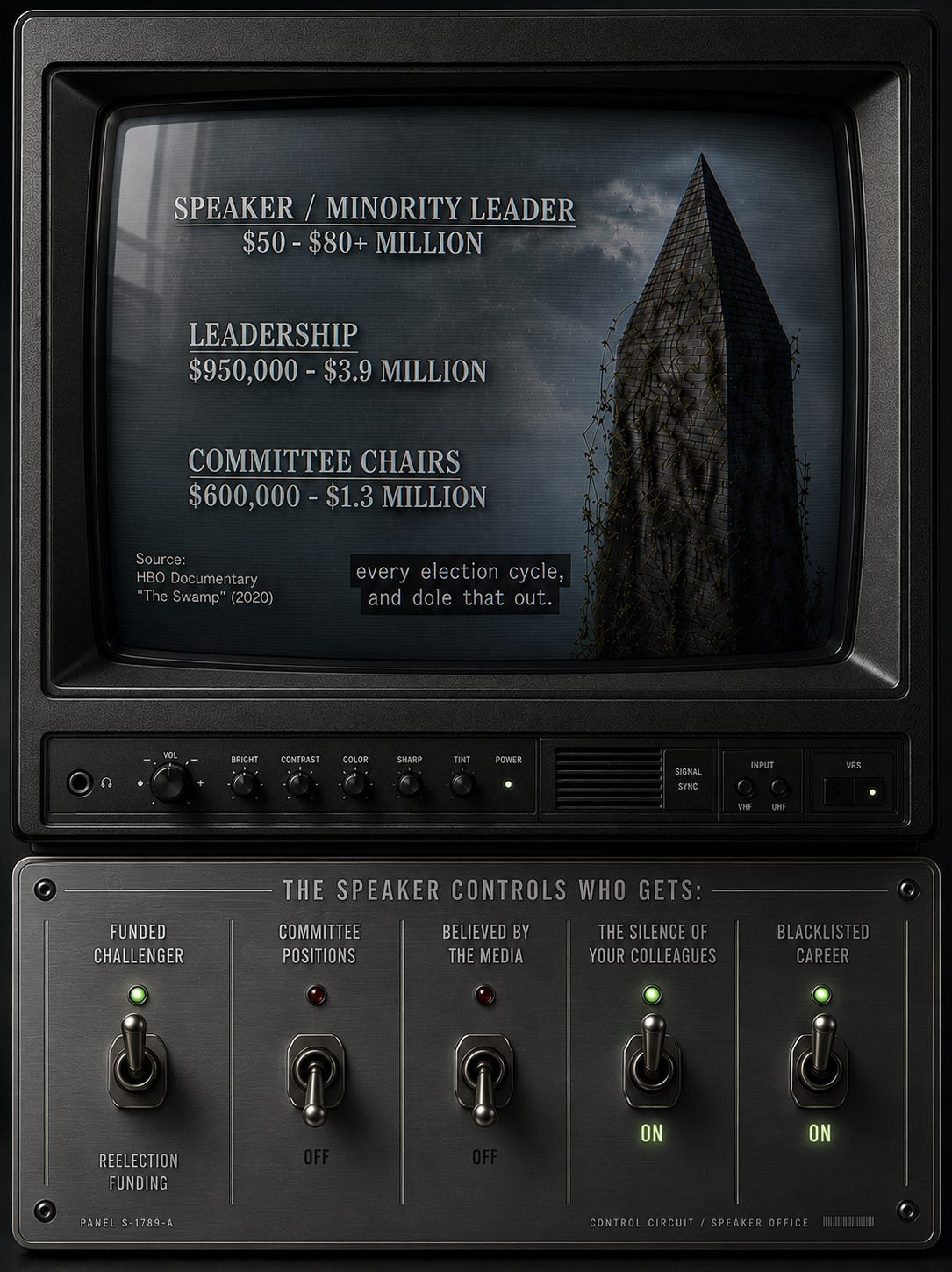
But the voting method itself also matters. When members must choose only one candidate, support for widely acceptable leaders can split across several people.
The result isn’t necessarily the most trusted leader. It’s often the most partisan one who can survive a divided majority.
Instead, Congress could use majority voting methods that allow support to combine rather than split.
If members can support every leader they find acceptable, the chamber can unite around someone with broad trust instead of rallying behind the least-bad partisan option.
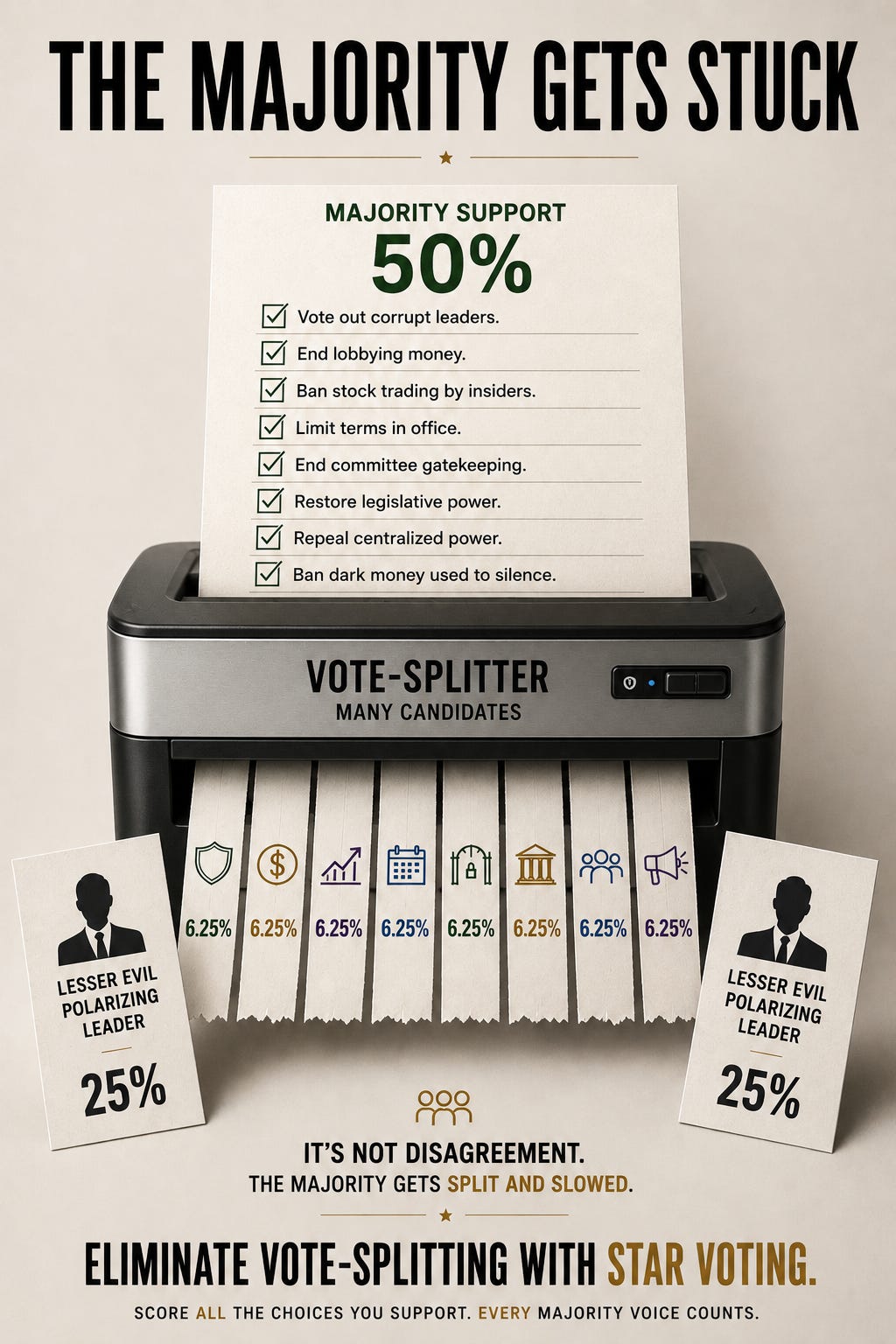
Leadership votes should also be anonymous so members can vote honestly without fear of retaliation from party leadership.
When support can combine instead of split, something important becomes possible.
If a corrupt or entrenched leader is in power, the majority can remove them.
Without the spoiler effect dividing alternatives, members can unite around better leadership instead of being divided and conquered by ideological differences or party pressure.
But leadership elections are only part of the problem. Much of Congress’s dysfunction comes from gatekeeping inside the legislative process.
Where the Majority Gets Blocked
Committees are not required by the Constitution.
Over time they have become choke points where a small number of insiders can quietly stop legislation before the rest of Congress ever votes on it. That undermines the design of the House itself.
Representatives face reelection every two years precisely so they remain responsive to voters. But when committees bury bills, newly elected members cannot actually represent the people who sent them there.
A representative body should allow representatives to vote.
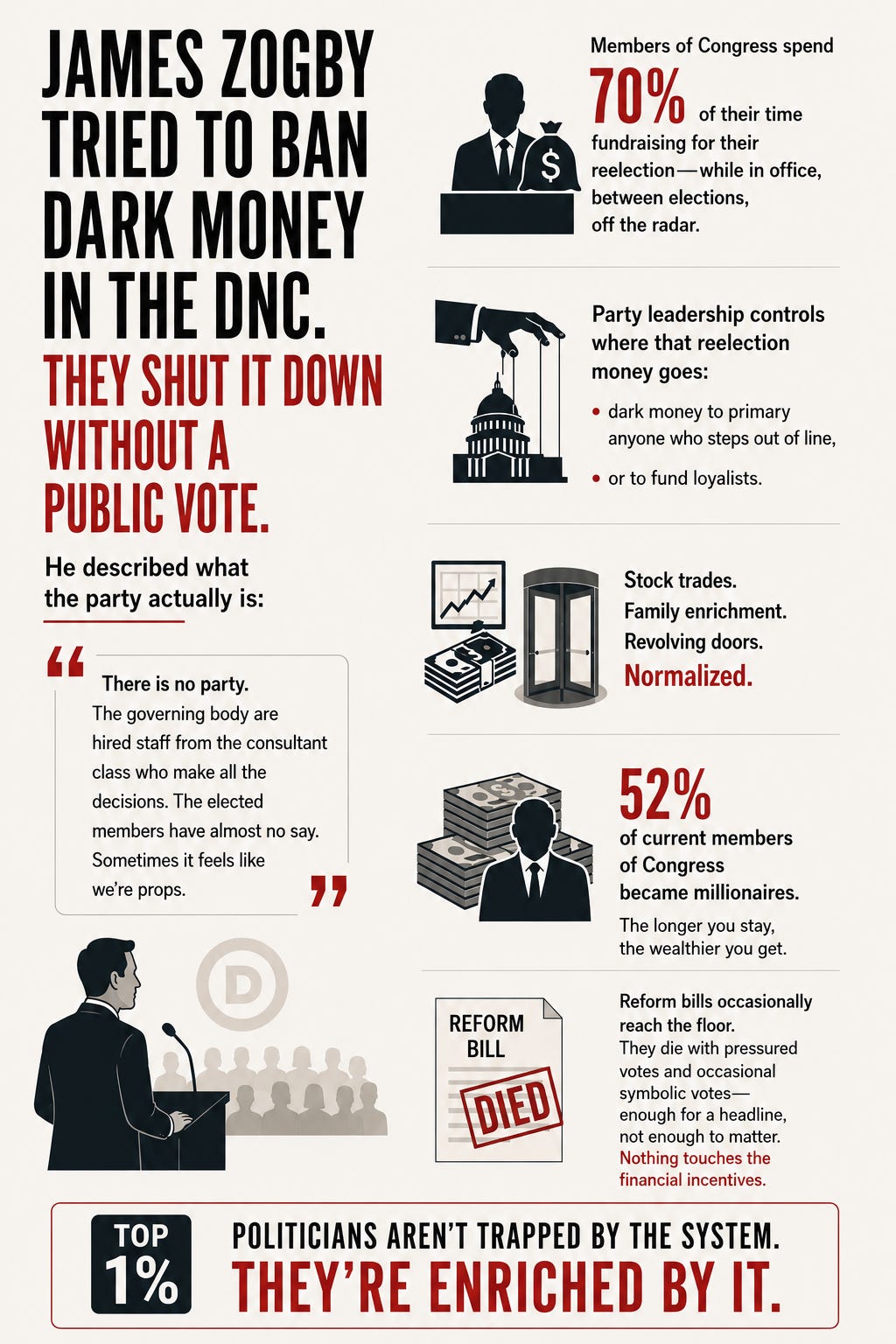
Outside of a few leaders, members of Congress have almost no power to shape legislation, and they have no incentive to admit it, because that would require them to reveal that so much of what they do is a carefully orchestrated performance. —Former Congressman Justin Amash
Make Congress Work, Literally
Require that some quota of legislation be released as clean, single-issue bills (stock trading ban, term limits). Omnibus (bills that contain several bills) then can’t be used as a hook for why a member voted against a bill.
Open the amendment process so party leaders cannot control which ideas are allowed to be considered.
Amendments would be submitted during a standardized and transparent amendment window. Once that window closes, the full chamber votes once on a single ballot containing all amendments.
Members could approve every amendment they believe improves the bill. If an amendment receives majority approval, it is automatically included. Amendments that have majority approval are harder to deny for why a member voted against a bill.
No backroom filtering.
No leadership gatekeeping.
Make votes compulsory so every member must take a public position and voters know where they stand.
Stop Splitting The Majority, Unite Them
Structural reform rarely advances for a simple reason:
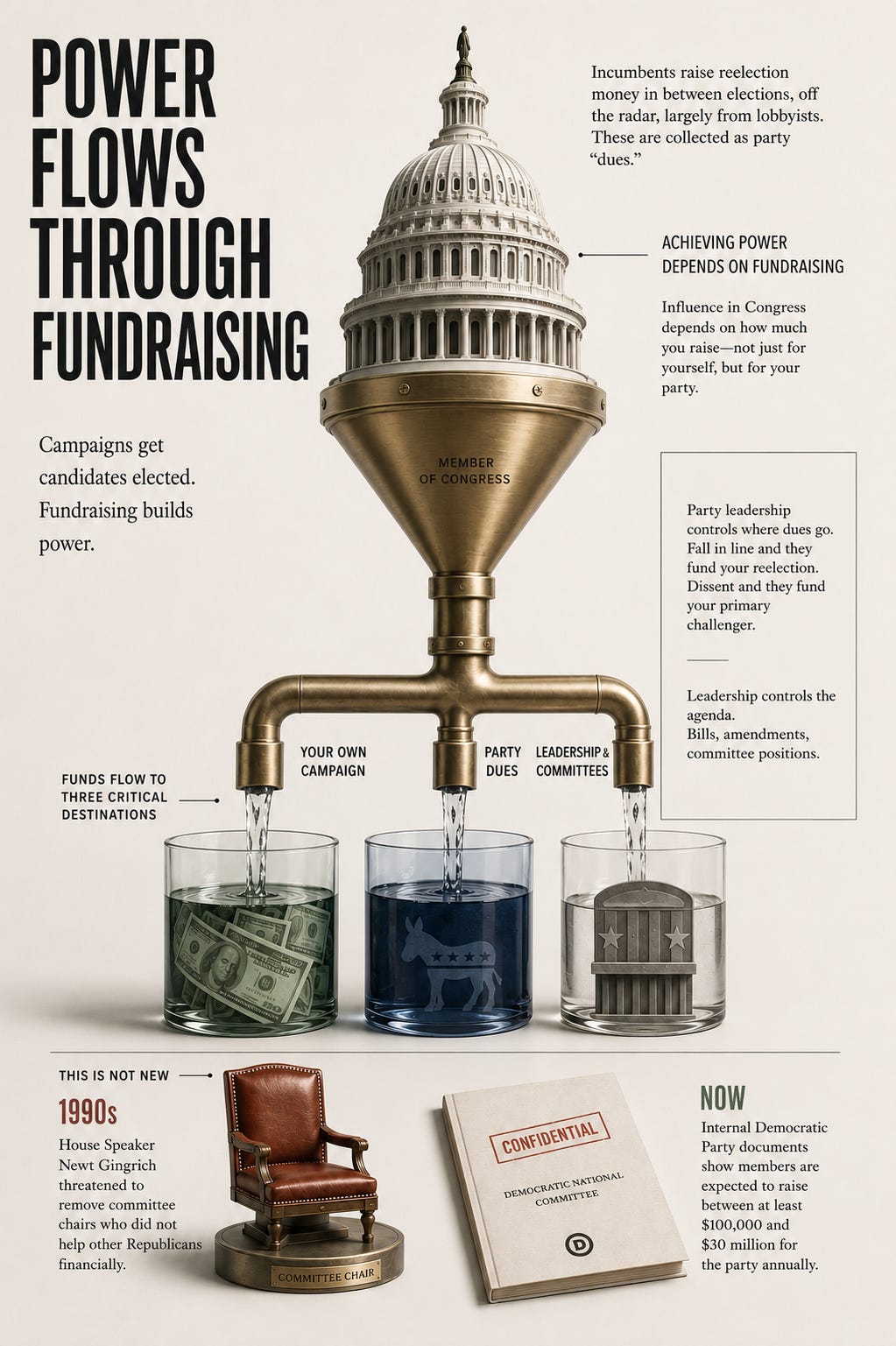
Those who benefit from the current system often control the agenda. And those who are complicit the longest (long-term incumbents) get to benefit from that agenda.
Proposals that would reduce insider advantages — banning congressional stock trading, limiting lobbying influence, or changing voting rules — frequently never receive a floor vote.
When unelected consultants and leadership controls the agenda, reform can be quietly stopped before it is ever debated.
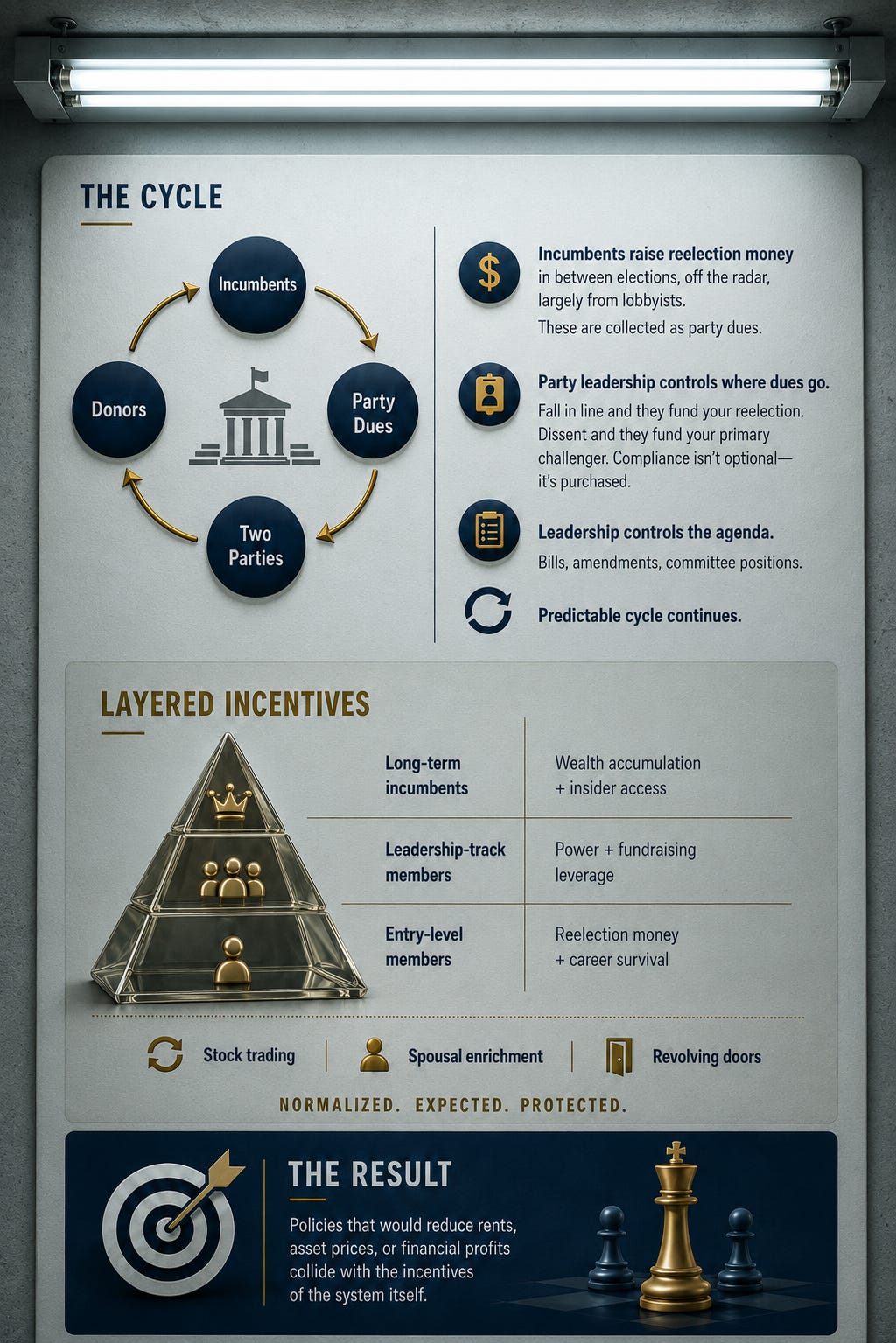

That agenda power shapes political conflict in subtle ways. The issues dominating public debate are often the ones that mobilize voters most strongly. Highly emotional social conflicts energize partisan bases and strengthen party loyalty.
Social media and cable news amplify these fights, spreading outrage and identity conflict.

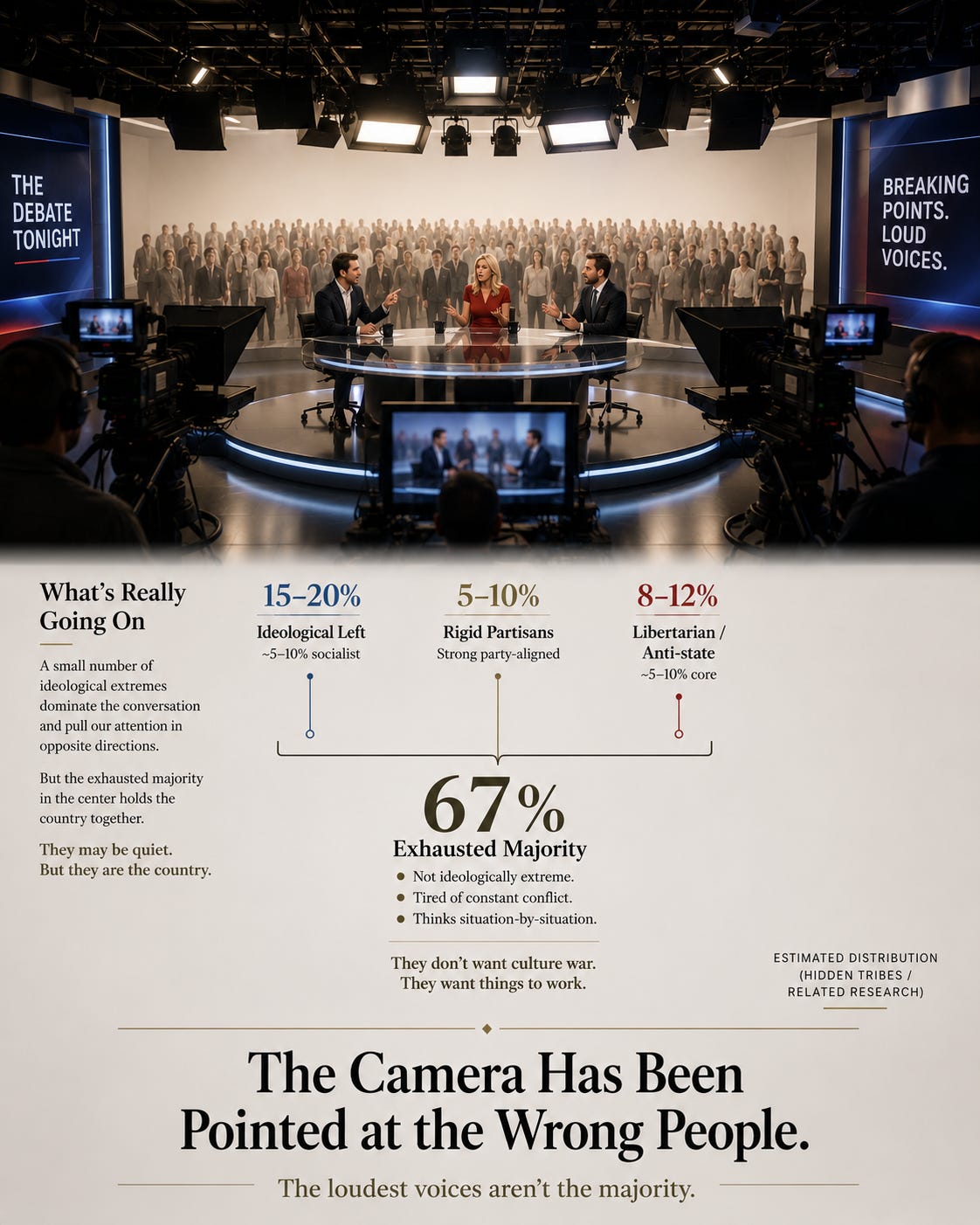
Polarization drives attention.
Attention drives engagement.
Engagement drives fundraising and advertising.

Some political problems persist for decades. Not because solutions are impossible. But because the conflict itself is politically valuable. A former governor once put it bluntly:
“There are issues critically important to Americans that will never be solved because they’re so valuable as political tools.”
The result is a system where conflict stays horizontal: Urban vs rural. Young vs old. One identity vs another. Red vs blue.
But rarely vertical: Voters vs the system itself.
The Larger Pattern
A system that consistently splits majorities will consistently produce outcomes that benefit concentrated power.
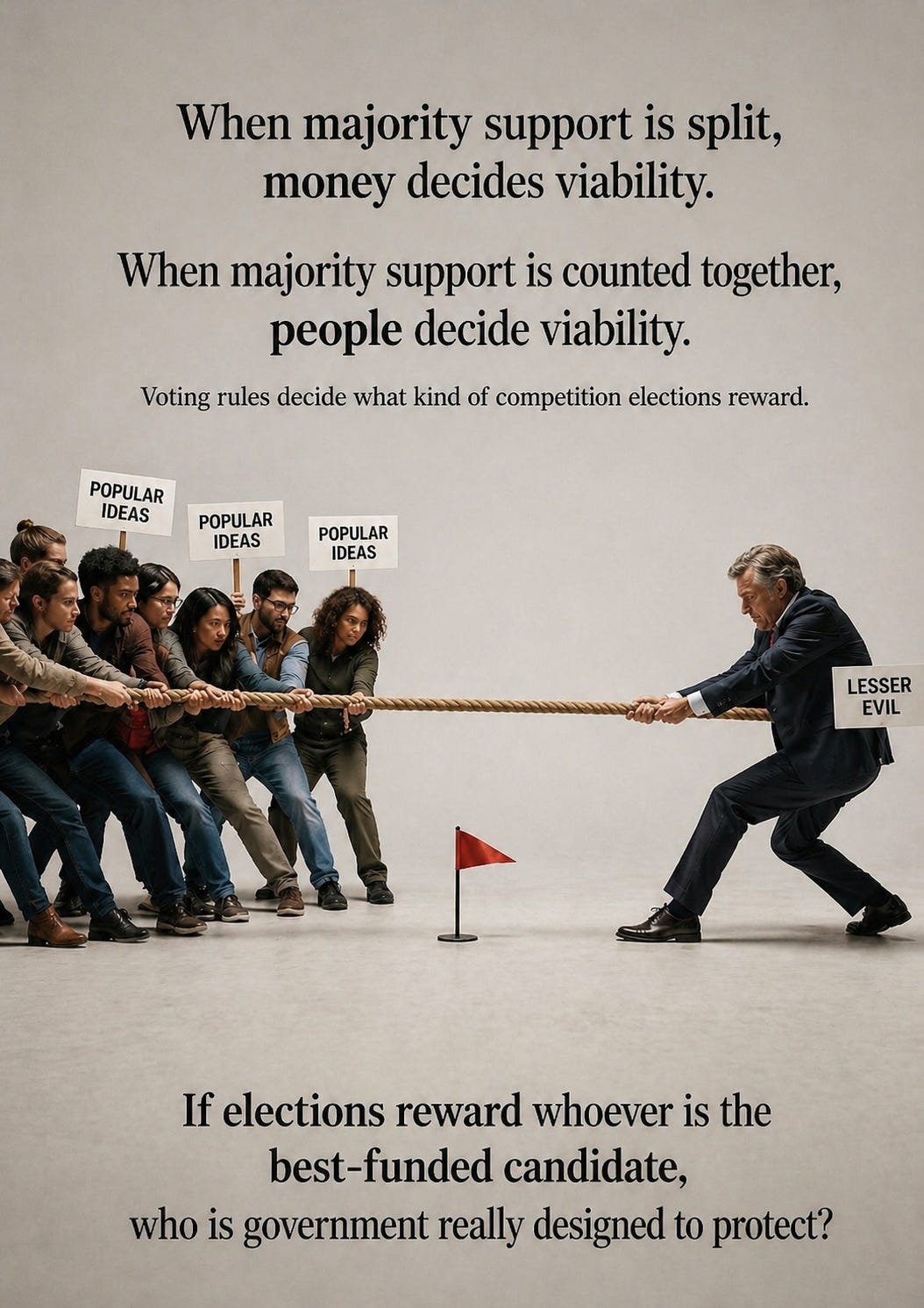
When the majority is fragmented, smaller organized interests gain leverage.
When the majority can combine, public preferences become visible — and much harder to ignore.
This pattern appears throughout American politics:
• elections
• leadership contests
• committee gatekeeping
• the legislative agenda itself

At every stage, rules that force single-choice competition divide coalitions that might otherwise govern together. And divided coalitions lose. Not because they lack support. But because they were never allowed to combine. As one Congressman put it,
“The special interests don’t want us working together because if we did, things would change, and if things change, the people making money off the current system wouldn’t be making money off that system.”
The Real Safeguard
Most reform debates focus on replacing leaders. But the deeper question is simpler:
What rules determine whether majorities can actually appear?
The founders feared concentrated power. Their answer was not blind faith in leaders. It was institutional design. A republic works only when its rules make it difficult for concentrated power to override the will of the many. That safeguard depends on something simple:
The majority must be able to see itself.
Because the moment a majority realizes it is a majority, it becomes very difficult to stop.

Design Matters
That’s where voting reform enters — not as a policy hobby, but as a pressure point.
When majority support is split, the most polarizing or best-funded candidate tends to win. When majority support is counted clearly, viability comes from people — not fundraising.
Once you see that structure, it’s hard to unsee.

From that point forward, the work becomes simpler. Not easy. But clearer.
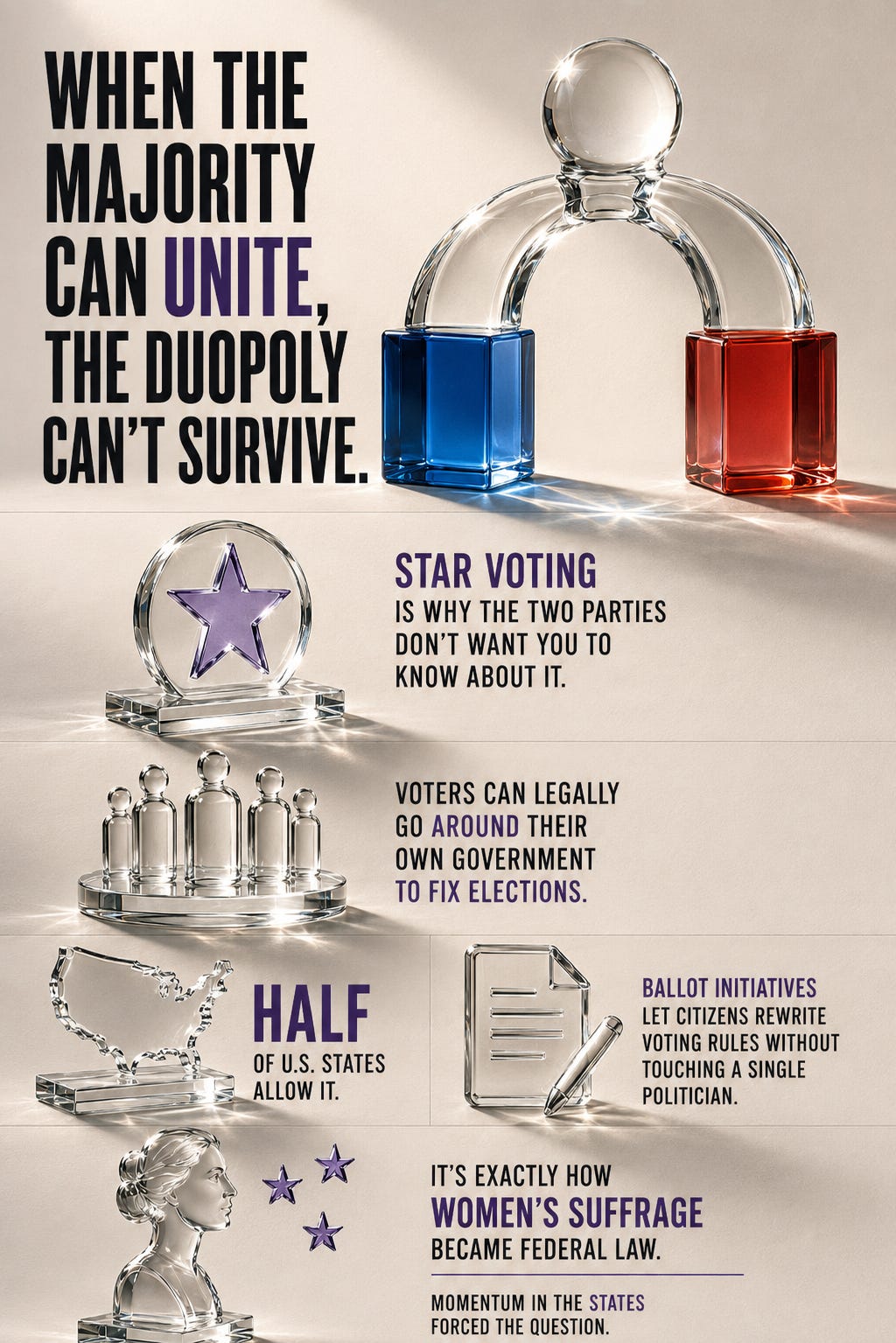
Change the rules.
That’s where the tunnel opens and the light appears.
Polarization Makes Reform Even Harder
“How do we implement term limits in Congress when the people who would pass such limits are the ones the limits would affect? The way forward has to come from outside the two-party duopoly.” —Andrew Yang


When politics organizes into hostile camps, structural reforms quickly become partisan battles.
Instead of asking:“Does this improve the system?”
Each side asks: “Will this help our side or hurt it?”
Take something like term limits. Term limits are overwhelmingly popular among voters. But inside polarized systems the debate quickly becomes factional.
Supporters of long-serving figures like Bernie Sanders may resist reforms that would remove a leader they value. Opponents may frame the same reform as weakening their rivals. Once reforms become tied to factional advantage, majority support fractures.
The reform collapses.
The fight stays horizontal.
Why Rankings Alone Don’t Solve the Coordination Problem
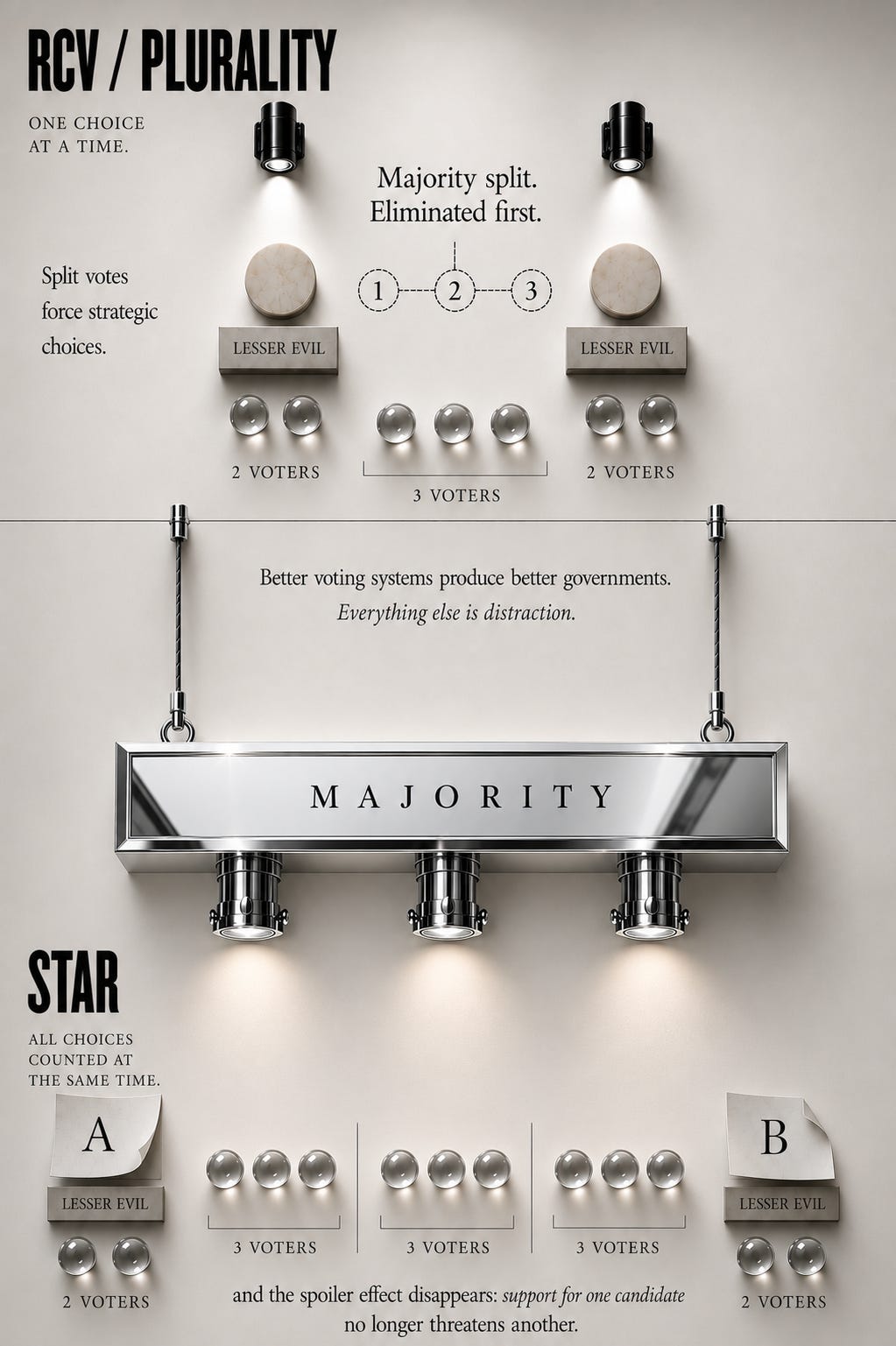
Supporters of ranked-choice voting often point out that voters can rank multiple candidates. But transfers only occur if candidates aren’t eliminated. And elimination depends heavily on first-choice support. That means candidates still need strong factional bases to survive early rounds.
If several reform candidates divide first-choice support, one or more can be eliminated before their broader coalition ever becomes visible. Ranking candidates does not solve the coordination problem if survival depends on elimination order.
Structural reform fails when reformers must defeat each other before they can defeat the system.

When Support Is Counted Instead of Eliminated

Consensus voting systems work differently.
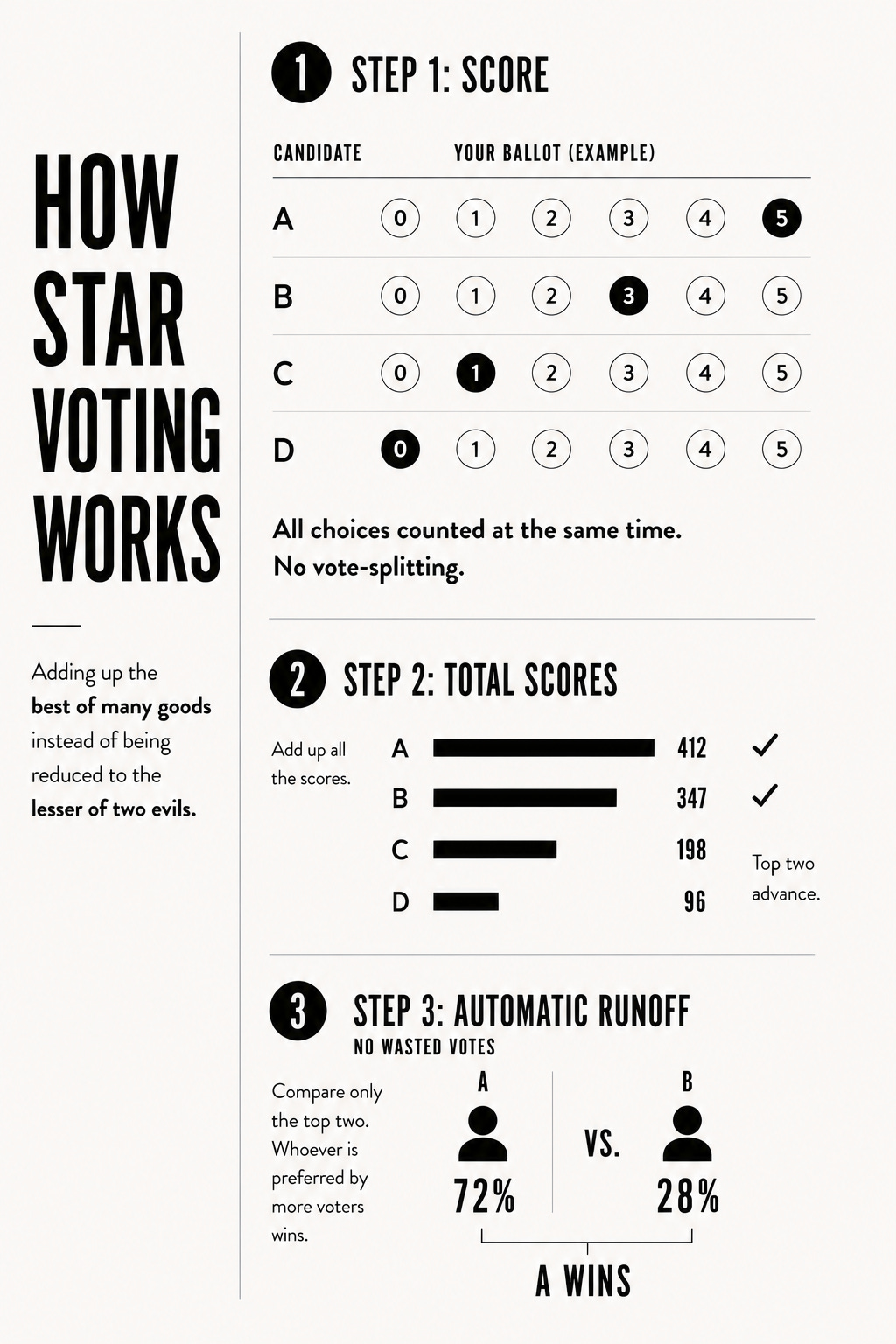
Under systems like STAR Voting voters can support multiple acceptable candidates.
A voter might support:
• an anti-corruption candidate
• an electoral reform candidate
• an economic reform candidate
All of those candidates receive support. Instead of eliminating candidates early, the system measures total support first.
Multiple reform candidates can remain viable at the same time.
Coalitions can then form after the election without a duopoly.

Instead of fragmenting across separate campaigns, overlapping support accumulates.
The majority does not disappear. The majority becomes visible.
World Peace Isn't That Polarizing, Actually.

Chapter 1: We Exported Plurality Voting To Palestinian Elections. It Elected Hamas. We Still Use It Here. Connect The Dots.